
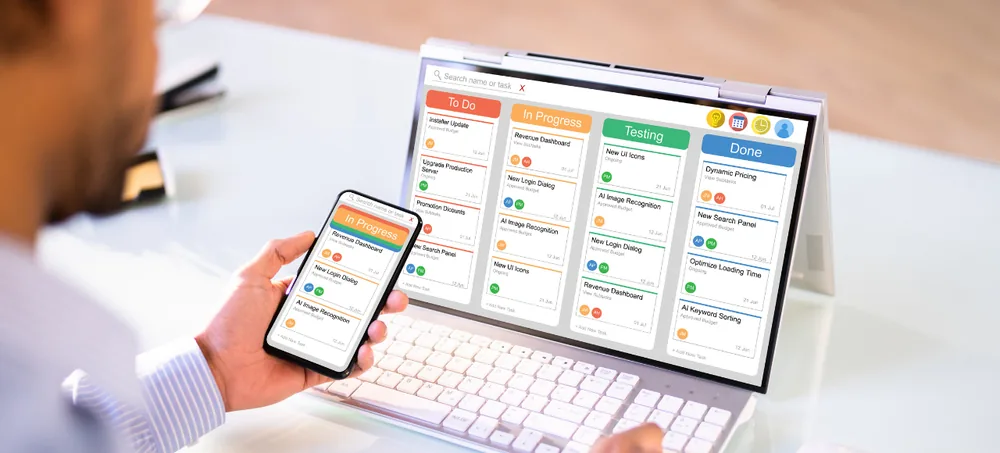
Move beyond disconnected applications, spreadsheets, manual approvals, and fragmented business information with a modern Cloud ERP Systems India solution. ERPLax is a cloud-only SaaS ERP platform from EchoPx Technologies, built to centralize operations, configure ERP workflows, connect departments, automate processes, and improve operational visibility.
Get a free walkthrough of ERPLax for your business.
ERP requirements often emerge gradually. A company may begin with spreadsheets and a few specialized applications; as the organization grows, additional systems are introduced for sales, purchasing, inventory, finance, and reporting. Eventually, employees spend significant effort connecting information between these applications. These five signals suggest it is time to evaluate a Cloud ERP Systems India platform.
Sales maintains one set of information, purchasing another, inventory teams use separate records, and management needs reports assembled from several sources.
Spreadsheets remain useful, but relying on them for complex cross-department workflows creates administrative work — updating files, communicating changes, reconciling data.
Purchase requests, sales exceptions, and expenses often require approval — without structured workflows, employees chase status over email and messages.
Business processes rarely stop at department boundaries. Sales affects inventory, inventory affects purchasing, purchasing affects finance — and finance depends on all of it.
When reporting means collecting data from different spreadsheets and systems, preparing an accurate operational picture consumes significant effort.
As organizations scale, more departments, roles, and reporting requirements make ad-hoc tools harder to coordinate consistently.
The value of enterprise resource planning comes from connecting processes. A transaction created by one department may become relevant to several others. ERPLax helps organizations establish connected workflows so business information can move through defined operational stages — supporting three objectives: centralized business management, configurable ERP workflows, and operational visibility.
Businesses comparing Cloud ERP India platforms often look at Web Based ERP Software India options, Online Cloud ERP Software India deployments, and broader Cloud enterprise resource planning strategies — sometimes described the other way round as enterprise resource planning cloud delivery. ERPLax is built as Cloud Based Business Management Software India teams can configure, whether the requirement is a Cloud Based ERP System for Business India or Cloud ERP Systems India for Businesses of any size, including teams evaluating Cloud ERP Solutions Karnataka or Cloud ERP Software Bangalore options and SaaS ERP India delivery models.
A cloud ERP system is an enterprise resource planning platform delivered through a cloud-based software model, giving businesses a centralized environment for managing multiple operational processes. Instead of treating sales, purchases, inventory, finance, approvals, and reporting as completely separate activities, a cloud ERP platform helps connect these processes. The central concept is integration — which makes cloud ERP an operational platform rather than simply another business application.
Consider a business that receives a customer order. That transaction may affect sales operations, inventory availability, fulfilment activities, invoicing, and financial information. With an Integrated Cloud ERP Software India solution, organizations design connected workflows so business activities follow a structured process instead of manual transfers between disconnected applications.
Customers expect efficient service, management teams need better information, departments need to coordinate activities, and growing organizations need processes that do not depend entirely on spreadsheets or manual follow-ups. This creates demand for Cloud Based ERP Software India. The opportunity is not simply to digitize an existing manual form — it is to redesign how information moves through the organization, which is the business value behind modern ERP Cloud Solutions India.
Businesses operate in increasingly connected environments — and disconnected tools cannot keep pace.
Customers expect fast, accurate service that disconnected systems struggle to support consistently.
Leadership teams need reliable, centralized information rather than reports assembled from scattered files.
Departments need to coordinate activities that rarely stop at their own boundaries.
Growing organizations need workflows that scale beyond individual spreadsheets and manual follow-ups.
ERPLax can support requirements across sales, purchase, inventory, finance, approvals, business reporting, and operational management — configured and developed within the SaaS platform according to business requirements.
A complete sales process may involve an enquiry, customer information, quotation, approval, order confirmation, inventory coordination, fulfilment, finance activities, and reporting. ERPLax supports structured sales processes within the cloud ERP environment, configured according to business requirements.
Manual systems create uncertainty around quotation status, approvals, and coordination with inventory.
Sales activities follow defined stages instead of remaining isolated within the sales team.
Better coordination between customer-facing teams and operational departments.
A department identifies a requirement, a request may need approval, purchasing coordinates the transaction, goods are received into inventory, and finance processes follow. ERPLax supports purchase management and procurement workflows within the SaaS ERP platform.
Manual procurement makes it difficult to track requirements, approvals, and inventory links.
Procurement workflows are configured around internal responsibilities and approval requirements.
A structured path from requirement to purchase and downstream activities.
Inventory affects sales, purchasing, fulfilment, production-related activities, and financial processes. A Cloud ERP for Manufacturing Industry India or distribution-oriented business places particular importance on inventory workflows because material movement is central to operations.
Disconnected inventory records make coordination between purchasing and sales difficult.
Purchase receipts feed inventory; sales processes interact with stock requirements.
Better coordination between every team that depends on inventory information.
Sales transactions generate financial implications, purchases create financial obligations, and expenses require recording and review. ERPLax supports structured finance processes within the integrated business environment, connecting operations with appropriate finance activities.
Separately maintained operational and finance information needs manual reconciliation.
Relevant operational activities flow into finance-related processes with structured approvals.
Finance teams gain process visibility while operational teams work within defined workflows.
An ERP system becomes valuable when management can use the information generated through everyday business activities — what sales are progressing, what purchases are processing, what inventory needs attention, and which transactions await approval. ERPLax supports centralized ERP reporting and digital business management practices that reduce reliance on manual spreadsheet consolidation.
Scattered information across tools makes these questions hard to answer quickly.
Business information is organized within connected workflows management can review directly.
A stronger foundation for business reporting and operational visibility.
Businesses do not all operate the same way — ERPLax supports configurable ERP workflows so organizations can align the SaaS platform with their own processes, then evaluate where workflow automation genuinely reduces administrative effort.
A purchase may require one approval in one organization and multiple stages in another. ERP implementation should not simply reproduce every manual activity exactly as it existed before — organizations should identify which steps are necessary, which can be standardized, where approvals are required, and where automation can help.
ERP automation is valuable when it removes unnecessary repetitive work while maintaining a clear operational process. Automation opportunities can exist around:
Without a centralized workflow, an employee may send an email, wait for a response, follow up manually, and update another system. A configured ERP approval workflow provides a structured sequence instead:
A collection of independent software tools may individually perform useful tasks — the challenge emerges when employees need to move information manually between them. An Integrated Cloud ERP Software India platform focuses on connecting business functions:
Cloud ERP for Small Business India should focus implementation on the processes creating the greatest operational friction, not every function at once.
Cloud ERP for Enterprises India requires careful workflow analysis across more departments, approval stages, and reporting requirements.
Cloud ERP for Manufacturing Industry India connects procurement, inventory, sales, finance, and operational activities.
Coordination between buying, stock management, selling, and finance across the full business cycle.
Structured customer processes, sales, purchasing, expenses, approvals, and finance — without unnecessary inventory overhead.
A cloud ERP implementation should create practical operational value rather than simply replacing one software interface with another.
Operational information organized within a common ERP environment.
Sales, purchasing, inventory, finance, approvals, and reporting structured as connected workflows.
Repetitive process steps evaluated for genuine automation opportunities.
Processes configured within the SaaS platform to match business requirements.
Centralized business information gives management a clearer view of operations.
Connected workflows help teams understand upstream and downstream processes.
Approval requirements become part of configured workflows, not manual follow-ups.
Appropriate manual processes replaced with structured digital workflows.
ERPLax is positioned around organizations seeking a cloud-only SaaS ERP platform with configurable business workflows and integrated processes.
ERP implementation requires understanding processes, workflow dependencies, and operational priorities — not just software selection.
Broad experience supporting business technology requirements across industries.
A substantial technology project background for organizations evaluating ERPLax.
ERPLax is a cloud-only SaaS ERP platform — evaluate it around this modern software model.
Configuration and development within the SaaS platform according to business requirements.
Centralized business management and integrated business processes, built to reduce operational fragmentation.
Two simplified scenarios show the core advantage of integrated ERP: a business transaction treated as an end-to-end process rather than a series of unrelated departmental activities.
Sales requirement recorded
Quotation prepared
Approval workflow
Sales order created
Inventory coordination
Finance process
Business reporting
A business transaction moves as one connected process from enquiry through to reporting.
Requirement identified
Request recorded
Stakeholder approval
Purchase progressed
Receipt recorded
Finance activities
Procurement reporting
A structured workflow helps organizations know where a transaction is and what action is required next.
Installing or subscribing to software does not automatically improve a process. Implementation should begin with business understanding, then move through these seven steps.
Identify requirements across sales, purchase, inventory, finance, reporting, and approvals.
Map each major process end-to-end, not just its final transaction step.
Configure capabilities within ERPLax to reflect responsibilities and approval requirements.
Identify other systems and applications that remain relevant to the business.
Determine what information needs to be prepared and how it should be structured.
Help users understand not just how, but why the workflow exists.
Review how processes operate in practice and refine configuration as needed.
The phrase Best Cloud ERP Software India is highly competitive, but there is no single platform automatically right for every organization. Evaluate these seven areas before deciding.
Start with workflows rather than software demonstrations.
Sales, purchase, inventory, finance, approvals, reporting, and more.
Whether the organization's workflows require platform configuration.
Which existing systems need to exchange information with the ERP platform.
Which information management teams require, and how it should be structured.
Process complexity, configuration, integrations, and data preparation.
Evaluate the complete scope of requirements rather than comparing only an advertised subscription amount — including required users, selected capabilities, configuration, implementation scope, and integrations.
Several applications can work when processes are simple and largely independent. The problem begins when those applications need to operate as one business system — sales data copied repeatedly, inventory maintained elsewhere, approvals through email, and reporting built by hand. Cloud ERP addresses this with an integrated business management foundation; the goal is to connect the processes that matter, not maximize the feature count.
Spreadsheets remain valuable for analysis and ad hoc tasks. But complex operational workflows — a purchase approval with responsibilities, statuses, records, and downstream activities — need structured process management. Businesses can keep using spreadsheets where appropriate while moving core operational workflows into a centralized ERP platform.
Which of our business processes will the ERP manage?
How will sales, purchasing, inventory, and finance connect?
Which approval workflows can be configured?
What reporting information will management receive?
What configuration is required for our processes?
Which integrations are required?
What data needs to be prepared?
What is included in the implementation scope?
How will users transition to the new workflows?
How will future workflow requirements be handled within the SaaS platform?
Cloud ERP Systems India are cloud-based enterprise resource planning platforms designed to manage multiple business processes through centralized software. They can connect functions such as sales, purchasing, inventory, finance, approvals, and reporting within an integrated environment.
ERPLax is a cloud-only SaaS ERP platform from EchoPx Technologies, designed for centralized business management, configurable ERP workflows, integrated business processes, business process automation, and operational visibility.
Disconnected applications typically manage individual business functions separately. Cloud ERP focuses on bringing relevant processes together so information can flow through integrated workflows across departments.
Yes. ERPLax is positioned exclusively as a cloud-only SaaS ERP platform.
ERPLax supports configuration and development within the SaaS platform according to business requirements. The scope depends on the specific workflow and functional requirements.
ERPLax can support structured sales processes involving customer requirements, quotations, approvals, sales activities, inventory coordination, finance processes, and reporting according to configured business requirements.
Yes. Purchase workflows can be structured around requirements, approvals, purchasing activities, receipts, inventory processes, finance processes, and reporting as applicable to the organization.
Cloud ERP can centralize inventory-related processes and connect them with purchasing, sales, and other relevant business activities.
ERPLax can support finance-related workflows within the broader integrated ERP environment. Exact requirements should be evaluated during business process analysis.
Configurable ERP workflows can support structured approvals according to defined business requirements.
Compare platforms based on process fit, required functions, configuration options, integration requirements, reporting needs, implementation scope, user requirements, and commercial considerations.
It can be. Small and growing organizations benefit when increasing operational complexity makes disconnected applications or manual workflows difficult to manage. Implementation scope should match actual business requirements.
Manufacturing organizations can use cloud ERP to connect purchasing, inventory, sales, finance, reporting, and operational processes. Exact workflow requirements depend on the manufacturing model.
Yes. Trading and distribution organizations often require connected purchasing, inventory, sales, and finance processes, making integrated ERP workflows particularly relevant.
Pricing considerations can include subscription requirements, users, required functionality, configuration, implementation scope, integrations, and other business-specific needs.
There is no single timeline appropriate for every organization. Timing depends on business process complexity, implementation scope, workflow configuration, integrations, data preparation, and organizational readiness.
Integration requirements can be evaluated according to the systems involved, available integration methods, and the organization's business needs.
Prepare your key business processes, current operational challenges, departments involved, required approvals, existing applications, reporting requirements, integration requirements, and the outcomes you want the implementation to support.
Sales. Purchasing. Inventory. Finance. Approvals. Reporting. Manage connected business processes through a modern cloud ERP platform designed for centralized operations. ERPLax helps organizations move toward configurable ERP workflows, integrated business processes, business process automation, and improved operational visibility — all within a cloud-only SaaS ERP environment.
Looking for Cloud ERP Systems India? If your business is researching Cloud ERP Software India, Cloud Based ERP Software India, SaaS ERP Software India, Cloud ERP Platform India, Integrated Cloud ERP Software India, or Cloud ERP Implementation Services India, start with your business processes. Identify what needs to connect, what needs to be automated, and where teams need better visibility — then build the ERP workflow around the way your organization needs to operate.
Specialized Applications
Purpose-built & ready to deploy. Hover to explore, click to learn more.
Testimonials
Real stories from businesses running their operations on ERPLax.
ERPLax gave us real-time visibility into stock across three warehouses. Wastage dropped and our fulfillment time improved almost overnight.
GST e-invoicing used to eat up two days every month. With ERPLax's accounting module it's now automatic and our filings are always on time.
Billing at our stores used to take a minute per customer. ERPLax's POS module cut that to under 15 seconds, even during peak festival rush.
Payroll for 200+ employees across two branches used to take our HR team a full week. ERPLax's HRM module now runs it in a single afternoon.
Tracking batch numbers and expiry across our distribution network was a nightmare on spreadsheets. ERPLax's inventory module made it effortless.
Front desk, housekeeping and billing are now all on one screen. ERPLax's hotel management module has made check-in day a breeze for our staff.
Fee collection, attendance and report cards used to live in three different tools. ERPLax brought it all into one dashboard our staff actually enjoys using.
Tracking material costs and site progress across four active sites was chaos before ERPLax. Now our project managers update status from their phones daily.
Our online store orders now sync straight into inventory and accounting — no more manual entry, no more overselling out-of-stock items.
Our sales team can now see every lead's history and follow-ups in one place. Deal closures are faster and nothing falls through the cracks anymore.
ERPLax gave us real-time visibility into stock across three warehouses. Wastage dropped and our fulfillment time improved almost overnight.
GST e-invoicing used to eat up two days every month. With ERPLax's accounting module it's now automatic and our filings are always on time.
Billing at our stores used to take a minute per customer. ERPLax's POS module cut that to under 15 seconds, even during peak festival rush.
Payroll for 200+ employees across two branches used to take our HR team a full week. ERPLax's HRM module now runs it in a single afternoon.
Front desk, housekeeping and billing are now all on one screen. ERPLax's hotel management module has made check-in day a breeze for our staff.
Fee collection, attendance and report cards used to live in three different tools. ERPLax brought it all into one dashboard our staff actually enjoys using.
Tracking material costs and site progress across four active sites was chaos before ERPLax. Now our project managers update status from their phones daily.
Our online store orders now sync straight into inventory and accounting — no more manual entry, no more overselling out-of-stock items.
Our sales team can now see every lead's history and follow-ups in one place. Deal closures are faster and nothing falls through the cracks anymore.