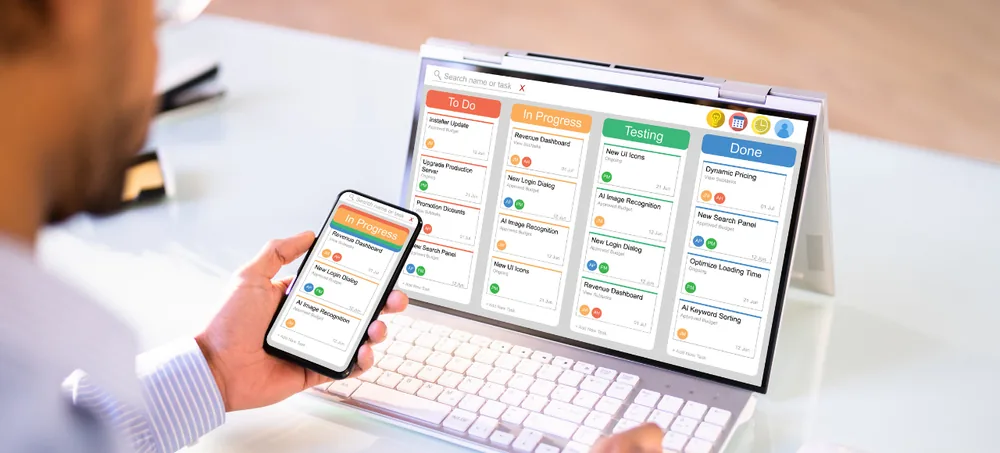
Implementing ERP in Bangalore involves more than installing software. ERPLax provides structured ERP implementation services — requirement analysis, configuration, data migration, testing, training, and go-live support within a cloud SaaS platform.
Tell us about your current systems and process — we'll get back to you.
Most implementation problems trace back to unclear scope, rushed migration, or weak adoption planning — not the software itself.
Without a documented requirement set, configuration decisions get made ad hoc and rework follows later.
Incomplete or poorly reviewed data carried into a new system creates accuracy problems from day one.
Without training and a clear reason for each process step, teams fall back to old habits after go-live.
Sales, purchase, inventory and finance teams often plan their piece of the rollout in isolation.
Approval workflows, roles, and reporting take longer to configure correctly than most timelines allow.
Businesses are often unclear on what support looks like once the system is live and daily use begins.
ERPLax provides ERP implementation services structured around requirement analysis, configuration, data migration, testing, training, and go-live support — all delivered within a cloud SaaS platform rather than an on-premise rollout.
Each stage is planned around your actual business process, not a generic template, so configuration reflects how your teams already work wherever that process is sound, and improves it where it isn't.
Whether you're looking at ERP software implementation Bangalore or ERP system implementation Bangalore, ERPLax works as an ERP implementation partner Bangalore businesses can plan around — including ERP implementation for small business Bangalore, ERP implementation for SMEs Bangalore, manufacturing ERP implementation Bangalore, Enterprise Resource Planning implementation Bangalore, and ERP solution implementation Bangalore.
A structured methodology covering planning, configuration, migration, testing, training, and go-live.
Document current processes, user roles, data sources, and reporting needs before configuration begins.
Map requirements to ERPLax modules and agree on the implementation scope and sequence.
Set up modules, workflows, approval steps, and reporting according to the agreed requirements.
Review, clean, and migrate existing business data into the configured platform.
Define responsibilities and access so each user sees the right information and actions.
Validate configured workflows against real business scenarios before go-live.
Train users on the system and the reasoning behind each process step.
Move to live usage with agreed support arrangements in place.
Structured documentation of current workflows before any configuration begins.
Modules configured to reflect agreed business requirements, not a fixed default.
Planning and execution of moving existing business data into ERPLax.
User roles and permissions structured around actual responsibilities.
Approval routing and process steps configured to match business rules.
Configured workflows checked against real scenarios before go-live.
User training aligned with actual roles and day-to-day tasks.
A defined go-live sequence to reduce disruption during transition.
Support arrangements discussed as part of the implementation scope.
Sales, purchase, inventory, and finance teams brought into one coordinated plan.
Processes structured around how your organization wants the system to be used.
A defined sequence reduces guesswork at each stage of the rollout.
Planning and testing before go-live reduce the chance of disruptive surprises.
Requirement analysis, configuration, and training each have defined responsibility.
Reviewed and cleaned data reduces post-go-live correction work.
Training tied to real roles helps teams use the system consistently from day one.
Coordinated go-live planning limits the impact on daily operations.
Sales, purchase, inventory, and finance data connected in one platform.
Configuration reflects how your organization actually operates.
Delivered through the SaaS model — no on-premise ERPLax deployment.
Documented configuration and training support ongoing use, not just launch day.
Implementation priorities differ by industry — the sequence and configuration should reflect that.
Inventory, purchase, and production-linked workflows configured to the shop floor process.
Purchase, warehouse, and dispatch workflows implemented around existing supplier relationships.
Customer, sales, and operational workflows implemented for day-to-day retail or service operations.
Project-linked procurement and cost tracking configured around project timelines.
Structured inventory and workflow implementation for regulated operating environments.
First-time ERP implementation scoped to what the business needs today.
Coordinated rollout across branch-level teams and central management.
Manufacturing ERP implementation in Bangalore typically involves inventory, purchase, work order, and production-related workflows. ERPLax implementation planning maps these processes before configuration begins, so the shop-floor and back-office processes stay connected.
ERP implementation for small business and SME requirements in Bangalore is scoped to what the organization needs today, with configuration and workflows structured to actual users and processes rather than an oversized template.
Cloud ERP implementation with ERPLax means no on-premise servers to manage. Implementation activity focuses on requirement analysis, configuration, and data migration within the SaaS platform, not infrastructure setup.
A defined sequence from requirement analysis through go-live and support.
No on-premise deployment, local installation, or perpetual license model.
Configuration mapped to your actual processes, not a fixed template.
Sales, purchase, inventory, and finance rollout planned together, not in isolation.
User training tied to actual responsibilities to support faster adoption.
Existing business data reviewed and migrated as part of the implementation scope.
Support arrangements discussed and agreed as part of the project scope.
19+ years, 1500+ clients, and 1700+ projects behind EchoPx Technologies.
A few things worth reviewing before implementation planning begins.
ERP implementation is the structured process of configuring, migrating data into, testing, and rolling out ERP software so it reflects an organization's actual business processes.
Yes. ERPLax by EchoPx Technologies provides ERP implementation services for Bangalore businesses, covering requirement analysis, configuration, data migration, testing, training, and go-live support within its cloud SaaS platform.
Yes. ERPLax is delivered through a SaaS subscription model. It is not offered as an on-premise installation, self-hosted application, perpetual-license product, or source-code handover solution.
Data migration is reviewed as part of implementation planning. Feasibility and approach depend on the structure, quality, format, volume, and availability of existing data and the agreed migration scope.
Configuration involves setting up modules, workflows, approval steps, user roles, and reporting within the ERPLax SaaS platform according to the business requirements defined during planning.
Some process adjustment is common during ERP implementation. The objective is to configure the system around a clearly defined process, which sometimes involves refining existing steps rather than transferring an inefficient process unchanged.
Implementation timelines vary with business process complexity, number of users, required modules, configuration scope, data migration, and integrations. A realistic approach begins by reviewing requirements before defining the project plan.
Training and documentation are part of the implementation process to help users understand not only how to use the system but why specific process steps matter, supporting consistent adoption after go-live.
ERPLax can support manufacturing businesses implementing ERP for inventory, purchase, production-related workflows, and reporting, configured according to the organization's specific manufacturing process.
ERPLax may be appropriate for small and medium-sized businesses implementing ERP for the first time, evaluated against actual users, processes, and implementation scope rather than business size alone.
Post-implementation support can be discussed as part of the project scope, covering ongoing configuration, user queries, and continued platform usage after go-live.
No. ERPLax is a cloud-only SaaS platform delivered through a subscription model, not a one-time purchase, perpetual license, or on-premise installation.
ERPLax is provided as a SaaS platform and is not positioned around source-code ownership or handover. Business-specific requirements are addressed through configuration and development within the platform.
Document your current processes, user roles, existing data sources, reporting needs, integration requirements, and major process problems before implementation planning begins.
Looking for ERP implementation services, consultants, or a partner in Bangalore? Explore ERPLax's structured approach to requirement analysis, configuration, data migration, testing, training, and go-live support.
Specialized Applications
Purpose-built & ready to deploy. Hover to explore, click to learn more.
Testimonials
Real stories from businesses running their operations on ERPLax.
ERPLax gave us real-time visibility into stock across three warehouses. Wastage dropped and our fulfillment time improved almost overnight.
GST e-invoicing used to eat up two days every month. With ERPLax's accounting module it's now automatic and our filings are always on time.
Billing at our stores used to take a minute per customer. ERPLax's POS module cut that to under 15 seconds, even during peak festival rush.
Payroll for 200+ employees across two branches used to take our HR team a full week. ERPLax's HRM module now runs it in a single afternoon.
Tracking batch numbers and expiry across our distribution network was a nightmare on spreadsheets. ERPLax's inventory module made it effortless.
Front desk, housekeeping and billing are now all on one screen. ERPLax's hotel management module has made check-in day a breeze for our staff.
Fee collection, attendance and report cards used to live in three different tools. ERPLax brought it all into one dashboard our staff actually enjoys using.
Tracking material costs and site progress across four active sites was chaos before ERPLax. Now our project managers update status from their phones daily.
Our online store orders now sync straight into inventory and accounting — no more manual entry, no more overselling out-of-stock items.
Our sales team can now see every lead's history and follow-ups in one place. Deal closures are faster and nothing falls through the cracks anymore.
ERPLax gave us real-time visibility into stock across three warehouses. Wastage dropped and our fulfillment time improved almost overnight.
GST e-invoicing used to eat up two days every month. With ERPLax's accounting module it's now automatic and our filings are always on time.
Billing at our stores used to take a minute per customer. ERPLax's POS module cut that to under 15 seconds, even during peak festival rush.
Payroll for 200+ employees across two branches used to take our HR team a full week. ERPLax's HRM module now runs it in a single afternoon.
Front desk, housekeeping and billing are now all on one screen. ERPLax's hotel management module has made check-in day a breeze for our staff.
Fee collection, attendance and report cards used to live in three different tools. ERPLax brought it all into one dashboard our staff actually enjoys using.
Tracking material costs and site progress across four active sites was chaos before ERPLax. Now our project managers update status from their phones daily.
Our online store orders now sync straight into inventory and accounting — no more manual entry, no more overselling out-of-stock items.
Our sales team can now see every lead's history and follow-ups in one place. Deal closures are faster and nothing falls through the cracks anymore.