
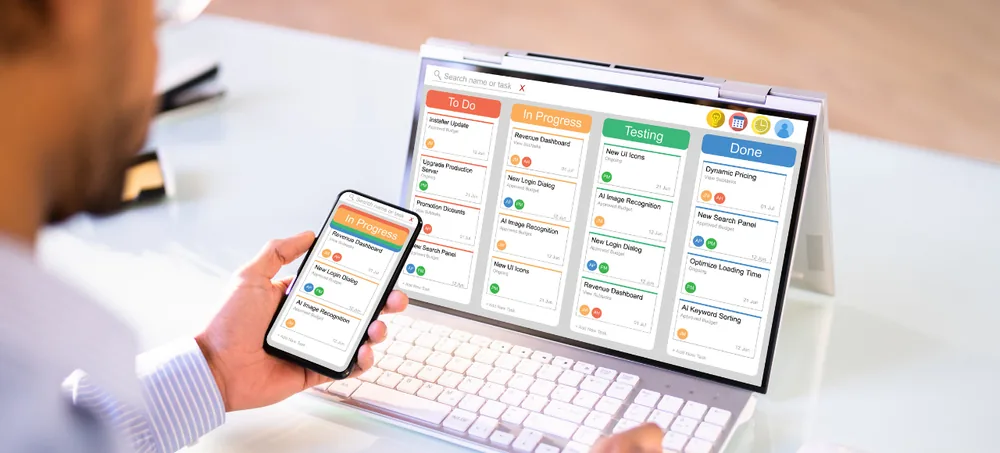
Leads arrive through different channels, sales representatives manage multiple opportunities, and customer information gets distributed across spreadsheets or applications. ERPLax Platform CRM India is a cloud CRM platform designed to help businesses organize customer information, manage leads, structure sales pipelines, coordinate follow-ups, automate workflows, and improve visibility into customer and sales activities.
Get a free walkthrough of ERPLax for your business.
CRM stands for Customer Relationship Management. A CRM platform helps an organization organize customer and prospect information while providing processes for managing sales activities, communication, opportunities, follow-ups, and related workflows. Modern CRM platforms increasingly emphasize unified customer information, sales processes, workflow automation, collaboration, and reporting — a connected view of customer interactions, not just a contact database.
Spreadsheets, email inboxes, notebooks, and individual employee records can work when customer volumes are small. A cloud CRM platform creates a centralized framework so sales representatives can organize leads and opportunities, managers can review pipeline activities, and reporting can provide structured visibility into sales operations.
EchoPx Technologies brings 19+ years of experience, exposure across 1500+ clients, and involvement in 1700+ projects — contributing to an understanding of how organizations translate business requirements into structured software workflows.
Growth creates more information to manage — hundreds or thousands of prospect and customer interactions distributed among sales representatives, managers, and business departments.
One salesperson maintains a spreadsheet, another uses personal notes, and discussions live in email threads — making relationships dependent on individual records.
Employees have to remember calls, meetings, responses, quotations, and pending discussions without a shared system.
Without centralized CRM software, managers depend on manually prepared spreadsheets or verbal updates.
When multiple people work incoming enquiries, organizations need a clear method for assigning and managing leads.
A customer requirement may require quotation preparation, internal approval, and coordination with other departments.
Preparing sales reports manually requires pulling information from different employees and spreadsheets.
Without centralized information, understanding previous interactions requires searching through emails, files, or employee notes.
ERPLax Platform CRM India is designed to help businesses establish structured customer and sales management processes within a cloud platform. Instead of treating customer information as isolated records, organizations manage customer-related activities as connected business workflows — leads, prospects, opportunities, sales activities, follow-ups, and reporting, all according to configured business requirements.
Teams comparing CRM solutions India shortlists often also look at Sales CRM software India and Sales CRM India options, checking a CRM system in India against known CRM providers in India before settling on Online CRM software India or broader CRM software solutions India coverage, whether the requirement is a CRM platform for businesses in India, CRM software for small business in India, or Sales CRM software for Indian businesses.
Without a structured CRM process, important questions become difficult to answer — which leads need follow-up, who owns each opportunity, and what happens next.
Hard to answer without a shared system.
Visibility across the full opportunity list.
Clear responsibility for every relationship.
Continuity across every customer touchpoint.
Structured stages instead of guesswork.
CRM management software India organizes these questions through a shared system.
ERPLax can support processes around leads, prospects, opportunities, customer information, sales activities, follow-ups, and reporting according to configured business requirements.
Turn incoming enquiries into structured sales processes with lead management software: lead received → recorded → ownership assigned → follow-up initiated.
Organize opportunities according to your sales methodology through qualification, requirement discussion, proposal, negotiation, and decision.
Organize opportunities by defined stages for a consistent sales pipeline management process with clear next-activity visibility.
Structure calls, meetings, discussions, proposal follow-ups, and next actions around relevant customer or opportunity records.
Understand customers as ongoing relationships, not isolated transactions — a shared record improves continuity across teams.
Organize the work behind the pipeline — follow-ups, meetings, internal reviews, and customer discussions through configured processes.
Define what should happen at specific process conditions across lead handling, opportunity progression, and approvals — a genuine CRM workflow automation foundation.
Commercial review, pricing review, discount approval, and proposal approval through defined approval paths instead of email chains.
Give sales managers visibility into activities, not just results — pipeline stages, pending activities, and team responsibilities.
Turn customer and sales information into operational visibility with connected CRM dashboards for leads, opportunities, and team activities.
A practical CRM process begins when a new business enquiry enters the organization.
Lead Creation
Ownership
Initial Follow-Up
Requirement Understanding
Opportunity Progression
Sales Activities
Pipeline Progression
Management Visibility
CRM does not have to remain an isolated database — customer-facing workflows can be designed with awareness of the wider business processes that follow a successful sale.
Managed through a shared platform instead of scattered records.
Defined stages and workflows for a consistent methodology.
A clearer operational view of active opportunities.
Activities organized around centralized records.
Reduced repetitive manual coordination.
Shared information helps teams coordinate customer-facing work.
A stronger foundation for management reporting.
Configuration and development within the SaaS platform.
Build sales discipline as you grow.
Longer, multi-stakeholder sales cycles.
Specs, quantities & commercial discussions.
Relationship- and follow-up-heavy sales.
Repeat enquiries & ongoing relationships.
Consistency as sales teams expand.
A CRM implementation should begin with an understanding of how the business manages customer relationships, not only the software itself.
Lead sources, ownership rules, sales stages, and approval processes.
Review existing customer information before migration or configuration.
Which applications need to exchange information with CRM?
Clear workflows make adoption easier when users understand the process.
CRM software pricing varies according to the solution and business requirements. For ERPLax, businesses should discuss their specific requirements rather than assume a standard price based on generic CRM comparisons.
Can the CRM support our lead management process?
Can we configure our sales stages?
Can it organize follow-ups and activities?
Can managers see the information they need?
Can workflows reflect our approval requirements?
What integrations do we require?
Can the platform support our changing processes?
What implementation work is required?
How will users adopt the system?
ERPLax follows a cloud-only SaaS model. Businesses use the CRM platform as a subscription solution rather than purchasing a perpetual software license or deploying a local installation. For businesses evaluating cloud CRM software India, important considerations include workflow fit, user requirements, required features, integrations, reporting needs, implementation scope, and scalability.
Not just a contact database — organized leads, customers, opportunities, activities, and workflows.
Configuration and development within the SaaS platform according to business requirements.
A shared CRM environment for organized customer and sales information.
Structured opportunities and activities for stronger management reporting.
EchoPx Technologies: 19+ years of experience, 1500+ clients, 1700+ projects.
Platform CRM India refers to a CRM platform used by businesses to manage customer information, leads, sales opportunities, follow-ups, activities, workflows, and related reporting through a centralized system.
CRM software is customer relationship management software. It helps organizations organize information and processes associated with prospects and customers, including leads, opportunities, sales activities, and interactions.
Yes. ERPLax is a cloud-only SaaS/subscription platform. CRM capabilities are provided within the cloud platform rather than through local installation or perpetual software licensing.
Depending on configured requirements, sales teams can use CRM processes to organize leads, customer information, opportunities, pipeline stages, follow-ups, activities, and reporting.
CRM can be useful for small and growing businesses that need to move from spreadsheets and individual follow-up methods toward a structured customer and sales management process.
ERPLax supports configuration and development within the SaaS platform according to business requirements. Required workflows should be defined during requirement analysis and implementation planning.
Consider your lead process, sales stages, user requirements, workflow needs, reporting expectations, integration requirements, implementation scope, and future process needs.
CRM cost depends on factors such as users, capabilities, workflows, configuration, development within the platform, integrations, and implementation requirements. Businesses should evaluate pricing against their actual CRM scope.
Yes. Sales pipeline management is a core CRM use case. Businesses can organize opportunities according to defined stages and use those stages to improve sales process visibility.
CRM can provide a structured environment for managing customer and opportunity activities, including follow-up processes according to the configured workflow.
Integration requirements depend on the applications and business processes involved. Organizations should identify required data exchanges and process connections during CRM planning.
No. Although sales is a major CRM use case, customer information and customer-facing processes can involve multiple teams. Modern CRM platforms commonly emphasize cross-team customer visibility and collaboration.
Sales management software generally focuses on sales processes, while CRM has a broader customer relationship focus, including lead management, customer records, opportunities, follow-ups, sales workflows, activities, and reporting.
Start by documenting current lead handling, sales stages, ownership rules, customer information requirements, approval workflows, reporting needs, user roles, and integration requirements. Existing customer information should also be reviewed before migration or configuration.
Online CRM software can support growing organizations that need centralized customer management and configurable processes. Suitability depends on the organization's workflow, feature, integration, user, and implementation requirements.
Customer relationships become more difficult to manage when leads, opportunities, follow-ups, and customer information are spread across disconnected tools. ERPLax Platform CRM India provides a centralized cloud CRM environment for businesses looking to organize customer relationships and create structured sales workflows. Manage leads. Organize customer information. Structure opportunities. Coordinate follow-ups. Configure sales processes. Improve operational visibility.
Organizations researching a CRM platform for lead management India, CRM software for sales pipeline management India, or a CRM solution for growing businesses India will find ERPLax equally suited to Online CRM software for sales teams India and Configurable CRM workflows India requirements — a genuine Business CRM platform India and Sales management CRM software India built around lead management software, customer data management, sales process automation, customer lifecycle management, customer interaction management, and connected CRM dashboards, all backed by consistent business process automation, including teams evaluating CRM companies India, CRM providers India, CRM software providers India, a CRM development company India, or a CRM software development company India. Backed by 19+ years of experience, 1500+ clients, and 1700+ projects, ERPLax helps organizations translate business requirements into structured digital workflows.
Specialized Applications
Purpose-built & ready to deploy. Hover to explore, click to learn more.
Testimonials
Real stories from businesses running their operations on ERPLax.
ERPLax gave us real-time visibility into stock across three warehouses. Wastage dropped and our fulfillment time improved almost overnight.
GST e-invoicing used to eat up two days every month. With ERPLax's accounting module it's now automatic and our filings are always on time.
Billing at our stores used to take a minute per customer. ERPLax's POS module cut that to under 15 seconds, even during peak festival rush.
Payroll for 200+ employees across two branches used to take our HR team a full week. ERPLax's HRM module now runs it in a single afternoon.
Tracking batch numbers and expiry across our distribution network was a nightmare on spreadsheets. ERPLax's inventory module made it effortless.
Front desk, housekeeping and billing are now all on one screen. ERPLax's hotel management module has made check-in day a breeze for our staff.
Fee collection, attendance and report cards used to live in three different tools. ERPLax brought it all into one dashboard our staff actually enjoys using.
Tracking material costs and site progress across four active sites was chaos before ERPLax. Now our project managers update status from their phones daily.
Our online store orders now sync straight into inventory and accounting — no more manual entry, no more overselling out-of-stock items.
Our sales team can now see every lead's history and follow-ups in one place. Deal closures are faster and nothing falls through the cracks anymore.
ERPLax gave us real-time visibility into stock across three warehouses. Wastage dropped and our fulfillment time improved almost overnight.
GST e-invoicing used to eat up two days every month. With ERPLax's accounting module it's now automatic and our filings are always on time.
Billing at our stores used to take a minute per customer. ERPLax's POS module cut that to under 15 seconds, even during peak festival rush.
Payroll for 200+ employees across two branches used to take our HR team a full week. ERPLax's HRM module now runs it in a single afternoon.
Front desk, housekeeping and billing are now all on one screen. ERPLax's hotel management module has made check-in day a breeze for our staff.
Fee collection, attendance and report cards used to live in three different tools. ERPLax brought it all into one dashboard our staff actually enjoys using.
Tracking material costs and site progress across four active sites was chaos before ERPLax. Now our project managers update status from their phones daily.
Our online store orders now sync straight into inventory and accounting — no more manual entry, no more overselling out-of-stock items.
Our sales team can now see every lead's history and follow-ups in one place. Deal closures are faster and nothing falls through the cracks anymore.