Every organization runs on documents. Contracts, invoices, purchase orders, compliance certificates, employee records, project specifications, customer communication, and regulatory filings all carry important business value. The volume is constant, and the risk of mismanagement is high.
A single misplaced contract can delay a deal by weeks. A missing compliance document can lead to audit issues. A versioning error in a product specification can create confusion, rework, or even manufacturing defects. Yet many businesses still manage documents through scattered shared drives, email attachments, desktop folders, and physical files that are difficult to track and control.
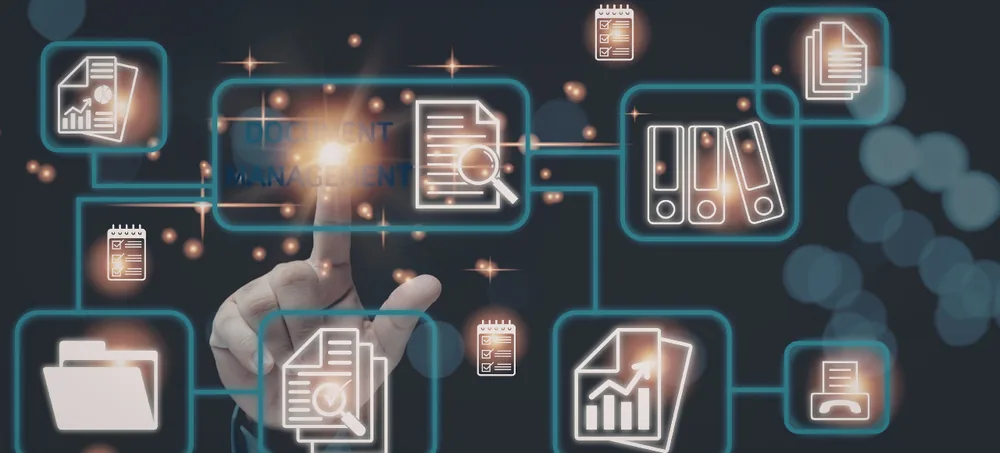
Automated document management systems bring structure, visibility, and control to this process. They help businesses capture documents from multiple sources, including scans, uploads, emails, and integrated business systems. These documents can then be classified automatically, routed through approval workflows, protected with role-based access, managed with retention policies, and made instantly searchable whenever needed.
In 2026, automated document management is no longer a luxury reserved for large or regulated industries. It is an operational necessity for any business that creates, processes, stores, or shares documents at scale.
ERPLax builds automated document management systems on the principle that guides everything we deliver: "Your processes. Your system." Headquartered in Bangalore and serving organizations across 25+ countries, we do not force your documents into a rigid folder hierarchy designed by someone who has never seen your workflows. We architect document automation that mirrors how your teams actually create, review, approve, distribute, and archive information — and then make those processes faster, more secure, and effortlessly scalable.
The Legacy Gap: Why Traditional Document Management Collapses Under Modern Business Demands
The document management market has existed for decades, but most solutions — whether legacy Cloud systems or modern SaaS platforms — share a set of fundamental limitations that become increasingly painful as businesses grow.
The first limitation is passive storage. Most document management systems are essentially digital filing cabinets. They store files. They organize them into folder structures. They provide basic search. But they do nothing with the documents once stored. The intelligence — knowing what to do with a document when it arrives, who needs to see it, what approvals it requires, when it expires, how long it must be retained — lives entirely in the heads of the people who manage them. When those people are busy, on leave, or no longer with the organization, the process breaks down. Documents sit in inboxes waiting for action. Approvals stall. Deadlines pass. Compliance lapses.
The second limitation is disconnected existence. Traditional document management operates as an island. Your ERP generates purchase orders, but they must be manually uploaded to the document system. Your CRM captures signed contracts, but they live in a different repository than your project management files. Your HR platform stores employee documents separately from finance records. Each system holds a fragment of your organizational knowledge, and none of them talk to each other. Teams waste hours searching across multiple platforms, emailing files back and forth, and manually reconciling versions.
The third limitation is version chaos. In any organization with multiple contributors, document versioning becomes a nightmare without rigorous automation. Teams email attachments named "Final_v3_REVISED_John_edits.docx" because the shared drive already has four versions and nobody knows which is current. Contracts go out with outdated terms. Reports are submitted with superseded data. Product specifications reference obsolete parameters. Manual version control is not just inefficient — it introduces errors that have real financial and legal consequences.
The fourth limitation is compliance exposure. Regulations across industries — financial services, healthcare, manufacturing, education, government contracting — impose specific requirements on document retention, access control, audit trails, and disposition. Manual compliance management means somebody must remember to apply retention policies, restrict access appropriately, maintain audit documentation, and dispose of expired records. The probability of consistent compliance across thousands of documents, managed manually by humans with competing priorities, approaches zero over time. Every gap is a potential audit finding, regulatory penalty, or legal liability.
The fifth limitation is scalability failure. A document management approach that works for an organization with a few thousand files collapses when the repository grows to hundreds of thousands or millions. Search slows down. Storage costs escalate without governance. Access controls become unmanageable. And the manual processes that held everything together at small scale become impossible bottlenecks.
ERPLax addresses every one of these limitations by design. We build document management systems that are active, not passive — systems that automate classification, routing, approval, retention, and retrieval as integral parts of your business workflows. Documents are not stored; they are managed, governed, and put to work.
Technical Deep Dive: The Architecture Behind Document Intelligence
An automated document management system must handle complex workflows, high-volume storage, rapid retrieval, stringent security, and deep integration with the business systems that generate and consume documents. ERPLax's technology stack is engineered for exactly this.
ERPLax-Based Modular Document Engine
ERPLax's document management module is built on ERPLax, leveraging the framework's file system abstraction, queue management, event system, and middleware architecture to handle enterprise-scale document operations with reliability and elegance. The modular design means every document management function — capture, classification, workflow routing, version control, retention management, search indexing, and audit logging — operates as an independent component. An organization that needs automated contract management deploys that module without activating invoice processing. A company focused on compliance documentation activates retention and audit modules while deferring HR document automation. Each module stands alone and integrates seamlessly when the business is ready to expand.
ERPLax's file system abstraction is particularly valuable for document management. Your documents can reside on local storage, cloud object storage like Amazon S3 or Azure Blob, or hybrid configurations — and the application layer interacts with them through a consistent interface regardless of the underlying storage provider. Changing storage backends requires configuration changes, not code rewrites.
API-First Architecture for Document Ecosystem Integration
Documents do not exist in isolation. They are generated by ERP systems, signed in CRM platforms, processed by accounting software, reviewed in project management tools, and archived by compliance systems. ERPLax's REST API architecture ensures that every document management function — upload, classification, workflow initiation, approval, retrieval, and archival — is accessible as a clean, documented API endpoint. Your ERP automatically files purchase orders in the correct repository with proper metadata. Your CRM stores executed contracts with automated classification and retention tagging. Your HR platform files onboarding documents with role-based access controls applied instantly. Integration is native and bidirectional, not a manual export-import cycle.
Redis Caching for Instant Document Retrieval
When a team member needs a document, they need it now — not after a full-text search grinds through millions of records. ERPLax leverages Redis to cache document metadata, search indices, recently accessed files, and user session data at memory speed. Search queries return results in milliseconds. Dashboard widgets render document status summaries instantly. Workflow queues display pending approvals without delay. The system feels responsive whether your repository contains ten thousand documents or ten million.
Sanctum Security for Document Access Control
Documents contain some of the most sensitive information in any organization — financial records, employee data, legal contracts, intellectual property, customer information, strategic plans. ERPLax employs Sanctum-based authentication with granular role-based access controls that govern visibility at the document, folder, category, and metadata level. A finance team member sees financial documents. An HR manager accesses personnel records. A project lead views project-specific deliverables. Nobody sees what their role does not require. Every access event — every view, download, edit, share, and print action — is recorded in immutable audit logs that provide the forensic documentation compliance teams and regulators demand.
Intelligent Classification and Metadata Automation
The value of a document management system depends on the quality of its organization. ERPLax automates document classification using rule-based engines that analyze document content, source, file type, and contextual metadata to assign categories, tags, retention policies, and access controls automatically at the point of capture. An invoice arriving from the accounts payable email is classified as a financial document, tagged with the vendor name and purchase order number, assigned a seven-year retention policy, and routed to the approvals workflow — without any human intervention. A signed contract uploaded through the CRM integration is classified by contract type, linked to the customer record, assigned to legal review if required, and filed with appropriate access restrictions. Classification rules are fully customizable and evolve as your organizational needs change.
Scalable Cloud-Native Storage
Document repositories grow continuously and indefinitely. ERPLax's cloud-native storage architecture scales seamlessly, supporting tiered storage strategies that keep frequently accessed documents on high-performance storage while automatically migrating older documents to cost-optimized archival tiers. Storage costs remain proportional to actual usage patterns, not worst-case capacity planning. Whether your organization stores fifty thousand documents or fifty million, the system scales without re-architecture, performance degradation, or budget surprises.
Industry Value: How Automated Document Management Transforms Operations Across Sectors
Document management automation generates measurable results when designed for the specific document types, workflows, compliance requirements, and operational realities of each industry. Here is how ERPLax delivers intelligent document management across three sectors with critical documentation needs.
Manufacturing
Manufacturing operations generate enormous document volumes — purchase orders, goods receipt notes, quality inspection reports, production batch records, material safety data sheets, shipping documentation, compliance certificates, and customer-facing technical datasheets. Managing these documents manually creates bottlenecks at every stage of the production and delivery cycle.
ERPLax automates the entire manufacturing document lifecycle. Purchase orders generated by the procurement module are automatically filed, indexed by supplier and material category, and linked to corresponding goods receipt notes when deliveries arrive. Quality inspection reports are captured at each production stage, classified by product line and batch number, and routed to quality managers for review with automated escalation if deviations exceed tolerance thresholds. Compliance certificates — ISO certifications, material test reports, environmental clearances — are tracked with automated expiration alerts that trigger renewal workflows months before deadlines. Shipping documentation including packing lists, invoices, and e-way bills is assembled automatically from order data and filed with the corresponding customer record. And engineering change orders flow through automated approval workflows that capture every review, comment, and revision in a complete audit trail.
The result: manufacturing clients eliminate document-related production delays, achieve instant retrieval of any document for customer inquiries or regulatory audits, and maintain compliance documentation that is always current, always complete, and always accessible.
Education
Educational institutions manage diverse document portfolios spanning student records, academic transcripts, faculty credentials, accreditation documentation, financial records, research publications, administrative policies, and legal agreements. The regulatory environment demands strict retention, access control, and auditability for student information in particular.
ERPLax builds education document automation that governs every document category with appropriate policies. Student admission documents — applications, transcripts, recommendation letters, identity verifications — are captured through online portals, classified automatically, and linked to student records in the enrollment management system. Academic records including grade sheets, degree certificates, and course completion documentation are generated, verified, and archived with retention policies that meet regulatory requirements for long-term preservation. Faculty documentation — appointment letters, qualification certificates, performance reviews, research publications — is managed with access controls that respect institutional privacy policies. Accreditation documentation is organized into automated portfolios that assemble required evidence packages on demand, eliminating the frantic document gathering that typically precedes accreditation visits. And financial documents — fee receipts, scholarship agreements, grant documentation, audit reports — flow through automated approval and archival workflows with complete audit trails.
The result: education clients achieve instant retrieval of any student or institutional document, maintain accreditation readiness continuously rather than cyclically, and reduce administrative document handling time dramatically — freeing staff for student-facing work.
Healthcare
Healthcare document management operates under the most demanding combination of volume, sensitivity, and regulatory scrutiny of any sector. Patient records, clinical notes, diagnostic reports, consent forms, insurance documentation, prescription records, and regulatory filings must be captured accurately, stored securely, accessible instantly to authorized personnel, and retained according to strict regulatory timelines.
ERPLax builds healthcare document automation with patient safety and regulatory compliance as foundational requirements. Patient intake documents — registration forms, insurance cards, consent forms, medical history questionnaires — are captured digitally, classified automatically, and linked to the patient record with role-based access controls applied instantly. Clinical documentation including physician notes, diagnostic imaging reports, lab results, and treatment plans flows into the patient record through automated workflows that validate completeness and flag missing elements. Prescription records are captured and archived with automated retention policies that meet pharmaceutical regulatory requirements. Insurance documentation — pre-authorization letters, claim forms, explanation of benefits — is processed through automated workflows that track status, flag discrepancies, and maintain complete audit trails. And regulatory reporting documentation is assembled automatically from operational data, ensuring that compliance submissions are accurate, timely, and fully documented.
The result: healthcare clients achieve instant access to complete patient records at the point of care, maintain regulatory compliance with automated enforcement rather than manual oversight, and reduce administrative documentation burden so clinical staff can focus on patient outcomes.
The Roadmap: From Document Chaos to Automated Order
ERPLax follows a structured four-phase methodology to transform your document management from a manual burden into an automated strategic asset.
Phase 1: Discovery & Document Audit
We begin by mapping your complete document landscape — every document type, every creation source, every workflow, every storage location, every access pattern, every compliance requirement. Our team interviews stakeholders across departments to understand not just what documents exist but how they flow through your organization, where bottlenecks occur, where compliance gaps hide, and where retrieval failures cost time and money. This phase produces a comprehensive document automation strategy with prioritized workflows, classification taxonomies, retention policies, and a phased implementation roadmap.
Phase 2: Architecture & Taxonomy Design
With the audit complete, our architects design the complete document management system — classification rules, metadata schemas, workflow logic, access control models, retention policies, integration specifications, and storage architecture. You review detailed workflow diagrams, taxonomy structures, and policy definitions before development begins. This collaborative design phase ensures every automation rule reflects your organizational policies, your compliance requirements, and your operational workflows.
Phase 3: Iterative Build & Migration
Our engineering team builds your document management system in agile sprints, delivering functional modules for review every two weeks. Simultaneously, we plan and execute document migration from existing repositories — mapping legacy folder structures to the new taxonomy, validating metadata accuracy, and ensuring zero document loss during transition. Each sprint includes automated testing, security validation, and search performance benchmarking. You see real automation operating with real documents, provide feedback early, and shape the system as it is built.
Phase 4: Launch, Training & Continuous Governance
Go-live is managed through phased rollout — starting with high-impact document categories, validating automation behavior, and progressively expanding to the full document portfolio. Your team receives role-specific training — document creators learn capture and classification tools, managers learn workflow and approval interfaces, compliance officers learn audit and reporting dashboards, and IT administrators learn system governance controls. Post-launch, we monitor system adoption, classification accuracy, workflow performance, and storage utilization, optimizing continuously based on operational outcomes.
Compliance, Security, and Total Document Ownership
Your documents contain your organization's most sensitive intellectual property, financial records, personal data, and strategic information. Security and compliance are the foundation, not an add-on.
ERPLax encrypts all documents with AES-256 at rest and TLS 1.3 in transit. Role-based access controls govern visibility at the document, folder, and metadata level — ensuring every user sees only what their role requires. Version control maintains complete revision history for every document, with the ability to restore any prior version instantly. Retention automation enforces legally mandated retention periods and triggers secure disposition workflows when documents reach end-of-life — with approval gates that prevent accidental destruction of records under legal hold. Immutable audit logs capture every action — every upload, view, edit, download, share, approval, and deletion — providing the complete forensic documentation that regulators, auditors, and legal teams demand. Whether your compliance obligations fall under GDPR, HIPAA, SOX, ISO 27001, or industry-specific frameworks, ERPLax delivers the controls, enforcement, and documentation to demonstrate compliance continuously.
And the commitment that defines ERPLax: you own everything. Your documents. Your metadata. Your classification rules. Your workflow logic. Your audit trails. Your Data. Full intellectual property ownership. Zero vendor lock-in. Complete control over the system that governs your organization's knowledge.
Turn Your Documents From a Burden Into a Business Asset
Documents are not just files to be stored — they are the operational memory of your business. Every contract, every specification, every compliance certificate, every customer record contains information that drives decisions, protects interests, and enables growth. When documents are managed manually, that knowledge is trapped — buried in inboxes, lost in folder hierarchies, inaccessible when it matters most. When documents are managed by an intelligent, automated system designed around your workflows, that knowledge becomes a strategic asset — instantly accessible, continuously governed, and always working for your business.
ERPLax builds automated document management systems that transform how your organization creates, manages, governs, and leverages its documents — systems engineered around your processes, integrated with your business platforms, and owned entirely by you.
Ready to bring order to your documents? [Request your free discovery session today] and let us show you what automated document management built for your business looks like.