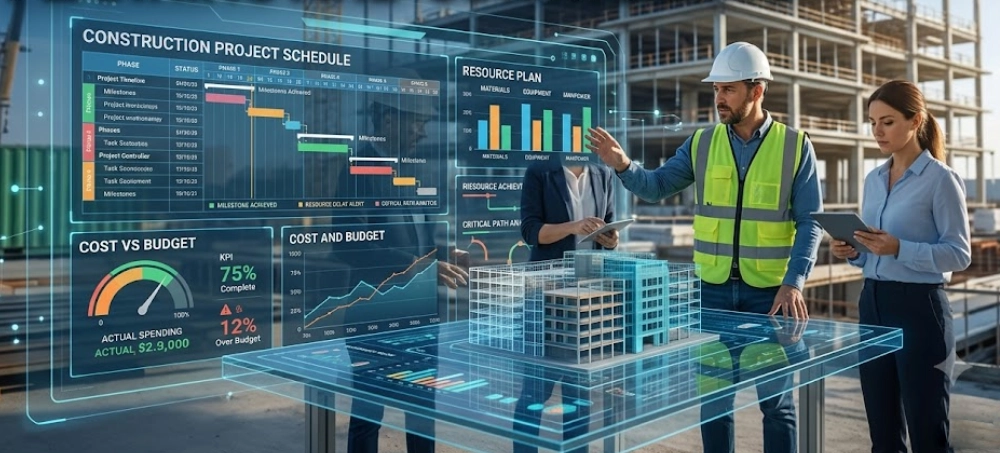
Plan, schedule, and control every construction project from a single dashboard. ERPLax's construction project planning and controlling software brings work breakdown structures, budgeting, cost control, and real-time site progress into one system built for contractors, EPC firms, and infrastructure developers.
Get a free walkthrough for your project portfolio
Most construction teams don't lack data — they lack one place where planning and control data actually meet.
Site engineers, planners, and management track progress on separate files that are never in sync, so nobody has one accurate schedule.
Cost overruns are often discovered only at the end of a billing cycle, long after corrective action was still possible.
Leadership has no live construction project dashboard showing how every project is tracking against its plan.
Running Account bills are prepared manually against BOQ line items, slowing invoicing and delaying client payments.
Variations and change requests are approved over email or chat with no audit trail tied back to cost impact.
Daily progress reports depend on someone manually collecting photos and updates from each site by phone or WhatsApp.
ERPLax construction project planning and controlling software connects every stage of a project — from initial planning to final handover — on one platform, so planning and controlling teams work off the same numbers.
Planning, execution, and finance teams work from the same schedule and budget, not separate spreadsheets.
Budget vs actual and earned value figures update as costs are recorded, not once a month.
RA bills generate from measured work, cutting the gap between site progress and invoicing.
Work breakdown structure, activity-wise scheduling, resource planning, and budget estimation completed before execution begins, so every site starts from an approved baseline.
Real-time tracking of cost, schedule, and physical progress against that baseline, with variance alerts the moment a site drifts off plan.
Construction project planning and controlling software gives contractors, EPC companies, and infrastructure developers a single system to plan schedules, estimate budgets, and control costs across every active site. Unlike a generic construction ERP software or a spreadsheet-based tracker, ERPLax's construction project management software is built around the planning-and-controls discipline used on real construction sites — work breakdown structure, Gantt-based scheduling, budget vs actual tracking, earned value management, and variance analysis all live inside one construction project controls software. Whether you run a single mid-size site or a portfolio of EPC and infrastructure projects, this construction project tracking software gives your planning, execution, and finance teams the same real-time picture of where every project actually stands. Many teams start out searching for project planning software for construction companies, an EPC project planning software platform, or infrastructure project controlling software — ERPLax serves all three, alongside real estate construction project management teams tracking multiple developments at once.
Catch variance while there's still time to act, not after the bill is raised.
Replace scattered spreadsheets with a single baseline every team references.
See every project's status without waiting for a weekly update meeting.
Turn measured progress into client invoices in days, not weeks.
Every variation is logged, approved, and costed — never lost in an inbox.
Plan the next project on actuals from this one, not guesswork.
Twenty modules covering the full construction project execution software lifecycle, from the first estimate to final handover.
Break every project into a construction work breakdown structure software model of phases, activities, and cost codes before a single task begins.
Build activity-wise schedules with construction scheduling software and construction Gantt chart software, complete with dependencies and baseline-vs-actual comparison.
Prepare item-wise budgets with construction budgeting software and construction cost estimation software, linked directly to BOQ rates and material costs.
Get construction budget vs actual tracking in real time — committed, actual, and forecast cost against budget — with construction project cost control software built for site-level accuracy.
Plan labour, equipment, and material needs across every site with construction resource planning software that flags shortages early.
Monitor every milestone with construction milestone tracking software that compares planned versus actual completion dates.
Plan purchase schedules against the project timeline so materials arrive exactly when each activity needs them.
Track subcontractor scope, rates, and performance separately from your own labour and equipment costs.
Log, approve, and cost every variation with a full audit trail linked back to the original budget line.
Flag schedule and cost risks early with issue logs tied directly to the affected activity or cost code.
Replace manual DPRs with construction progress monitoring software that pulls site photos and updates straight from the field.
Keep drawings, approvals, and site documents version-controlled and linked to the relevant project phase.
Track labour attendance and equipment utilisation against the plan for every active site.
Give leadership one construction project dashboard software view across every site, contract, and client.
Generate construction earned value management software and construction variance analysis software reports with schedule and cost performance indices at a glance.
Generate RA bills straight from measured, completed work and push them to client-ready invoices faster.
Run stage-wise quality and safety checklists so no site milestone is marked complete without sign-off.
Let site engineers update progress, log issues, and upload photos from a mobile app, even with limited connectivity.
Compare tendered BOQ rates against actual execution cost to catch estimation gaps on the next bid.
Forecast project cash flow against the billing and payment schedule so funding gaps are visible in advance.
Two disciplines sit at the heart of construction project planning and controlling software: keeping the schedule honest, and keeping the budget honest.
Compare baseline versus actual dates on every activity, track the critical path, and tag the root cause behind every delay before it cascades into the next milestone.
Watch budget utilisation and cost variance update in real time, with every approved change order automatically reflected in the revised budget.
Field data should reach the office the same day it happens, not at the end of the week.
Site engineers log photo-based DPRs with manpower counts, weather, and activity status straight from the mobile app — no more chasing WhatsApp threads for updates.
Generate construction site progress tracking software reports for clients and consultants automatically, complete with milestone completion percentages.
Project Setup & WBS
Baseline Schedule & Budget
Resource & Procurement Planning
Execution & Field Tracking
Progress & Milestone Monitoring
Cost & Variance Control
Change & Risk Management
Handover & Closure
Access schedules, budgets, and site reports from anywhere, on any device, with automatic backups.
Keep head-office finance Cloud while site teams work from a cloud-connected mobile app.
Host on your own infrastructure for full control over data residency and IT policy.
WBS, scheduling, and budgeting
Material, vendor, and labour planning
Progress, DPR, and milestones
EVM, variance, and dashboards
RA bills, handover, documentation
Nearly two decades delivering ERP software across industries.
Trusted across India and beyond, including construction and infrastructure firms.
A proven implementation track record across sectors.
Built around real site workflows, not generic project templates.
Deploy the way that fits your IT policy, not ours.
A named team through rollout, not a rotating support queue.
Adapts to how your sites already run, not the other way around.
Site and office teams onboarded properly, with support after go-live.
It is software that combines pre-construction planning, work breakdown structures, scheduling, and budgeting with real-time controlling: tracking cost, progress, and schedule against the baseline plan so variances are caught early.
ERPLax tracks committed, actual, and forecast cost against the approved budget for every cost code, flags variance in real time, and ties every change order back to its cost impact so overruns are visible immediately, not at month end.
Yes. A multi-project portfolio dashboard shows schedule, budget, and progress status for every active site in one view, so leadership does not need to collect updates site by site.
Yes, ERPLax generates earned value reports with schedule and cost performance indicators so planning teams can see whether a project is ahead, on track, or behind against both time and budget.
Yes, ERPLax supports integration with AutoCAD, Primavera P6, and Microsoft Project alongside accounting tools like Tally, Zoho Books, and QuickBooks.
Both. Modules can be deployed in phases, so a single mid-size contractor can start with scheduling and billing while a large EPC firm rolls out the full planning-and-controls suite across a project portfolio.
RA bills are generated directly from measured, completed work linked to BOQ line items, so invoices reflect actual site progress and reach clients faster than manual bill preparation.
Yes, subcontractor scope, agreed rates, and performance are tracked independently of your own labour and equipment cost, with their own approval and payment workflow.
Yes, the mobile site app is built for field conditions and syncs progress updates, photos, and issue logs once connectivity is available.
Every cost code carries a budgeted, committed, and actual value that updates as purchase orders, invoices, and labour costs are recorded, giving a live budget-vs-actual view rather than a monthly reconciliation.
Yes, every change order is logged, routed for approval, and linked back to the original budget and schedule so its cost and time impact is documented, not scattered across email.
ERPLax supports cloud, Cloud, and hybrid deployment, so head-office finance can stay Cloud while site teams work from a cloud-connected mobile app, or any combination that fits your IT policy.
Timelines depend on the number of modules and active sites, but a phased rollout, starting with planning and scheduling before adding cost control and billing, typically goes live within a few weeks per phase.
Yes, ERPLax's implementation team provides onboarding training for site and office staff plus ongoing support, backed by 19+ years of ERP delivery experience.
Talk to ERPLax about construction project planning and controlling software built for your project portfolio.
Specialized Applications
Purpose-built & ready to deploy. Hover to explore, click to learn more.
Testimonials
Real stories from businesses running their operations on ERPLax.
ERPLax gave us real-time visibility into stock across three warehouses. Wastage dropped and our fulfillment time improved almost overnight.
GST e-invoicing used to eat up two days every month. With ERPLax's accounting module it's now automatic and our filings are always on time.
Billing at our stores used to take a minute per customer. ERPLax's POS module cut that to under 15 seconds, even during peak festival rush.
Payroll for 200+ employees across two branches used to take our HR team a full week. ERPLax's HRM module now runs it in a single afternoon.
Tracking batch numbers and expiry across our distribution network was a nightmare on spreadsheets. ERPLax's inventory module made it effortless.
Front desk, housekeeping and billing are now all on one screen. ERPLax's hotel management module has made check-in day a breeze for our staff.
Fee collection, attendance and report cards used to live in three different tools. ERPLax brought it all into one dashboard our staff actually enjoys using.
Tracking material costs and site progress across four active sites was chaos before ERPLax. Now our project managers update status from their phones daily.
Our online store orders now sync straight into inventory and accounting — no more manual entry, no more overselling out-of-stock items.
Our sales team can now see every lead's history and follow-ups in one place. Deal closures are faster and nothing falls through the cracks anymore.
ERPLax gave us real-time visibility into stock across three warehouses. Wastage dropped and our fulfillment time improved almost overnight.
GST e-invoicing used to eat up two days every month. With ERPLax's accounting module it's now automatic and our filings are always on time.
Billing at our stores used to take a minute per customer. ERPLax's POS module cut that to under 15 seconds, even during peak festival rush.
Payroll for 200+ employees across two branches used to take our HR team a full week. ERPLax's HRM module now runs it in a single afternoon.
Front desk, housekeeping and billing are now all on one screen. ERPLax's hotel management module has made check-in day a breeze for our staff.
Fee collection, attendance and report cards used to live in three different tools. ERPLax brought it all into one dashboard our staff actually enjoys using.
Tracking material costs and site progress across four active sites was chaos before ERPLax. Now our project managers update status from their phones daily.
Our online store orders now sync straight into inventory and accounting — no more manual entry, no more overselling out-of-stock items.
Our sales team can now see every lead's history and follow-ups in one place. Deal closures are faster and nothing falls through the cracks anymore.