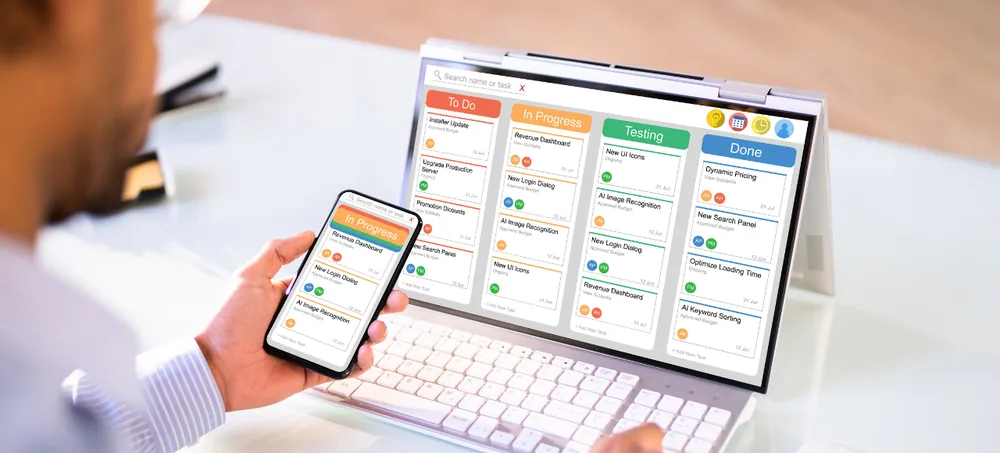
Custom ERP for Sales, Purchase, Inventory, Finance, Projects, Manufacturing and Business Growth. Businesses comparing ERP software companies in Abu Dhabi need more than a standard software package. The right ERP partner understands existing workflows, identifies process gaps, configures suitable modules, plans data migration, integrates business applications, trains users and provides dependable support after implementation. ERPLax provides customizable ERP solutions for small, medium and growing businesses operating in Abu Dhabi and across the UAE.
Get a free consultation for your ERP requirement in Abu Dhabi.
Businesses often use separate applications for accounting, billing, customer management, inventory, projects, manufacturing and employee records. As the organization grows, disconnected software may create:
A confirmed sales order can check available inventory, reserve products, create a purchase or production requirement, prepare delivery documents, generate an invoice and update customer receivables — all from one connected ERPLax platform.
ERP stands for Enterprise Resource Planning. ERP Software is an integrated business management platform used to connect departments, transactions, workflows and reports through a shared database — CRM, sales, purchasing, inventory, warehouses, billing, finance, manufacturing, construction, field services, facilities management, projects, HR, payroll, assets, approvals and reports.
Custom ERP Software is configured or developed according to the organization's actual processes — business-specific modules, industry-specific workflows, custom forms and calculations, multi-company and multi-branch access, and role-based permissions. ERPLax uses a modular approach: businesses can begin with priority modules and add more functions as requirements grow.
A complete ERP software company provides consulting, configuration, custom development, implementation, data migration, integrations, training and ongoing support. Services typically include:
ERPLax ERP connects departments through one centralized platform, so authorized managers can review current business information through configurable dashboards.
Maintain customers, suppliers, products, inventory, projects, employees and financial records through one platform.
Track available, reserved, transferred, damaged, ageing, batch-controlled and serial-controlled stock.
Connect enquiries, quotations, sales orders, inventory allocation, delivery, invoicing and collections.
Manage requests, supplier quotations, comparisons, approvals, purchase orders, receipts and invoices.
Review receivables, payables, expenses, cash flow, cost centres, branch results and profitability.
Maintain separate transactions and records for different entities while providing consolidated visibility.
Provide location-specific access while authorized users review overall business performance.
Connect budgets, procurement, materials, labour, subcontractors, equipment, expenses, billing and collections.
Connect demand, inventory, material requirements, production orders, quality checks and finished goods.
Route quotations, discounts, purchases, payments, expenses and stock adjustments to authorized users.
Connected modules reduce repeated data entry and reconciliation between separate systems.
Generate sales, inventory, purchasing, finance, project, service and production reports using current records.
What do ERP software companies provide? ERPLax reviews current processes before planning the ERP, then delivers the full range of services a business needs.
Review current applications, department workflows, operational problems, data movement, reporting needs and deployment options before planning the ERP.
Document how transactions move — enquiry to order, purchase request to supplier payment, demand to production, expense to reimbursement.
Develop business-specific modules, custom masters, transaction screens, calculations, document formats and API integrations.
Configure company setup, branch setup, warehouse setup, user roles, currencies, price lists and document numbering around your organization.
Modify standard functions with new fields, additional validation, custom calculations, role-based menus and custom dashboards.
Requirement analysis, module configuration, master-data setup, migration planning, testing, training and controlled go-live.
Move agreed customers, suppliers, products, price lists, opening inventory, chart of accounts and project records from existing systems.
Connect ERP with ecommerce websites, accounting applications, banking systems, WhatsApp Business API, SMS gateways and barcode devices.
Practical, role-based training for sales, purchase, warehouse, accounts, production, project, service and HR teams.
Ongoing issue resolution, permission updates, workflow changes, report development, dashboard modifications and system enhancements.
Instead of maintaining the same information in different applications, teams work with connected records — a sales invoice links to the customer, quotation, sales order, delivery, stock movement and payment history.
Company master, contact persons, billing and delivery addresses, categories, credit limits and price lists.
Lead capture, source tracking, salesperson assignment, follow-up reminders and CRM dashboards.
Product selection, customer-specific pricing, multiple currencies, discounts and approval workflows.
Confirmed orders, PO references, price and credit-limit checks, stock reservation and order status.
Purchase requests, RFQs, supplier comparisons, approvals, purchase orders and goods receipts.
Product master, batch and serial tracking, barcode and QR support, reorder levels and stock valuation.
Zones, bins, racks, put-away, picking, packing, dispatch planning and warehouse-specific access.
Sales, service and proforma invoices, credit and debit notes, recurring invoices and multi-currency billing.
Chart of accounts, general ledger, receivables, payables, bank reconciliation and financial dashboards.
Customer and supplier currencies, exchange-rate fields, base-currency reporting and currency-wise profitability.
Expense requests, employee claims, branch and project expenses, approval workflows and reimbursement tracking.
Quotation, discount, purchase, payment and expense approvals with multi-level routing and escalation alerts.
Company-specific users, transactions, document numbering, inter-company transactions and consolidated dashboards.
Branch master, branch-wise sales, purchasing and inventory, stock transfers and consolidated dashboards.
BOM, MRP, production planning, work orders, quality inspection, machine maintenance and production costing.
Project stages, milestones, tasks, timesheets, project materials, customer billing and project profitability.
Service requests, contracts, preventive and corrective maintenance, technician assignment and job cards.
Employee master, attendance, leave, shifts, salary structures, payroll processing and HR reports.
Asset master, categories, employee assignment, maintenance schedules, warranty and disposal records.
CRM follow-ups, sales quotations, inventory lookup, purchase and payment approvals via mobile-friendly access.
Sales, purchase, inventory, receivable and payable ageing, cash-flow and custom MIS dashboards.
Company, branch, department and warehouse-level access with activity history and audit trails.
ERPLax can configure relevant customer, supplier, product, invoice, credit-note, debit-note, calculation and reporting fields according to your agreed requirements — including external e-invoicing integration fields and APIs.
Every business has a different operating structure — ERPLax configures ERP around your company structure, sales process, inventory workflow and reporting needs.
Customer enquiries, quotations, multi-currency purchasing, warehouse stock, billing and product profitability.
Dealer records, territories, price lists, credit limits, batch tracking, dispatch planning and delivery routes.
Raw materials, BOM, MRP, production planning, work orders, quality control and production costing.
Tenders, estimates, BOQs, project budgets, site inventory, subcontractor billing and retention.
Service quotations, projects, work orders, equipment allocation, technician assignment and site activity.
Customer sites, service contracts, preventive maintenance, technician assignment and job cards.
Property projects, units, broker records, bookings, payment schedules, collections and handovers.
POS billing, promotions, customer loyalty, store inventory, returns and multi-store reports.
Product & stock synchronization, online-order import, courier allocation and marketplace reconciliation.
CRM, proposals, contracts, projects, timesheets and recurring billing.
Connect customers, suppliers, sales, purchasing, inventory, finance, projects, manufacturing, services and employees.
Review current orders, stock, purchases, expenses, receivables, payables, projects, services and production.
Track stock by company, branch, warehouse, bin, batch, serial number and project.
Connect quotations, sales orders, stock reservations, deliveries, invoices and collections.
Use inventory levels, sales demand, project requirements, service needs and production plans to guide procurement.
Connect operational transactions with receivables, payables, expenses, cash flow and profitability.
Connected records reduce repeated entry and mismatched information.
Use structured approval workflows with clear status and transaction history.
Track materials, labour, equipment, subcontractors, overheads, expenses and billing.
Provide location-specific access with consolidated management visibility.
Configure modules, forms, calculations, documents, approvals and reports around actual requirements.
Add companies, branches, users, warehouses, projects and modules as operations expand.
ERPLax can introduce these capabilities in phases according to business priorities and user readiness.
Small businesses can begin with practical, essential modules and expand later.
Growing SMEs can add centralized masters, multi-warehouse control and financial dashboards.
Larger organizations can configure ERP for complex, multi-entity operations.
A structured, ten-step implementation process used across ERPLax ERP projects in Abu Dhabi and the UAE.
Understand current systems, departments, workflows, users, reports, pain points and growth plans.
Document sales, purchase, inventory, finance, manufacturing, project and approval processes.
Define modules, custom requirements, reports, integrations, user roles and rollout phases.
Configure companies, branches, warehouses, users, master records, currencies and permissions.
Develop agreed forms, calculations, reports, integrations, mobile functions and automation.
Prepare customer, supplier, product, inventory, accounting and other agreed records.
Test complete business transactions across all relevant modules.
Train users according to their daily responsibilities.
Introduce the ERP according to the agreed implementation plan.
Monitor usage, resolve issues and refine workflows where required.
Cloud ERP deployment decisions should consider organizational needs, technology, processes, users, security and integration — not hosting alone. ERPLax can recommend a deployment model after reviewing these requirements.
Cloud ERP can support businesses that need remote, mobile-friendly access.
Cloud deployment may suit businesses with specific infrastructure needs.
Businesses searching for the best ERP software in Abu Dhabi should compare providers based on business fit and delivery capability rather than relying only on “best” or “leading” claims.
The provider should understand how your organization manages sales, purchases, inventory, finance, manufacturing, projects, services and approvals.
Review whether the ERP supports the transactions, documents, inventory methods, costing requirements and reports used in your industry.
Check whether forms, fields, calculations, workflows, documents, permissions, reports and dashboards can be configured.
The provider should help identify process gaps, automation opportunities, implementation priorities and avoidable complexity.
A structured implementation should include requirement analysis, process mapping, configuration, migration, testing and training.
Existing customer, supplier, product, inventory, accounting, employee, asset and project information should be reviewed before migration.
Check whether the ERP can connect with websites, ecommerce platforms, accounting systems, logistics services, hardware and mobile applications.
The system should support your legal entities, business divisions, branches, warehouses, stores and reporting hierarchy.
Review which deployment model matches your access, infrastructure, security and internal IT requirements.
Management dashboards should reflect the operational and financial indicators important to the organization.
Sensitive financial, pricing, inventory, project, customer, supplier and employee information should have role-based controls.
Employees should receive training based on the transactions they perform.
The ERP should support additional users, companies, branches, warehouses, projects and modules.
Clarify how user issues, workflow changes, reports, integrations and new requirements will be managed.
The right ERP company is one that understands your workflow, configures a practical solution, supports user adoption and helps the system evolve with the business.
ERPLax does not claim to be the automatic best ERP software company in Abu Dhabi, leading ERP software company in Abu Dhabi or best ERP system in Abu Dhabi pick among every ERP companies in Abu Dhabi, ERP solution providers in Abu Dhabi or ERP software providers in Abu Dhabi option. Whether you need Abu Dhabi ERP software, Abu Dhabi ERP solutions, business management software Abu Dhabi, or full Enterprise Resource Planning Software Abu Dhabi coverage, ERPLax is happy to show how our approach compares against the criteria above.
For businesses researching the Best ERP Software for Abu Dhabi Companies 2026, the same evaluation approach applies — compare delivery capability today against the criteria above, not just a published ranking.
Businesses evaluating the best ERP software for Abu Dhabi companies in 2026 can use the following checklist.
ERPLax configures ERP Software around your actual business workflows, not a fixed template.
Supports small businesses, SMEs, multi-branch organizations and growing enterprises.
Configure ERP for trading, distribution, manufacturing, construction, industrial services, facilities management, real estate and retail.
Connect CRM, sales, purchases, inventory, billing, finance, manufacturing, projects, services and HRM.
Begin with essential modules and add more functions phase by phase.
Select a deployment model based on accessibility, infrastructure and security requirements.
Manage multiple entities and locations with consolidated visibility for authorized users.
Control information by company, branch, department, warehouse, project and employee responsibility.
Automate approvals, alerts, reminders, escalations and recurring activities.
Build operational, financial, inventory, project, production and management reports.
Add business-specific forms, calculations, documents, workflows, permissions and modules.
Connect supported websites, ecommerce platforms, communication tools, accounting applications and hardware.
Plan configuration, data preparation, migration, testing, training and controlled go-live.
User training, issue assistance, workflow updates and reporting enhancements per agreed scope.
ERP Software is an integrated business system used to manage sales, purchasing, inventory, billing, accounting, manufacturing, projects, employees, approvals and reports.
ERP companies may provide consulting, software configuration, customization, implementation, data migration, integration, training, maintenance and support.
Yes. ERPLax provides customizable ERP solutions for businesses operating in Abu Dhabi and across the UAE.
No. ERP consulting, configuration, development, training, deployment and support can be planned for businesses operating in Abu Dhabi without implying a physical ERPLax office in the city.
Yes. Modules, fields, forms, calculations, documents, approvals, permissions, reports, dashboards and integrations can be customized.
Yes. Small businesses can begin with customers, suppliers, sales, purchasing, inventory, billing, expenses, accounting and reports.
Yes. SMEs can add multiple branches, warehouses, companies, approvals, projects, manufacturing, mobile access and integrations.
Yes. Multi-company ERP can maintain separate transactions, inventory, accounts, users and reports while providing consolidated visibility where required.
Yes. Branches and warehouses can have location-specific users, inventory, transactions, approvals and reports.
Yes. Customer, supplier, sales, purchase, pricing, accounting and reporting workflows can be configured for multiple currencies.
Yes. Relevant customer, supplier, product, invoice, credit-note, debit-note, calculation, reporting and integration fields can be configured. Final statutory processes should be validated against current FTA requirements.
Yes. ERPLax can manage warehouses, bins, batches, lots, serial numbers, transfers, stock ageing, reorder levels, physical counts and valuation.
Yes. Manufacturing modules can include BOM, MRP, production planning, work orders, material consumption, quality control, maintenance and production costing.
Yes. The ERP can manage estimates, BOQs, budgets, procurement, site materials, subcontractors, measurements, billing, variations, retention and project costing.
Yes. Modules can be configured for service quotations, projects, work orders, equipment, technicians, materials, timesheets, service reports, billing and profitability.
Yes. ERP can manage customer sites, service contracts, preventive maintenance, service requests, technician allocation, spare parts, job cards, billing and renewals.
Yes. Accounting integrations can be planned according to the required data flow and technical feasibility.
Yes. ERP can connect with supported ecommerce platforms for products, inventory, customers, orders, shipments, returns and reconciliation.
WhatsApp Business API integration can be added based on approved account access, provider configuration, message templates and technical feasibility.
Yes. ERPLax can provide cloud-based ERP. Cloud deployment can also be considered according to business requirements.
Selected CRM, sales, approval, inventory, project, service and dashboard functions can be provided through mobile-friendly access.
Yes. Customer, supplier, product, inventory, accounting, project, employee, asset, BOM and other agreed records can be migrated from supported files or systems.
The timeline depends on modules, users, companies, branches, workflows, customization, integrations, migration, testing and training.
ERP cost depends on users, modules, companies, branches, warehouses, customization, integrations, deployment, migration, implementation, training and support.
Compare providers based on process understanding, industry fit, customization, implementation, migration, integrations, reporting, security, scalability, user training and ongoing support.
The most suitable ERP is the one that matches the company's workflow, industry, users, reporting needs, integrations, deployment requirements, implementation capacity and future growth plans.
Do not let sales, purchasing, inventory, finance, manufacturing, projects, services and operations remain disconnected across spreadsheets and separate applications. ERPLax provides customizable ERP solutions for businesses operating in Abu Dhabi and across the UAE.
Specialized Applications
Purpose-built & ready to deploy. Hover to explore, click to learn more.
Testimonials
Real stories from businesses running their operations on ERPLax.
ERPLax gave us real-time visibility into stock across three warehouses. Wastage dropped and our fulfillment time improved almost overnight.
GST e-invoicing used to eat up two days every month. With ERPLax's accounting module it's now automatic and our filings are always on time.
Billing at our stores used to take a minute per customer. ERPLax's POS module cut that to under 15 seconds, even during peak festival rush.
Payroll for 200+ employees across two branches used to take our HR team a full week. ERPLax's HRM module now runs it in a single afternoon.
Tracking batch numbers and expiry across our distribution network was a nightmare on spreadsheets. ERPLax's inventory module made it effortless.
Front desk, housekeeping and billing are now all on one screen. ERPLax's hotel management module has made check-in day a breeze for our staff.
Fee collection, attendance and report cards used to live in three different tools. ERPLax brought it all into one dashboard our staff actually enjoys using.
Tracking material costs and site progress across four active sites was chaos before ERPLax. Now our project managers update status from their phones daily.
Our online store orders now sync straight into inventory and accounting — no more manual entry, no more overselling out-of-stock items.
Our sales team can now see every lead's history and follow-ups in one place. Deal closures are faster and nothing falls through the cracks anymore.
ERPLax gave us real-time visibility into stock across three warehouses. Wastage dropped and our fulfillment time improved almost overnight.
GST e-invoicing used to eat up two days every month. With ERPLax's accounting module it's now automatic and our filings are always on time.
Billing at our stores used to take a minute per customer. ERPLax's POS module cut that to under 15 seconds, even during peak festival rush.
Payroll for 200+ employees across two branches used to take our HR team a full week. ERPLax's HRM module now runs it in a single afternoon.
Front desk, housekeeping and billing are now all on one screen. ERPLax's hotel management module has made check-in day a breeze for our staff.
Fee collection, attendance and report cards used to live in three different tools. ERPLax brought it all into one dashboard our staff actually enjoys using.
Tracking material costs and site progress across four active sites was chaos before ERPLax. Now our project managers update status from their phones daily.
Our online store orders now sync straight into inventory and accounting — no more manual entry, no more overselling out-of-stock items.
Our sales team can now see every lead's history and follow-ups in one place. Deal closures are faster and nothing falls through the cracks anymore.