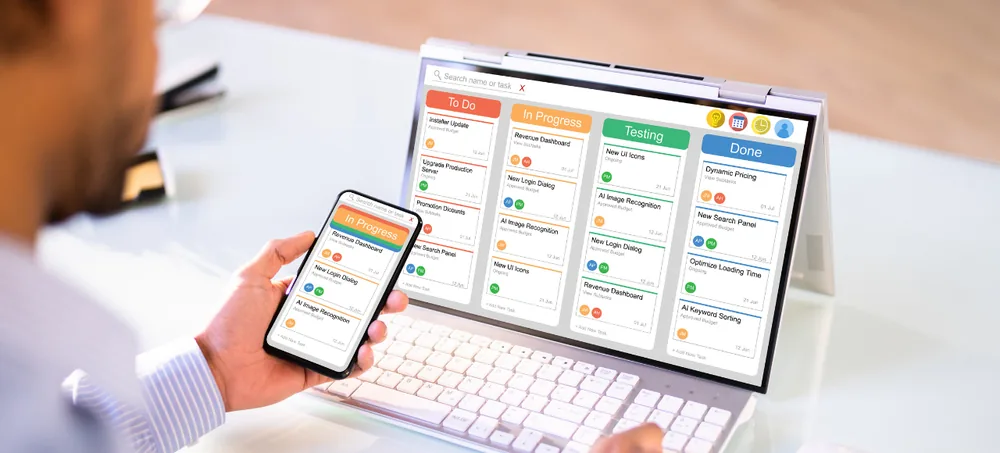
Businesses in Bangalore evaluating ERP software companies compare platforms on functionality, customization, implementation approach and scalability. ERPLax is a cloud ERP platform connecting sales, purchase, inventory, finance and reporting into one configurable SaaS workflow — backed by 19+ years of ERP experience.
Tell us about your business. We'll recommend the right ERPLax modules for your operations.
Businesses in Bangalore operate in a competitive environment where efficient processes, accurate information and faster decision-making are essential. Many face these challenges when operations are managed through disconnected systems or manual processes.
Sales, purchasing, finance, inventory and reporting run through disconnected systems, so teams spend extra time collecting data and coordinating activities.
Business leaders need accurate, current information to make informed decisions — difficult to get without integrated systems.
Approvals for purchases, expenses and sales activities managed through emails or manual communication slow decisions down.
Without real-time stock information, purchasing decisions, stock planning and order management all become harder to get right.
Manual transaction recording, reporting and business analysis increase operational effort for finance teams.
With many ERP software companies in Bangalore to evaluate, comparing functionality, customization and support can feel overwhelming.
ERPLax is a cloud ERP platform that helps organizations manage business operations through connected modules and configurable processes. Unlike traditional disconnected applications, ERPLax brings different business functions into one centralized environment — improving coordination between departments and creating consistent operational processes.
Businesses looking for ERP software providers in Bangalore can evaluate ERPLax based on their process requirements, operational goals and business growth plans — delivered entirely as cloud SaaS, with no on-premise installation and no source code handed over.
A connected feature set covering the functions Bangalore businesses use most when comparing ERP software companies.
Four connected workflow tracks — Sales, Purchase, Inventory and Finance — configurable to your operational sequence.
A unified platform where businesses manage multiple operations together instead of separate tools.
Business process automation reduces repetitive manual activities and creates structured workflows.
Integrated ERP processes improve communication between sales, purchase, inventory and finance teams.
Different businesses have different operational requirements — workflows adapt to your processes, not the other way round.
Centralized information helps management understand operational activities more effectively.
Connected modules mean less duplicate data entry across spreadsheets and disconnected systems.
Up-to-date, centralized data helps leadership respond to business conditions without waiting on manual reports.
Add users, branches and modules over time on a cloud platform with no infrastructure to manage.
ERPLax is configured for the way each industry actually operates, not a one-size-fits-all template.
Production-related processes, inventory management, purchasing and operational planning connected through structured workflows.
Efficient sales, purchasing, inventory and finance management for organized business operations.
Manage projects, customers, billing and internal operations through centralized processes.
Organized management of operational activities and information flow with improved process coordination.
Administrative operations, financial activities and reporting requirements through structured institutional workflows.
When comparing ERP software companies in Bangalore, here's where ERPLax fits the evaluation criteria that matter.
Designed for businesses seeking a SaaS ERP solution without traditional deployment complexity.
Every organization has unique processes — ERPLax supports configuration and development within the SaaS platform accordingly.
ERPLax connects business activities through integrated workflows, improving operational coordination.
EchoPx Technologies understands different business process requirements across sectors.
ERP systems support current operations while allowing businesses to adapt processes as requirements change.
Customization is handled as configuration and development work within the platform — no source code handed over.
Priced on a subscription basis around users and modules — never a one-time licence purchase.
Give employees access according to company, department and responsibility.
ERPLax works with organizations across Bangalore, Karnataka comparing ERP solutions near their business — offering cloud ERP solutions Bangalore companies can scale with, as a fully cloud-based, subscription-only platform.
Businesses should evaluate ERP functionality, industry requirements, workflow capabilities, customization options, implementation approach, and long-term usability before selecting an ERP provider.
Yes. ERPLax is a cloud ERP platform delivered as a SaaS ERP solution for businesses looking for centralized business management capabilities.
ERPLax supports configuration and development within the SaaS platform according to business requirements and operational workflows. No source code is handed over as part of this customization.
ERP implementation timelines depend on business requirements, process complexity, modules selected, and organizational readiness.
Yes. ERP solutions are designed to connect business processes such as sales, purchasing, inventory, finance, and reporting.
Yes. ERP software can support small businesses by helping them organize operations, improve process visibility, and manage business activities through centralized workflows.
Companies should compare ERP providers based on platform capabilities, business requirements, workflow flexibility, implementation support, and experience — rather than pricing alone.
No. ERPLax is delivered exclusively as a cloud-based SaaS subscription platform. On-premise or self-hosted deployment is not offered.
ERPLax is priced on a subscription basis rather than a one-time licence purchase. Pricing depends on users, modules and configuration, so a requirement-based quotation is recommended.
Integrations can be developed based on the required application and available method, which may include accounting software, GST tools, WhatsApp, SMS, email and other business systems.
Yes. ERPLax provides implementation guidance, user training and ongoing support as part of the SaaS relationship.
ERPLax serves manufacturing, trading and distribution, service-based organizations, healthcare and education institutions across Bangalore that need structured, connected business management software.
Businesses researching ERP software companies in Bangalore also search for ERP software in Bangalore, ERP in Bangalore, ERP companies in Bangalore, ERP solutions in Bangalore, ERP software providers in Bangalore, ERP implementation companies in Bangalore, Cloud ERP software companies in Bangalore and ERP software development companies in Bangalore. ERPLax also fits searches for the Best ERP software company in Bangalore, Top ERP software companies in Bangalore, ERP software solutions for small businesses in Bangalore, Enterprise ERP solutions Bangalore, Custom ERP solutions Bangalore, ERP implementation and consulting companies in Bangalore and Affordable ERP software in Bangalore. As a Cloud ERP platform and SaaS ERP solution, ERPLax supports business process automation, centralized business management, configurable ERP workflows, integrated business processes, inventory management software, finance automation, sales process management, purchase workflow automation and an ERP reporting system — for ERP software Bangalore searches, ERP companies Bangalore Karnataka, Cloud ERP solutions Bangalore and anyone comparing ERP solutions near Bangalore businesses.
Choosing the right ERP software company in Bangalore helps businesses build stronger processes, improve operational visibility, and manage business activities through an integrated platform. Connect with EchoPx Technologies to explore how ERPLax can support your business with a flexible SaaS ERP solution.
Specialized Applications
Purpose-built & ready to deploy. Hover to explore, click to learn more.
Testimonials
Real stories from businesses running their operations on ERPLax.
ERPLax gave us real-time visibility into stock across three warehouses. Wastage dropped and our fulfillment time improved almost overnight.
GST e-invoicing used to eat up two days every month. With ERPLax's accounting module it's now automatic and our filings are always on time.
Billing at our stores used to take a minute per customer. ERPLax's POS module cut that to under 15 seconds, even during peak festival rush.
Payroll for 200+ employees across two branches used to take our HR team a full week. ERPLax's HRM module now runs it in a single afternoon.
Tracking batch numbers and expiry across our distribution network was a nightmare on spreadsheets. ERPLax's inventory module made it effortless.
Front desk, housekeeping and billing are now all on one screen. ERPLax's hotel management module has made check-in day a breeze for our staff.
Fee collection, attendance and report cards used to live in three different tools. ERPLax brought it all into one dashboard our staff actually enjoys using.
Tracking material costs and site progress across four active sites was chaos before ERPLax. Now our project managers update status from their phones daily.
Our online store orders now sync straight into inventory and accounting — no more manual entry, no more overselling out-of-stock items.
Our sales team can now see every lead's history and follow-ups in one place. Deal closures are faster and nothing falls through the cracks anymore.
ERPLax gave us real-time visibility into stock across three warehouses. Wastage dropped and our fulfillment time improved almost overnight.
GST e-invoicing used to eat up two days every month. With ERPLax's accounting module it's now automatic and our filings are always on time.
Billing at our stores used to take a minute per customer. ERPLax's POS module cut that to under 15 seconds, even during peak festival rush.
Payroll for 200+ employees across two branches used to take our HR team a full week. ERPLax's HRM module now runs it in a single afternoon.
Front desk, housekeeping and billing are now all on one screen. ERPLax's hotel management module has made check-in day a breeze for our staff.
Fee collection, attendance and report cards used to live in three different tools. ERPLax brought it all into one dashboard our staff actually enjoys using.
Tracking material costs and site progress across four active sites was chaos before ERPLax. Now our project managers update status from their phones daily.
Our online store orders now sync straight into inventory and accounting — no more manual entry, no more overselling out-of-stock items.
Our sales team can now see every lead's history and follow-ups in one place. Deal closures are faster and nothing falls through the cracks anymore.