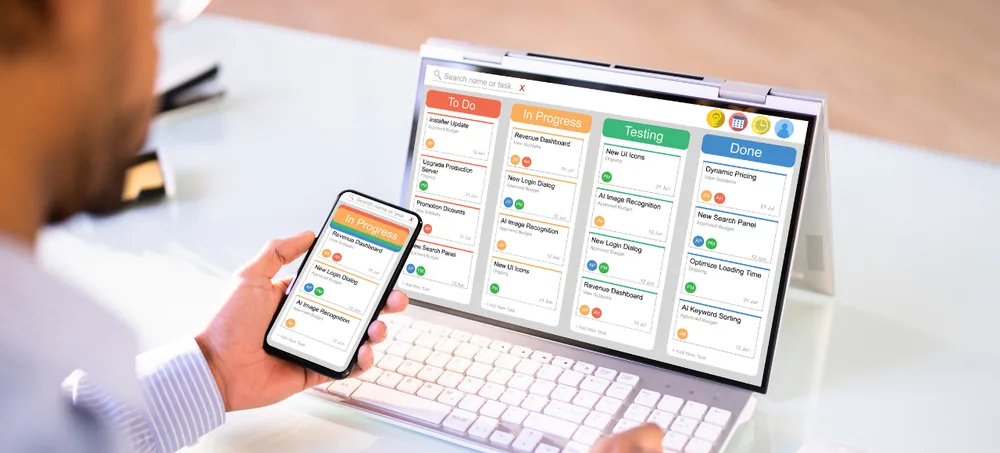
Connect finance, sales, purchasing, inventory, warehouses, manufacturing, CRM, projects, HR and reporting through one flexible business management platform.
ERPLax provides customizable ERP software in Saudi Arabia for small, medium-sized and growing businesses, configured around your workflow, branches, warehouses and reporting requirements.
Tell us about your business and our ERP experts will get in touch.
Growing businesses often use separate systems for accounting, inventory, customer management, purchasing, employee administration and reporting. ERPLax combines these functions through one customizable ERP system in Saudi Arabia, so sales, purchase, inventory and billing activity move through connected workflows instead of separate spreadsheets.
The same information is typed into multiple disconnected systems.
Manual handoffs between sales, stock and billing slow every order.
Spreadsheets fall out of sync with actual warehouse quantities.
Manual invoicing increases the risk of pricing and tax errors.
Purchases and expenses wait on email threads and paper sign-offs.
Management waits days for consolidated sales and stock reports.
Enterprise Resource Planning software is a centralized system used to manage and connect the core activities of a business, including finance, sales, purchasing, inventory, manufacturing, HR and reporting. Instead of each department maintaining separate data, ERP software in Saudi Arabia connects transactions through one shared platform so an approved sales order can reserve stock, trigger a purchase requirement, generate an invoice and update financial reports automatically.
ERP software in Saudi Arabia is a business management system configured for companies operating in the Kingdom. In addition to standard ERP modules, an ERP system in Saudi Arabia may need to consider Saudi Riyal transactions, VAT-related fields, ZATCA e-invoicing workflows, Arabic and English data, multiple branches and local business reporting. Whether a business is searching for ERP KSA, ERP in KSA or Saudi ERP solutions, the required configuration differs according to the company's business model, sector, tax obligations and applicable regulatory requirements.
Many businesses comparing ERP Saudi Arabia providers are replacing spreadsheets, migrating from disconnected applications, or reviewing cloud and Cloud options as they plan for growth.
Connect departmental data so teams stop maintaining separate records.
Replace fragile spreadsheets with structured data, roles and workflows.
Track available, reserved, incoming, batch and near-expiry stock.
Convert quotations into orders, deliveries and invoices without re-entry.
Review stock, reorder levels, supplier prices and lead times before buying.
Track balances, payment terms, credit limits and overdue invoices.
Monitor quotations, orders, receipts, invoices and outstanding balances.
Route purchases, discounts, expenses and payments through approval levels.
Control transactions across branches and warehouses centrally.
Review sales, stock, expenses and branch performance from connected data.
Begin with essential modules and add capability as your business grows.
Chart of accounts, journal entries, ledgers, cost centres and financial dashboards alongside operational transactions. Final accounting structure and statutory treatment should be reviewed by your qualified finance and tax professionals.
Enquiries, quotations, sales orders, price lists, delivery scheduling and branch-wise sales analysis.
Lead capture, opportunities, sales pipeline, follow-up reminders and conversion reports for Saudi sales teams.
English and Arabic customer names, VAT information, credit limits, price lists and full transaction history.
Requisitions, approval workflows, RFQs, purchase orders, goods receipt and supplier analysis.
Centralized supplier records, price agreements, purchase history, outstanding balances and performance.
Product master, opening stock, stock transfer, reorder levels, stock valuation and ageing reports.
Multiple warehouses, zones, racks, bins, put-away, picking, packing and dispatch across locations.
Batch and lot numbers, manufacturing and expiry dates, near-expiry alerts and recall support.
Serial registration, warranty periods, returns, replacements and service history for individual products.
Barcode generation, label printing, goods-receipt scanning, picking verification and POS billing.
Tax invoices, simplified invoices, bilingual formats, VAT fields and QR codes where applicable.
Customer invoices, receipts, payment allocation, ageing reports and overdue alerts.
Supplier invoices, due-date tracking, payment approvals and purchase-order matching.
Cash and bank receipts, payments, account transfers and reconciliation support.
BOM, MRP, production planning, work centres, work-in-progress and production costing.
Project budgets, milestones, timesheets, project purchases and project profitability.
Employee master, attendance, leave, shifts and payroll-related processing. Final payroll setup should be reviewed against current Saudi labour and wage-protection requirements by qualified advisers.
Asset registration, department and location assignment, depreciation and disposal.
Barcode billing, cash and card payments, customer loyalty, cashier controls and branch inventory.
Saudi Arabia's e-invoicing framework is administered by the Zakat, Tax and Customs Authority (ZATCA), covering a generation phase and an integration phase, with applicable taxpayers brought into the integration phase through notified waves.
Depending on your applicable requirements, an ERPLax implementation can evaluate support for the following configuration areas:
ERPLax should not be presented as automatically or universally "ZATCA compliant" without validating the exact implementation, software configuration, taxpayer obligations and current ZATCA specifications. The final invoicing workflow should be tested with your finance team, tax adviser and the applicable regulatory process.
BOM, MRP, production planning, WIP, quality and shop-floor control.
Quotations, sales, purchasing, imports, landed cost and supplier balances.
Warehouses, inventory allocation, picking, dispatch and delivery routes.
Estimates, BOQ, budgets, site inventory, subcontractors and progress billing.
Property inventory, enquiries, bookings, leasing and broker commissions.
POS, inventory, procurement, promotions and customer loyalty across branches.
Product, order, customer, payment and delivery synchronization with your storefront.
Purchasing, pharmacy stock, batch tracking, billing and financial administration.
Customer contracts, shipments, vehicles, routes and delivery status.
Ingredients, recipes, batches, expiry dates and distribution operations.
Spare-parts inventory, workshops, service requests and customer history.
Leads, projects, timesheets, expenses and project profitability.
Availability, bookings, rental contracts, dispatch, return and billing.
Manage core departments from one connected business system.
Reduce repeated entries and inconsistent records between departments.
Monitor current sales, purchases, stock, finance and operations.
Connect quotations, orders, inventory, delivery and invoices.
Track product movement across branches, warehouses and batches.
Use demand, stock and supplier data to make informed decisions.
Monitor receivables, payables, expenses, margins and cash position.
Route transactions to the right manager without email or paper.
Give authorized users access to order and payment history.
Review location-level activity and consolidated performance.
Generate reports directly from connected transaction data.
Add modules, users, branches and integrations over time.
Set up companies, branches, warehouses, users, products, customers and approval rules.
Enter customer enquiries, sales requirements, purchase requests or production demand.
Generate quotations, requisitions or budgets and route them through approval.
Convert approved quotations or requests into sales, purchase or production orders.
Review inventory, materials, capacity, employees or supplier availability.
Perform purchasing, warehouse, manufacturing, project or service activities.
Create picking lists, packing records, deliveries or completion documents.
Prepare the required invoice from the approved transaction.
Track customer collections, supplier payments and outstanding balances.
Monitor operational, financial and management dashboards.
Final cloud architecture should consider security, backups, data policies and business continuity.
ERPLax can discuss cloud and Cloud options based on your operational and technical requirements.
Head-office operations, multiple branches, sales, finance and consolidated reporting for Riyadh businesses. Companies comparing ERP software companies in Riyadh should evaluate workflow fit, integrations and long-term support, not only the feature list.
Trading, distribution, warehousing, retail, imports, construction and service operations for companies based in Jeddah.
Manufacturing, industrial supply, projects, maintenance, distribution and warehouse operations across the Eastern Province.
The best ERP system in Saudi Arabia is the one that fits your organisation's workflow, industry, size and growth plans.
ERPLax does not claim to be the single best ERP provider in Saudi Arabia for every business. The right system depends on your workflow, localization needs, integrations and long-term support requirements — the criteria above are offered to help you evaluate any ERP provider, including ERPLax.
ERPLax configures the system around the way your organisation actually operates.
Additional workflows, screens, reports and integrations built to your agreed scope.
Begin with priority modules and add more capability phase by phase.
Supports small, medium-sized and expanding Saudi organisations alike.
Choose the deployment model that suits your infrastructure and policies.
Adapted for manufacturing, trading, construction, retail and services.
Control multiple entities, locations, warehouses and departments.
Protect business information with user-specific permissions.
Automate approvals, assignments, alerts and transaction stages.
Implementation guidance, user training and support per project scope.
ERP software is an integrated business system used to manage finance, sales, purchasing, inventory, manufacturing, projects, HR and reporting from one connected platform.
It is ERP software configured for businesses operating in Saudi Arabia, including relevant business, tax, invoicing, language, currency and reporting requirements specific to the Kingdom.
The best system is the one that matches your workflow, industry, users, integrations, localization needs and growth plan. ERPLax provides customizable ERP software based on these requirements rather than a one-size-fits-all package.
Modules can include finance, sales, CRM, purchasing, inventory, warehouses, manufacturing, projects, billing, POS, HRM, assets, approvals and reports, added according to your business needs.
Yes. Small businesses can begin with essential modules such as sales, purchasing, inventory and billing, then add further capabilities as operations expand.
Yes. Multi-company and multi-branch functionality can be configured according to the required structure, with consolidated reporting across locations.
Arabic, English and selected bilingual data or documents can be evaluated during requirement analysis to match your operating and reporting needs.
VAT-related invoice fields and calculations can be configured based on the agreed requirements and professional tax advice from your finance and tax team.
ERPLax can evaluate ZATCA-related invoice and integration requirements. The exact solution must be configured and tested according to the customer's applicable ZATCA obligations; ERPLax cannot be presented as automatically or universally compliant.
Yes. Cloud-based deployment can be provided for access across branches and locations. Cloud deployment can also be considered depending on your infrastructure needs.
Yes. Manufacturing modules can include BOM, MRP, production planning, production orders, work-in-progress, quality control and production costing.
Yes. Construction workflows can include estimates, BOQ, purchases, site inventory, subcontractors and billing, while trading businesses can manage quotations, purchasing, imports and customer credit.
Yes. Supported ecommerce integrations can exchange products, inventory, orders and delivery information, and an approved WhatsApp API provider can be evaluated for quotations, confirmations and reminders.
The cost depends on modules, users, customization, integrations, data migration, deployment model, training and support required for your business.
Yes. ERPLax can provide project-based ERP implementation for businesses in Riyadh and other Saudi locations under the agreed delivery model.
Connect sales, finance, purchasing, inventory, manufacturing, projects, CRM, HR and reporting through one flexible ERP system. Discuss your current workflow, operational challenges and integration requirements with ERPLax.
ZATCA-related invoicing support is evaluated and configured per customer; ERPLax does not claim automatic or universal ZATCA compliance.
Specialized Applications
Purpose-built & ready to deploy. Hover to explore, click to learn more.
Testimonials
Real stories from businesses running their operations on ERPLax.
ERPLax gave us real-time visibility into stock across three warehouses. Wastage dropped and our fulfillment time improved almost overnight.
GST e-invoicing used to eat up two days every month. With ERPLax's accounting module it's now automatic and our filings are always on time.
Billing at our stores used to take a minute per customer. ERPLax's POS module cut that to under 15 seconds, even during peak festival rush.
Payroll for 200+ employees across two branches used to take our HR team a full week. ERPLax's HRM module now runs it in a single afternoon.
Tracking batch numbers and expiry across our distribution network was a nightmare on spreadsheets. ERPLax's inventory module made it effortless.
Front desk, housekeeping and billing are now all on one screen. ERPLax's hotel management module has made check-in day a breeze for our staff.
Fee collection, attendance and report cards used to live in three different tools. ERPLax brought it all into one dashboard our staff actually enjoys using.
Tracking material costs and site progress across four active sites was chaos before ERPLax. Now our project managers update status from their phones daily.
Our online store orders now sync straight into inventory and accounting — no more manual entry, no more overselling out-of-stock items.
Our sales team can now see every lead's history and follow-ups in one place. Deal closures are faster and nothing falls through the cracks anymore.
ERPLax gave us real-time visibility into stock across three warehouses. Wastage dropped and our fulfillment time improved almost overnight.
GST e-invoicing used to eat up two days every month. With ERPLax's accounting module it's now automatic and our filings are always on time.
Billing at our stores used to take a minute per customer. ERPLax's POS module cut that to under 15 seconds, even during peak festival rush.
Payroll for 200+ employees across two branches used to take our HR team a full week. ERPLax's HRM module now runs it in a single afternoon.
Front desk, housekeeping and billing are now all on one screen. ERPLax's hotel management module has made check-in day a breeze for our staff.
Fee collection, attendance and report cards used to live in three different tools. ERPLax brought it all into one dashboard our staff actually enjoys using.
Tracking material costs and site progress across four active sites was chaos before ERPLax. Now our project managers update status from their phones daily.
Our online store orders now sync straight into inventory and accounting — no more manual entry, no more overselling out-of-stock items.
Our sales team can now see every lead's history and follow-ups in one place. Deal closures are faster and nothing falls through the cracks anymore.