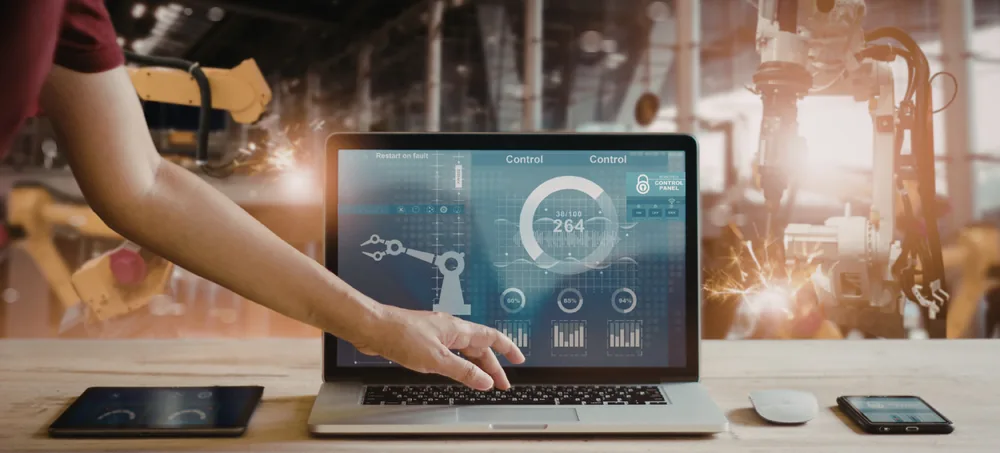
Custom ERP solutions designed around your business workflow
ERPLax provides flexible ERP software UAE businesses can customise to manage their complete operations through one connected platform. As an established ERP company UAE businesses turn to for ERP implementation UAE from planning through go-live, we help organisations integrate finance, inventory, sales, purchasing, CRM, manufacturing, HR, reporting and workflow automation into a unified business management software UAE system.
Tell us about your business — we'll get back within 24 hours
Businesses across the UAE operate in highly competitive industries where efficiency, automation and accurate information are essential. Many companies still depend on spreadsheets and multiple disconnected systems to manage different departments. Whether you're comparing ERP providers UAE and ERP solutions UAE broadly, or looking specifically for ERP solutions Dubai and ERP consultants UAE who understand local business requirements, the goal is the same: one connected system instead of several disconnected ones.
The same information gets re-typed across disconnected spreadsheets and tools.
Stock counts drift out of sync without one connected source of truth.
Manual consolidation slows down month-end and management reporting.
Purchase and expense approvals get stuck in email chains and paper forms.
Sales, finance and warehouse teams work from different, disconnected records.
Owners lack a single real-time view of sales, stock and cash position.
ERP (Enterprise Resource Planning) software is an integrated business management system that connects multiple departments through one central platform. Instead of managing separate software for finance, inventory, sales and operations, this enterprise resource planning software UAE businesses adopt allows companies to manage their activities through connected modules — a complete ERP system UAE teams can build their operations around.
From efficiency to real-time visibility, ERP software changes how UAE businesses run day to day.
A connected set of modules covering every department in your business.
General ledger, accounts payable/receivable, invoicing and financial statements.
Product management, warehouse tracking, barcode and batch tracking, reorder alerts.
Quotations, sales orders, pricing, customer history and sales reports.
Supplier management, purchase orders, approval workflows and purchase reports.
Lead management, customer database, opportunity and pipeline tracking.
Production planning, bill of materials, work orders and production tracking.
Employee records, attendance, leave tracking and payroll processing.
Warehouse locations, stock movement, picking, packing and dispatch.
Sales, financial, inventory and employee reports with management dashboards.
Approval workflows, automated notifications, task assignments and reminders.
As an ERP development company UAE businesses can rely on, ERPLax delivers a genuine custom ERP software for UAE businesses option — whether you need accounting ERP software UAE, inventory ERP software UAE, or full CRM ERP integration UAE in one connected system, alongside dedicated ERP implementation services UAE from planning through go-live.
ERPLax ERP software UAE can be customised for how each industry actually operates.
An eight-step process from requirement analysis through to continuous improvement.
Processes & objectives
Modules & integrations
Rules, roles & reports
Existing business data
Connect existing systems
Workflows & feedback
Launch, training & support
New modules as needs change
A connected platform that improves visibility, accuracy and decision-making across the business.
Manage different departments through one integrated platform.
Access accurate business information anytime.
Automation improves productivity and reduces repetitive tasks.
Connected systems reduce duplicate entries and errors.
Real-time reports help managers make informed decisions.
Track stock movement and availability efficiently.
Connect CRM, sales and customer information.
Add modules and users as your business expands.
ERPLax ERP software UAE solutions can integrate with the systems your business already runs on.
ERPLax provides cloud based ERP software UAE teams can access from anywhere, alongside Cloud options for businesses that need internal infrastructure control.
Access business information from different locations.
For businesses requiring internal infrastructure control.
Custom ERP development, built around your business workflow — not a fixed template. Many businesses searching for ERP software Dubai or a complete ERP system in UAE want more than what generic "best ERP software UAE" listings surface: a genuine ERP software for small business UAE starting point, ERP solutions for growing companies UAE that scale, and dedicated manufacturing ERP software UAE capability where production is involved.
Built to match your workflow
Manufacturing, trading, retail & more
Start small, expand gradually
Connect with existing applications
Built for your management needs
Choose your deployment approach
Implementation guidance & ongoing help
Support across the Emirates
Common questions from UAE businesses evaluating ERP software.
Improve efficiency, automate operations and manage your complete business through a flexible ERP solution designed for your organisation. ERPLax helps UAE businesses implement scalable ERP systems with customised modules, automation and integrations.
Specialized Applications
Purpose-built & ready to deploy. Hover to explore, click to learn more.
Testimonials
Real stories from businesses running their operations on ERPLax.
ERPLax gave us real-time visibility into stock across three warehouses. Wastage dropped and our fulfillment time improved almost overnight.
GST e-invoicing used to eat up two days every month. With ERPLax's accounting module it's now automatic and our filings are always on time.
Billing at our stores used to take a minute per customer. ERPLax's POS module cut that to under 15 seconds, even during peak festival rush.
Payroll for 200+ employees across two branches used to take our HR team a full week. ERPLax's HRM module now runs it in a single afternoon.
Tracking batch numbers and expiry across our distribution network was a nightmare on spreadsheets. ERPLax's inventory module made it effortless.
Front desk, housekeeping and billing are now all on one screen. ERPLax's hotel management module has made check-in day a breeze for our staff.
Fee collection, attendance and report cards used to live in three different tools. ERPLax brought it all into one dashboard our staff actually enjoys using.
Tracking material costs and site progress across four active sites was chaos before ERPLax. Now our project managers update status from their phones daily.
Our online store orders now sync straight into inventory and accounting — no more manual entry, no more overselling out-of-stock items.
Our sales team can now see every lead's history and follow-ups in one place. Deal closures are faster and nothing falls through the cracks anymore.
ERPLax gave us real-time visibility into stock across three warehouses. Wastage dropped and our fulfillment time improved almost overnight.
GST e-invoicing used to eat up two days every month. With ERPLax's accounting module it's now automatic and our filings are always on time.
Billing at our stores used to take a minute per customer. ERPLax's POS module cut that to under 15 seconds, even during peak festival rush.
Payroll for 200+ employees across two branches used to take our HR team a full week. ERPLax's HRM module now runs it in a single afternoon.
Front desk, housekeeping and billing are now all on one screen. ERPLax's hotel management module has made check-in day a breeze for our staff.
Fee collection, attendance and report cards used to live in three different tools. ERPLax brought it all into one dashboard our staff actually enjoys using.
Tracking material costs and site progress across four active sites was chaos before ERPLax. Now our project managers update status from their phones daily.
Our online store orders now sync straight into inventory and accounting — no more manual entry, no more overselling out-of-stock items.
Our sales team can now see every lead's history and follow-ups in one place. Deal closures are faster and nothing falls through the cracks anymore.