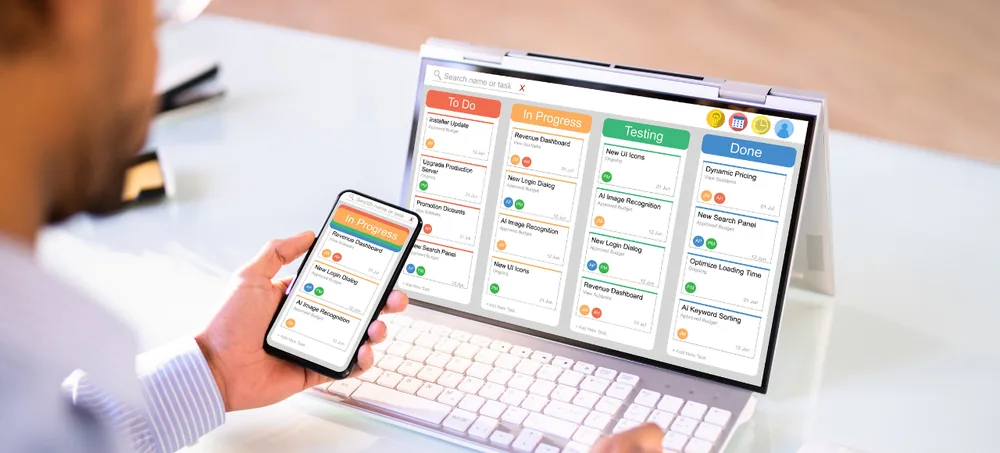
Businesses need connected systems that help teams manage operations, improve collaboration and make informed decisions. ERPLax provides ERP system implementation in Bangalore on a configurable cloud ERP platform built around your actual business processes.
Tell us how your departments work today and we will map it to a realistic implementation scope.
ERPLax is built and delivered by EchoPx Technologies, a Bengaluru business technology team.
From ERP planning and configuration through to workflow setup and integration, ERPLax helps organizations adopt a structured SaaS ERP solution aligned with their operational requirements. The platform is one part of it; the implementation approach decides whether the platform gets used.
ERPLax helps businesses implement a cloud ERP platform that connects important business functions through structured workflows and centralized information management. The ERP implementation process focuses on understanding business requirements, configuring suitable workflows and creating a system that supports daily operations rather than sitting beside them.
As a cloud ERP implementation solution, ERPLax supports organizations looking for a flexible SaaS ERP approach without traditional software deployment methods. Businesses comparing ERP implementation companies in Bangalore should confirm early who performs configuration, who prepares data and who handles change requests after go-live, because those answers vary far more than feature lists do.
Enterprise resource planning system implementation is ultimately a change project with a software component. The technical configuration is rarely the hard part. Getting departments to record work in one place, agreeing what a number means across teams and keeping scope tight enough to actually finish the first phase is where projects are won or lost.
Growing organizations run into the same operational difficulties when processes are managed through disconnected systems, spreadsheets or manual workflows.
When finance, sales, inventory, procurement and operations work separately, businesses experience delays, duplicated information and communication gaps that nobody owns.
Manual approvals, repetitive data entry and disconnected reporting increase operational effort and make process tracking difficult even for the people running it.
Without a centralized ERP system, management teams struggle to access accurate information across departments when a decision actually needs making.
Maintaining information across multiple systems creates duplicate records and steadily reduces confidence in the business data itself.
Structured reporting is needed to analyze operations, monitor workflows and support planning, but assembling it manually eats days every cycle.
Some organizations arrive having already tried once. Scope grew faster than adoption, ownership was unclear, and the system never became the place work happens.
ERP software implementation Bangalore businesses can complete is built on scope discipline, not on switching every module on at once.
ERPLax connects finance, sales, inventory, procurement and reporting through structured workflows and centralized information management. Requirements are established first, configuration follows, and each department comes onto the platform in a sequence the team can absorb.
Because delivery is cloud-only SaaS, there is no server sizing exercise, no on-premise installation and no perpetual or one-time licence to negotiate before work can start. Configuration begins immediately rather than after a hardware procurement cycle.
ERP customization and integration services are handled inside the platform. ERPLax performs configuration and development within the SaaS ERP environment according to business requirements, which does not include source code ownership or handover.
The ERP deployment process changes considerably when the platform is delivered as SaaS rather than installed. Most of what used to sit before kickoff simply disappears.
Nothing to specify, procure or commission before configuration can begin.
Requirement analysis moves straight into configuration instead of waiting on hardware.
Platform improvements apply without a separate upgrade project each cycle.
Backup runs as part of platform operations rather than an internal checklist.
Add users, branches and modules as each phase goes live, without re-platforming.
ERPLax is cloud-only. The platform is provided strictly as a SaaS subscription, so there is no on-premise installation, no locally installed build, no self-hosted deployment and no perpetual or one-time licence purchase. That is worth confirming early when comparing an ERP implementation company against a licence reseller, because it changes both the project plan and what a quotation covers.
Business process automation is where most of the day-to-day return appears after go-live. Approvals that travelled by phone call move onto a defined route with a visible queue, documents generate from the transaction rather than a template someone fills in, and the follow-up chasing that quietly consumes senior time largely disappears. That shift is the point of the project, not a side effect of it.
Organizations evaluating ERP software in Bangalore alongside implementation support should treat the two as one decision. A capable platform with a weak rollout produces a system nobody uses, and strong ERP solutions Bangalore teams can actually adopt usually come from the same party handling both.
What an ERP implementation actually delivers, area by area.
Every organization follows unique workflows. ERPLax supports ERP configuration based on business requirements, so approvals, transactions, reporting and departmental coordination follow your operating model.
Implementation connects accounting activity with the operational processes that generate it, improving financial data organization, transaction tracking and reporting workflows.
A connected ERP system helps sales teams manage customer processes, quotations, orders and internal coordination through structured workflows rather than personal spreadsheets.
ERP software implementation improves inventory visibility by connecting operational activity with centralized information, so stock answers do not require a physical count.
Purchase processes, approval flows and supplier-related activity are configured to create consistent operational procedures with a visible pending queue.
A centralized ERP platform organizes operational data and produces meaningful reports for business planning, built on records already captured at source.
ERPLax supports ERP integration requirements to connect business processes and improve workflow continuity between systems, scoped during requirement analysis.
Configuration and development within the SaaS ERP platform according to business requirements, helping organizations adapt workflows while staying on a cloud ERP solution.
A structured approach that moves a business from disconnected processes to organized digital workflows, one phase at a time.
Implementation begins with understanding current operations, business objectives and workflow requirements. No configuration starts before this is documented, because a demo cannot tell you where your process actually breaks.
The platform is configured against the workflows identified in analysis. This is where the system starts to resemble how your organization already works rather than a generic template.
Departments are connected through integrated ERP workflows so teams collaborate through one centralized system. A sales order consumes stock, triggers procurement where needed and reaches finance without anyone re-keying the detail.
Before operational use, workflows and configurations are reviewed against business requirements using real transactions rather than sample data. This is where gaps surface cheaply instead of expensively.
Teams are guided on using ERP workflows effectively so the system becomes the place work happens. Adoption should not depend on a single internal champion, which is why training covers each role rather than one power user.
What changes in the ordinary week once departments record work in one place.
Repetitive manual activity is reduced by organizing workflows through structured digital processes.
A centralized ERP system gives access to relevant operational information across departments.
ERP workflows standardize how approvals, transactions and operational activities are handled.
Connected processes let teams work from shared information with better coordination.
Organized reporting and operational data help management evaluate business activity more effectively.
A configurable cloud ERP platform lets businesses adapt workflows as operational needs change.
Timelines depend on the modules in scope, workflow complexity, data preparation, integrations and how quickly users adopt the new process. A focused first phase covering the highest-volume processes generally reaches live usage sooner and builds internal confidence for the next one, which is why ERP implementation consultants in Bangalore usually push back on all-at-once rollouts.
Data preparation is the stage most often underestimated. Item masters, customer records and opening balances carried across without cleaning become the reason people stop trusting the system in month two. Agreeing early who owns that cleanup, and when it happens, removes most of the friction later.
The modules overlap across sectors. The workflows, approvals and reports rarely do, which is why configuration matters more than a fixed template.
ERP systems connecting production processes, inventory management, procurement and operational planning.
Managing sales processes, inventory movement, purchasing activity and reporting on one platform.
Business operations, inventory information, sales workflows and consolidated reporting requirements.
Workflows supporting project activity, customer management, finance processes and internal coordination.
Centralized systems for increasing workflow complexity and expanding departmental requirements.
What an ERP implementation partner should be able to state plainly before you commit.
A subscription-based cloud ERP solution with centralized management, and no on-premise, self-hosted or one-time licence option.
Implementation aligns workflows with actual business requirements rather than applying generic processes to every client.
Operational functions connect through structured ERP workflows on shared records instead of separate silos.
Configuration and development within the SaaS ERP platform to support specific operational requirements.
Requirement discussions, configuration, testing and support handled locally in Karnataka, India.
19+ years of experience, 1500+ clients and 1700+ projects behind EchoPx Technologies.
Shortlists for ERP consulting services Bangalore businesses run usually mix three kinds of vendor. Some are resellers who pass implementation to a third party. Some are project shops that build something bespoke and hand it over. Others are product teams offering the platform, the configuration and ongoing support as one relationship. Knowing which one you are speaking to changes what a quotation actually covers.
ERPLax sits in the third group. EchoPx Technologies runs the requirement discussion, configures the platform, prepares the data and supports the rollout, so consulting and implementation sit inside the same engagement rather than being bought separately.
ERP system implementation is the process of configuring and deploying an ERP platform according to business workflows, operational requirements and reporting needs. It covers requirement analysis, configuration, process integration, testing and user adoption.
Businesses in Bangalore adopt ERP implementation to improve process management, connect departments, reduce manual operations and create better operational visibility across finance, sales, inventory and procurement.
Yes. ERPLax is a cloud-only SaaS ERP platform designed for centralized business management and configurable workflows. There is no on-premise installation, locally installed version or self-hosted deployment.
Yes. ERPLax provides configuration and development within its SaaS ERP platform according to business requirements. That work is performed inside the platform by the ERPLax team and does not include source code ownership or handover.
ERP implementation timelines depend on business requirements, workflow complexity, configuration needs, integrations and implementation scope. A focused first phase generally reaches live usage sooner than a full multi-department rollout.
ERP implementation can include integration requirements to connect business processes and improve workflow continuity between systems. Integration scope is agreed during requirement analysis rather than assumed.
Manufacturing, trading, retail, service and growing businesses can consider ERP implementation based on their operational needs, particularly once spreadsheets and disconnected applications stop keeping up with transaction volume.
Businesses should evaluate ERP capabilities, implementation approach, customization options, workflow understanding and long-term support requirements, including who performs configuration changes after go-live.
The stages are business requirement analysis, ERP configuration, process integration across departments, testing and process review, then user adoption and support. Each stage has an owner agreed between the business and the implementation team.
No. ERPLax is delivered exclusively as a cloud SaaS subscription. There is no on-premise installation, no perpetual or one-time licence purchase and no self-hosted deployment option.
Cost depends on the modules in scope, user count, workflow complexity, integrations, data preparation effort and training requirements. ERPLax is offered on a SaaS subscription basis, so commercials are discussed against the agreed implementation scope.
Most stalled rollouts come from scope growing faster than user adoption, unclear ownership between the business and the implementation team, or data that was never cleaned before migration. A focused first phase with agreed ownership reduces those risks.
Transform disconnected business processes into structured workflows on a configurable cloud ERP platform. ERPLax helps businesses in Bangalore implement ERP solutions designed around operational requirements, process improvement and centralized business management.
ERPLax by EchoPx Technologies, Bengaluru, Karnataka, India. Email info@erplax.in
Specialized Applications
Purpose-built & ready to deploy. Hover to explore, click to learn more.
Testimonials
Real stories from businesses running their operations on ERPLax.
ERPLax gave us real-time visibility into stock across three warehouses. Wastage dropped and our fulfillment time improved almost overnight.
GST e-invoicing used to eat up two days every month. With ERPLax's accounting module it's now automatic and our filings are always on time.
Billing at our stores used to take a minute per customer. ERPLax's POS module cut that to under 15 seconds, even during peak festival rush.
Payroll for 200+ employees across two branches used to take our HR team a full week. ERPLax's HRM module now runs it in a single afternoon.
Tracking batch numbers and expiry across our distribution network was a nightmare on spreadsheets. ERPLax's inventory module made it effortless.
Front desk, housekeeping and billing are now all on one screen. ERPLax's hotel management module has made check-in day a breeze for our staff.
Fee collection, attendance and report cards used to live in three different tools. ERPLax brought it all into one dashboard our staff actually enjoys using.
Tracking material costs and site progress across four active sites was chaos before ERPLax. Now our project managers update status from their phones daily.
Our online store orders now sync straight into inventory and accounting — no more manual entry, no more overselling out-of-stock items.
Our sales team can now see every lead's history and follow-ups in one place. Deal closures are faster and nothing falls through the cracks anymore.
ERPLax gave us real-time visibility into stock across three warehouses. Wastage dropped and our fulfillment time improved almost overnight.
GST e-invoicing used to eat up two days every month. With ERPLax's accounting module it's now automatic and our filings are always on time.
Billing at our stores used to take a minute per customer. ERPLax's POS module cut that to under 15 seconds, even during peak festival rush.
Payroll for 200+ employees across two branches used to take our HR team a full week. ERPLax's HRM module now runs it in a single afternoon.
Front desk, housekeeping and billing are now all on one screen. ERPLax's hotel management module has made check-in day a breeze for our staff.
Fee collection, attendance and report cards used to live in three different tools. ERPLax brought it all into one dashboard our staff actually enjoys using.
Tracking material costs and site progress across four active sites was chaos before ERPLax. Now our project managers update status from their phones daily.
Our online store orders now sync straight into inventory and accounting — no more manual entry, no more overselling out-of-stock items.
Our sales team can now see every lead's history and follow-ups in one place. Deal closures are faster and nothing falls through the cracks anymore.