
Manual Book Registers
Many libraries still record accession numbers, book details and circulation entries in physical registers — locating a specific title or borrower history can become time-consuming as the collection grows.
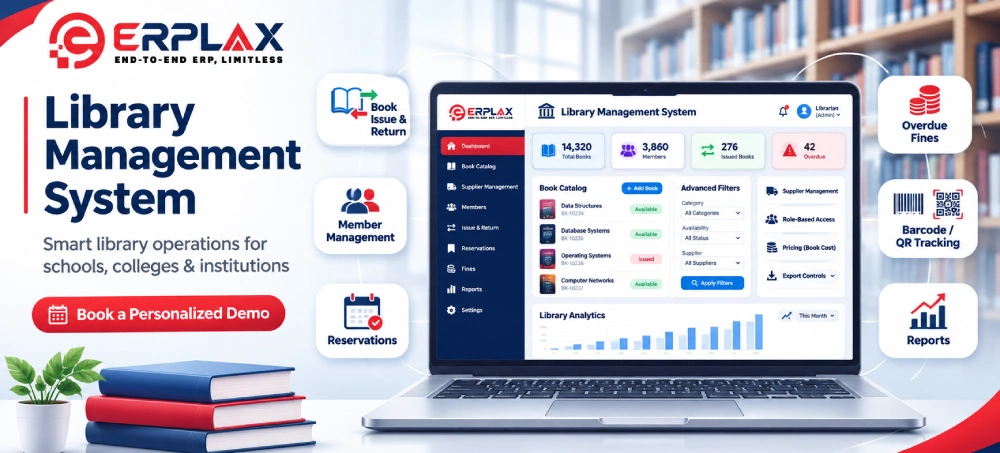
Organize book cataloging, circulation, membership, acquisitions and fine administration with ERPLax. ERPLax is a cloud ERP platform developed by EchoPx Technologies to help schools, colleges, universities and other institutions manage library collections, member records, reservations, overdue tracking and vendor procurement through integrated workflows, with specialized library-automation capabilities verified against the proposed configuration.
ERPLax is developed by EchoPx Technologies, bringing business software experience to institutions evaluating cloud library management systems. Libraries should consider this background alongside demonstrated product functionality, implementation scope, integrations and subscription terms.
Looking for a reliable library management system to organize book cataloging, circulation, membership records, reservations, overdue tracking, acquisitions and finance through a centralized platform? ERPLax is a cloud ERP platform developed by EchoPx Technologies to help schools, colleges, universities and other institutions manage important library processes through integrated workflows.
A library involves coordinating book collections, member categories, circulation activity, supplier relationships and administrative processes required to support borrowers. A school, college, university, public or corporate library may each have different collection sizes, circulation rules, membership categories and reporting needs, and each may have different cataloging standards, acquisition procedures and fine policies. When these activities are maintained through separate registers, spreadsheets and disconnected applications, library staff may spend additional time locating records, verifying borrowing status and preparing reports.
ERPLax provides a cloud-only SaaS ERP platform for institutions seeking centralized library management and configurable operational workflows. Libraries can evaluate ERPLax functionality for cataloging, circulation, membership, procurement, inventory, finance and reporting. Specialized library-automation capabilities — including barcode or RFID-based circulation, OPAC member self-service, automated reservation notifications and integration with student information systems — should be verified against the proposed configuration. Whether your institution operates a school library, a college or university library, a public library or a corporate knowledge center, ERPLax can be evaluated around your operational requirements.
Connect book cataloging, circulation, membership, reservations, overdue fines, acquisitions, inventory, finance and reporting through one configurable cloud ERP platform built for libraries and educational institutions.
Searching for Library Management Software, Library Management System Software, Cloud Library Management System, Online Library Management System, ERP for Libraries, Library ERP Software, School Library Management System, College Library Management System, Library Automation Software, Library Cataloging Software, Library Circulation Software, Digital Library Management System, Library Software for Institutions, SaaS Library Management System or Library Membership Management Software? ERPLax offers a configurable cloud ERP that libraries can evaluate directly.
Many institutions also look for a cloud-based library management system for schools and colleges, library management software for book cataloging and circulation, ERP software for library acquisitions and vendor management, a library management system with overdue and fine tracking, library automation software for academic institutions, subscription-based library management system software, library management software for membership and borrower records, an ERP solution for library stock verification and inventory, a library management system for multiple campus locations, library software with barcode and RFID integration, library management system implementation for institutions and cloud ERP for public and community libraries while comparing providers.
Schools, colleges, universities and public libraries manage collections that range from a few thousand titles to large multi-branch holdings — as membership, circulation activity and acquisitions grow, manually maintained registers and disconnected spreadsheets become harder to keep consistent and searchable.
Many libraries still record accession numbers, book details and circulation entries in physical registers — locating a specific title or borrower history can become time-consuming as the collection grows.
Book issue and return activity recorded separately from membership information can make it difficult to confirm which books a member currently holds or whether dues remain outstanding.
Student, staff and public member records maintained across different registers or spreadsheets can make renewals, eligibility checks and borrowing-limit verification inconsistent.
Without a consistent process for tracking due dates, overdue items and applicable fines may go unnoticed until a member visits the library, affecting book availability for other members.
Book purchase requests, supplier orders and invoices tracked independently can make it difficult to confirm what has been ordered, received or is pending for the collection.
Periodic physical verification of the book collection against catalog records can be difficult to perform accurately without a structured inventory process.
Catalog information recorded inconsistently across registers or spreadsheets can make it difficult for library staff and members to search by author, subject or classification.
Library records maintained separately from the institution's broader administrative or student information systems can require duplicate data entry and limit consolidated reporting.
Without structured records, library management may find it difficult to review circulation trends, collection usage or outstanding fines in a consistent, consolidated format.
A library management system is a business management system used to organize and connect the operational and administrative activities associated with running a library collection. A library may need to coordinate cataloging, member registration, circulation transactions, reservations, overdue fines, acquisitions and vendor records — for example, a new book acquisition may require a purchase request, a supplier order, a received shipment, a catalog entry and an accession record before it is available for circulation. Without an integrated approach, each stage might be recorded in a different register; with configured ERP workflows, related library records can be organized around the same collection activity.
Library management system and digital library platforms: a library management system generally focuses on administrative activities such as cataloging, circulation, membership and fine administration, while a digital library platform focuses more specifically on hosting and delivering digital content such as e-books and online journals. A library may require capabilities from more than one category, and ERPLax should be evaluated according to which processes can be supported through its existing SaaS modules, configurable workflows or agreed additional development.
Beyond ordinary spreadsheets and registers: library requirements frequently extend beyond standard spreadsheets to include accession-level tracking, circulation rules by member category, reservation queues, fine calculations and acquisition-to-catalog workflows.
Illustrative circulation sequence — the actual workflow routing depends on your configured ERP modules and approvals
Selecting a library management system requires understanding what each feature does, which operational problem it addresses and how staff will use it. ERPLax offers core business management modules that can support relevant library processes, while specialized library-automation capabilities must be evaluated against the proposed configuration.
Organize book titles, authors, publishers, editions, subjects and classification details within a structured catalog record for consistent searching and reference.
Maintain accession numbers and copy-level identifiers for individual book copies, linking each physical copy to its catalog record and current status.
Organize book issue, return and renewal transactions against member records, with borrowing limits and due dates applied according to the configured policy.
Maintain member records for students, staff and other borrower categories, including eligibility, borrowing limits and membership validity.
Organize reservation requests for books currently on loan, with members notified according to the configured process once a copy becomes available.
Track due dates for issued books and calculate applicable fines according to the library's configured overdue policy and rate structure.
Organize purchase requests, approvals and supplier orders for new books, periodicals and reference material additions to the collection.
Maintain supplier and publisher records, including contact details, pricing terms and order history relevant to library procurement.
Support periodic stock verification activities, comparing physical book counts against catalog and accession records to identify discrepancies.
Assess integration requirements for barcode scanning or RFID-based identification to support faster circulation and stock verification processes.
Organize records for digital resources, e-books and online subscriptions alongside the physical collection for consolidated reference.
Evaluate online public access catalog requirements so members can search the collection and review their own borrowing and reservation status.
Organize membership renewal cycles and applicable fee records for student, staff and external borrower categories according to institutional policy.
Organize catalog, membership and circulation information for institutions operating more than one library location or campus branch.
Support fine collection, membership fee records and related financial transactions connected to library operations.
Present information captured through configured workflows for circulation activity, overdue items, acquisitions and collection usage.
Assess integration requirements with student information systems or institutional administrative software used alongside the library.
Configure borrowing limits, loan periods, renewal rules and approval responsibilities according to the library's own policies.
A library management system demonstration should use realistic circulation scenarios relevant to the institution's collection and members — the following example circulation workflow (Member Identification → Book Availability → Borrowing Rules → Book Issue → Due Date Tracking → Book Return) illustrates one such sequence.
A librarian identifies a required title, a purchase request is raised and approved, the supplier processes the order, the received book is recorded, and the title is cataloged with an accession record before being added to the collection.
A member is identified, book availability is confirmed, applicable borrowing rules are checked, the book is issued with a due date assigned, and the book is later returned and checked back into the collection.
A due date passes without a return, the system identifies the overdue item, an applicable fine is calculated according to the configured rate, and the fine is recorded and settled when the book is returned.
A member requests a book currently on loan, the reservation is recorded against the title, and the member is notified according to the configured process once a copy becomes available for issue.
Library staff schedule a periodic verification activity, physical book counts are compared against catalog and accession records, and discrepancies are reviewed and recorded for correction.
A new member submits registration information, eligibility and borrower category are confirmed, membership validity and borrowing limits are recorded, and a membership record is activated in the system.
A well-configured library management system implementation can support better coordination between cataloging, circulation, acquisitions and finance when staff use a common system and maintain accurate records.
Structured workflows can help reduce repeated manual entry across cataloging, circulation and membership records, depending on the configured processes.
Catalog, accession and copy-level information can be maintained consistently, making book details easier to reference and search.
Circulation, due date and overdue records can be reviewed consistently, helping library staff and members track borrowing status.
Member eligibility, borrowing limits and renewal information can be organized consistently across student, staff and other borrower categories.
Acquisition and supplier records help library staff track purchase requests, orders and receipts relevant to collection development.
Stock verification records help identify discrepancies between the physical collection and catalog information more consistently.
Circulation, acquisition and fine information captured through configured workflows can support more consistent management review.
ERPLax provides a configurable SaaS platform as a basis for evaluating library workflows alongside broader institutional administration needs.
Libraries serve several institution types with different collection sizes, membership categories and administrative needs. A relevant library management system should reflect those differences.
Evaluate cataloging, circulation, membership and fine workflows for primary and secondary school libraries serving students and teaching staff.
Evaluate book acquisitions, circulation and reporting requirements for college libraries supporting undergraduate programs and faculty.
Evaluate multi-department and multi-campus library records, acquisitions and circulation workflows for university library systems.
Evaluate catalog classification, periodical management and circulation requirements relevant to technical and engineering reference collections.
Evaluate cataloging, circulation and acquisition workflows relevant to medical reference material, journals and restricted-access collections.
Evaluate membership, circulation and reporting requirements for public libraries serving community borrowers across different categories.
Evaluate catalog and circulation requirements for corporate knowledge centers and internal reference collections maintained by organizations.
Evaluate cataloging, acquisitions and digital resource workflows relevant to research libraries supporting specialized reference collections.
Evaluate membership fee administration, circulation and renewal workflows relevant to community and subscription-based lending libraries.
The best library management system depends on the institution's collection, membership categories, circulation model and reporting requirements — not just comparing feature lists.
Determine whether the library manages books, periodicals, digital resources or a combination, and confirm how the system organizes titles, copies and classification.
Confirm how the proposed system supports cataloging fields, subject classification and search requirements relevant to your collection.
Determine borrowing limits, loan periods and renewal rules required for different member categories, and confirm whether barcode or RFID-based circulation is needed.
Determine whether members need online catalog search or self-service access to their own borrowing and reservation status.
Identify how acquisitions, supplier orders and fine collection should be recorded, and confirm the required approval procedures.
Determine whether the library management system needs to connect with student information systems or other institutional administrative software.
Review subscription scope, user requirements, selected modules, configuration and implementation services rather than headline pricing alone.
A detailed proposal provides a better basis for comparison than headline pricing alone — review integration requirements, implementation readiness and future scalability before committing to a particular library management system.
Library management system pricing depends on operational requirements, the number of users, modules and implementation complexity. ERPLax follows a cloud-only SaaS subscription model, and a detailed quotation should account for the specific processes the institution needs to manage.
Request Library Management System Pricing based on your actual operational needs rather than choosing software solely from an advertised starting price.
A library management system decision should consider business-process suitability, cataloging and circulation capability, configuration flexibility, implementation planning and commercial transparency.
ERPLax operates through a cloud-based subscription model, so institutions can evaluate relevant library and administrative modules without maintaining separate software applications.
ERPLax is developed by EchoPx Technologies, with 19+ years of experience, 1500+ clients and 1700+ projects, alongside demonstrated software functionality and implementation planning.
ERPLax supports workflow configuration according to agreed library and institutional requirements, with additional development within the SaaS platform considered where necessary.
ERPLax brings together relevant business management processes, including cataloging, circulation, procurement, inventory, finance and reporting.
Implementation planning focuses on identified collections, members, workflows and reporting needs rather than assuming every library follows identical procedures.
ERPLax is offered exclusively through a cloud subscription model, with ongoing access tied to the agreed subscription term and scope.
Implementing a library management system involves reviewing existing processes, preparing catalog and member data and establishing clear staff responsibilities — from requirements discovery through functional scope assessment, data preparation, workflow configuration, integration assessment, testing, training and operational rollout.
The institution documents its collection, membership categories, circulation policies and existing processes, identifying requirements involving cataloging, acquisitions, fines and reporting.
Required library processes are reviewed against available ERPLax modules, with specialized cataloging and circulation functionality assessed for feasibility and included in the proposed scope where appropriate.
The institution prepares catalog, accession, member and supplier records, reviews existing information for duplicates or inconsistencies, and migrates the prepared data into the platform.
Relevant circulation rules, approval responsibilities and business settings are configured within the ERPLax platform, with additional development requirements assessed separately.
External applications such as student information systems or barcode and RFID hardware are reviewed where integration is required, confirming technical feasibility and responsibilities.
Library staff test representative circulation transactions, reservations, acquisitions and fine calculations against agreed acceptance criteria.
Librarians, circulation staff, procurement personnel and administrative users receive training relevant to their responsibilities within the configured system.
The institution adopts the configured workflows according to an agreed project plan, with operational processes reviewed afterward for appropriate adjustments as requirements evolve.
ERPLax cloud ERP can be evaluated by schools, colleges, universities and public libraries across India and the UAE. The cloud-only SaaS delivery model is not tied to a particular city — the commercial proposal should clarify implementation, training, applicable tax and other service arrangements.
Schools, colleges and institutions in Bangalore and across Karnataka can evaluate cataloging, circulation, membership and reporting workflows for their library collections.
Educational institutions and public libraries in Mumbai and Pune may require structured circulation, acquisitions and fine administration workflows.
Institutions in Hyderabad and Chennai can evaluate cloud-based library automation for cataloging, membership and collection reporting requirements.
Libraries across Delhi NCR and Ahmedabad may need coordinated circulation, acquisitions and multi-location reporting workflows.
Educational and community libraries in Coimbatore and Kochi can evaluate membership, circulation and fine-tracking workflows relevant to their collections.
Institutions and libraries across the UAE can evaluate ERPLax cloud library management workflows, including applicable tax considerations for subscription and service billing.
Answers on cataloging, circulation, membership, reservations, overdue fines, acquisitions, GST invoicing, pricing and implementation.
A library management system helps libraries organize connected activities such as book cataloging, circulation, membership administration, reservations, overdue tracking, acquisitions and reporting.
The best solution depends on the size of the collection, membership categories, circulation requirements and budget. ERPLax is an option for institutions seeking a configurable cloud ERP platform with integrated library workflows.
ERPLax can be evaluated for cataloging, circulation, membership, acquisitions, inventory, finance and reporting. Specialized library functionality should be demonstrated before implementation.
Yes. ERPLax is a cloud-only SaaS platform offered through a subscription model.
ERPLax can be evaluated for organizing book titles, authors, publishers, subjects and classification details within a structured catalog record.
Accession and copy-level identification can be assessed during solution discovery, linking individual book copies to their catalog records and current status.
Yes. ERPLax supports circulation-related workflows for recording book issue, return and renewal transactions against member records.
ERPLax can be evaluated for organizing member records, eligibility, borrowing limits and membership validity across different borrower categories.
Reservation and hold-request workflows can be assessed during solution discovery, with notification processes confirmed according to institutional requirements.
Overdue tracking and fine calculation can be configured according to the library's own policy and rate structure. Specific fine rules should be confirmed during implementation.
Yes. ERPLax includes purchase and procurement functionality that can be evaluated for book, periodical and reference material acquisitions.
Supplier and publisher information can be organized within ERPLax's procurement workflows, including order history and pricing terms relevant to library purchasing.
Stock verification workflows can be evaluated for comparing physical book counts against catalog and accession records to identify discrepancies.
Barcode and RFID integration requirements can be assessed separately, confirming compatible hardware and workflow feasibility for faster circulation and verification.
Digital resource and e-library records can be organized alongside the physical collection for consolidated reference, depending on the configured requirements.
OPAC and self-service access requirements can be evaluated so members can search the catalog and review their own borrowing and reservation status.
Multi-branch and multi-campus library requirements can be assessed, with centralized or location-specific records configured according to institutional needs.
Membership fee records and renewal cycles can be organized through ERPLax's financial workflows according to institutional policy.
Integration feasibility depends on the student information system, available interfaces and agreed development scope. Specific data exchange requirements must be assessed separately.
ERPLax includes reporting capabilities for relevant library information. Specialized circulation and collection-usage reports depend on the configured modules and recorded data.
Yes. ERPLax supports configurable workflow automation that can be evaluated for acquisition authorization and related purchasing procedures.
ERPLax supports workflow configuration and additional development within its SaaS platform according to agreed requirements. The proposed solution should distinguish existing functionality, configuration and additional development.
Pricing depends on selected modules, users, workflows, integrations, implementation services and subscription terms. Institutions should request a quotation based on their operational needs.
Implementation duration depends on the size of the collection, number of users, data preparation requirements, integrations and training. A project schedule should be agreed following requirements assessment.
Small libraries can evaluate ERPLax for relevant cataloging, circulation, membership and financial workflows. Suitability depends on functional requirements and commercial scope.
A library management system organizes administrative activities such as cataloging and circulation, while a digital library typically refers to the collection of digital resources itself. Institutions may require both types of functionality.
Educational institutions managing more than one library can evaluate ERPLax for consistent cataloging, circulation and reporting across school and college library locations.
ERPLax financial functionality can be assessed for GST-related billing requirements. Specific tax calculations, invoice formats and statutory reporting must be confirmed.
ERP financial processes can help organize fine collection and membership fee records. Consistent reporting depends on the configured business structure and recorded transactions.
Visit the ERPLax website and request a consultation or product demonstration. Prepare information about your collection, membership categories, circulation policies and required reporting.
Managing school, college, university or public library collections requires coordination between cataloging staff, circulation desks, suppliers, members and finance personnel. When these activities depend on disconnected registers, spreadsheets and manual records, library managers may struggle to review borrowing status, acquisitions and fines together.
ERPLax provides a cloud-only SaaS ERP platform for institutions seeking centralized library management and configurable operational workflows. Libraries can evaluate the platform for cataloging, circulation, membership, procurement, inventory, finance and reporting, with specialized requirements involving barcode or RFID circulation, OPAC member access, reservation notifications and student information system integrations confirmed through a requirements-based demonstration.
Discuss your collection size, cataloging standards, circulation rules, membership categories, acquisitions, fine administration and reporting needs with the ERPLax team.
Discuss the modules, workflow configurations, integrations and implementation services required for your library or institution.
Request a practical demonstration based on the library operations your staff perform every day.
ERPLax — Cloud ERP Software for Library Cataloging, Circulation, Membership, Acquisitions, Fines and Reporting for Schools, Colleges, Universities and Public Libraries. Developed by EchoPx Technologies | 19+ Years of Experience | 1500+ Clients | 1700+ Projects. Write to info@erplax.in
Specialized Applications
Purpose-built & ready to deploy. Hover to explore, click to learn more.
Testimonials
Real stories from businesses running their operations on ERPLax.
ERPLax gave us real-time visibility into stock across three warehouses. Wastage dropped and our fulfillment time improved almost overnight.
GST e-invoicing used to eat up two days every month. With ERPLax's accounting module it's now automatic and our filings are always on time.
Billing at our stores used to take a minute per customer. ERPLax's POS module cut that to under 15 seconds, even during peak festival rush.
Payroll for 200+ employees across two branches used to take our HR team a full week. ERPLax's HRM module now runs it in a single afternoon.
Tracking batch numbers and expiry across our distribution network was a nightmare on spreadsheets. ERPLax's inventory module made it effortless.
Front desk, housekeeping and billing are now all on one screen. ERPLax's hotel management module has made check-in day a breeze for our staff.
Fee collection, attendance and report cards used to live in three different tools. ERPLax brought it all into one dashboard our staff actually enjoys using.
Tracking material costs and site progress across four active sites was chaos before ERPLax. Now our project managers update status from their phones daily.
Our online store orders now sync straight into inventory and accounting — no more manual entry, no more overselling out-of-stock items.
Our sales team can now see every lead's history and follow-ups in one place. Deal closures are faster and nothing falls through the cracks anymore.
ERPLax gave us real-time visibility into stock across three warehouses. Wastage dropped and our fulfillment time improved almost overnight.
GST e-invoicing used to eat up two days every month. With ERPLax's accounting module it's now automatic and our filings are always on time.
Billing at our stores used to take a minute per customer. ERPLax's POS module cut that to under 15 seconds, even during peak festival rush.
Payroll for 200+ employees across two branches used to take our HR team a full week. ERPLax's HRM module now runs it in a single afternoon.
Front desk, housekeeping and billing are now all on one screen. ERPLax's hotel management module has made check-in day a breeze for our staff.
Fee collection, attendance and report cards used to live in three different tools. ERPLax brought it all into one dashboard our staff actually enjoys using.
Tracking material costs and site progress across four active sites was chaos before ERPLax. Now our project managers update status from their phones daily.
Our online store orders now sync straight into inventory and accounting — no more manual entry, no more overselling out-of-stock items.
Our sales team can now see every lead's history and follow-ups in one place. Deal closures are faster and nothing falls through the cracks anymore.