
LMS Application for Course Management, Online Learning & Assessments
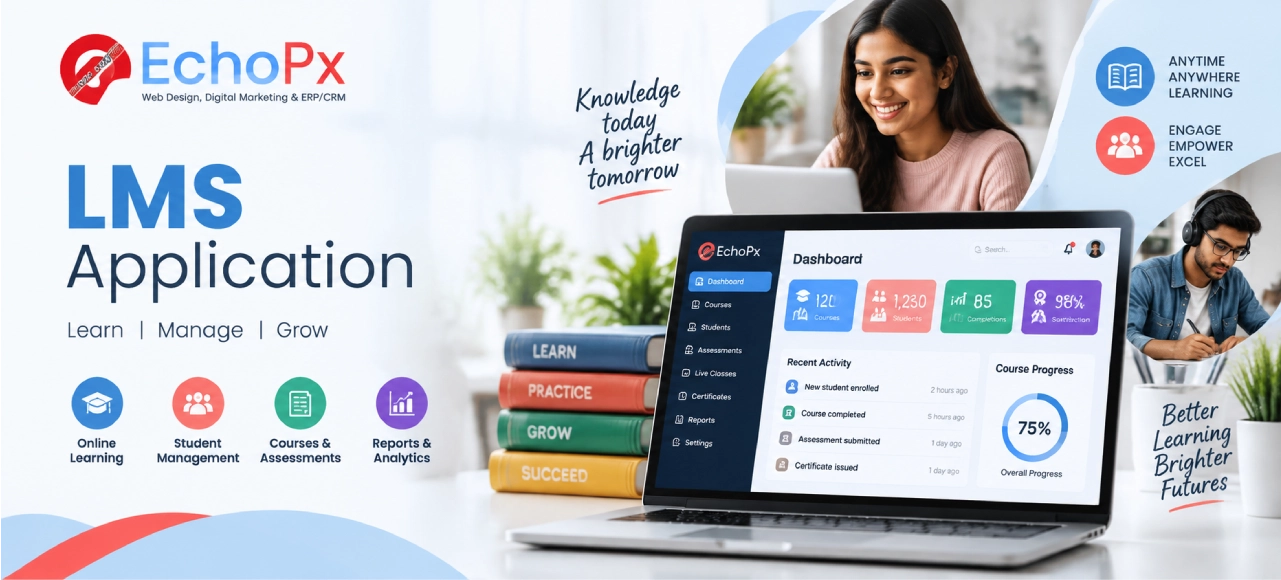
A cloud-based LMS application built by ERPLax to manage courses, batches, live and recorded classes, online assessments, certificates and learner progress in one place - configured around how your institute, academy or training team already works.
Talk to an LMS Specialist
Tell us about your courses and we'll get back with a plan.
Running Courses Without an LMS Gets Harder to Manage
As batches and content grow, spreadsheets, chat groups and manual grading stop scaling.
Course Content Scattered Everywhere
PDFs, videos and notes spread across drives, WhatsApp and email make it hard for learners to find what they need.
No Visibility into Learner Progress
Without a central system, instructors can't see who is falling behind or which lessons learners are stuck on.
Manual Assessments & Grading
Paper or spreadsheet-based tests are slow to grade and hard to analyse across batches.
Manual Certificate Issuance
Certificates typed and shared one by one delay recognition and create inconsistent records.
Disconnected Communication
Announcements, reminders and doubts get lost across multiple apps instead of one course thread.
No Tracking of Enrollment & Payments
Course sign-ups and fee collection tracked manually make it hard to reconcile revenue with attendance.
What Is the ERPLax LMS Application?
The ERPLax LMS Application is a cloud-based learning management system configured for your courses, instructors and learners. It brings course content, live classes, assessments, certificates, payments and reporting into one platform, so your team spends less time coordinating tools and more time teaching.
It's built as a configurable module within the ERPLax platform - not a rigid off-the-shelf product - so course structures, assessment formats, certificate templates and notifications can be set up to match how your institute or training team actually runs. Whether you need online course software for a single program or full e-learning platform development for multiple batches, it scales with you.
Content, live classes, assessments and certificates in a single learner-facing system.
See attendance, assessment scores and completion status per learner or batch.
Issue certificates automatically once your completion criteria are met.
Add new courses, instructors and cohorts without rebuilding your process each time.
Everything Needed to Run Courses Online
Configured features covering content, delivery, assessment and certification.
Course & Curriculum Builder
Structure courses into modules, lessons and topics with a set sequence or flexible learner-paced access.
Live Classes
Schedule and run live sessions with supported video-conferencing tools, linked to the right batch.
Recorded Content Library
Upload video, PDF and document lessons learners can revisit anytime from their dashboard.
Quizzes & Assessments
Built-in online assessment software with objective, subjective and mixed formats, question banks and randomised sets.
Auto & Manual Grading
Auto-grade objective questions while routing subjective answers to instructors for review.
Certificate Generation
Issue certificates automatically once a learner meets your configured completion criteria.
Learner Progress Dashboard
Student progress tracking software built in, showing attendance, scores and completion per learner, batch or course.
Batch & Cohort Management
Group learners into batches with their own schedule, instructor and content access.
Assignment Submission
Let learners upload assignments and instructors review, comment and grade them.
Discussion Forum & Q&A
Give learners a space to ask questions and instructors to respond per course or topic.
Payment & Enrollment
Configure enrollment and fee collection through supported payment gateways.
Mobile-Friendly Access
Learners and instructors can access courses, classes and reports from mobile devices.
From Enrollment to Certification
A learner's journey through the ERPLax LMS Application, end to end.
Enrollment & Payment
Learner browses a course, enrolls and completes payment through a supported gateway.
Batch Allocation
Learner is assigned to a batch with its schedule, instructor and content access.
Learning & Live Classes
Learner attends live sessions or works through recorded lessons at their pace.
Assignments & Assessments
Learner submits assignments and attempts quizzes, graded automatically or by instructors.
Certification & Reporting
On meeting completion criteria, a certificate is issued and progress is recorded for reporting.
What You Gain With the ERPLax LMS Application
Save Instructor Time
Auto-grading, templated certificates and one dashboard cut down repetitive admin work.
Data-Backed Decisions
See which lessons learners struggle with and which batches need attention.
Better Learner Experience
One login for classes, content, assignments and results instead of juggling apps.
Cleaner Revenue Tracking
Enrollment and payment records stay linked to course and batch data.
Consistent Certification
Every certificate follows the same criteria and template, reducing disputes.
Learn From Anywhere
Mobile-friendly access keeps learners connected outside the classroom.
Built for Course-Led Businesses
Coaching Institutes
An LMS for coaching institutes to manage batches, live classes, tests and results for competitive-exam and skill coaching.
Corporate Training & L&D
Corporate training software for onboarding and upskilling programs, with tracked completion and assessments.
Certification Bodies
Deliver courses and issue verifiable certificates on completion of set criteria.
Ed-Tech Businesses
Launch a branded course platform without building an LMS from scratch.
Skill-Training Academies
Manage vocational and skill-based courses with practical assessments and batches.
Schools & Colleges
Add an online-learning layer for study material, assignments and assessments.
Connects With the Tools You Already Use
Supported integrations can be configured based on your requirements.
Why Institutes & Training Teams Choose ERPLax
19+ Years of Experience
Building ERP and business software for organisations across industries since inception.
1500+ Clients Served
A track record across coaching, training, education and services businesses.
Cloud-Only, Always Updated
No installs to maintain - your LMS runs on ERPLax's managed cloud infrastructure.
Configured Around Your Courses
Course structures, assessments, certificates and reports set up for how you work.
Frequently Asked Questions
An LMS (Learning Management System) application is software used to create courses, deliver lessons online, run assessments and track learner progress. ERPLax develops LMS applications as part of its cloud-based platform, configured around your courses, batches, instructors and certification process.
Coaching institutes, corporate training and L&D teams, ed-tech businesses, schools and colleges running online programs, professional certification bodies, and skill-training academies that need to manage courses, learners and assessments in one system.
Yes. The LMS Application supports live class scheduling with supported video-conferencing tools alongside a recorded content library, so learners can join sessions live or revisit lessons later.
Yes. You can build objective, subjective and mixed-format assessments with auto-grading for objective questions and manual review workflows for subjective answers, along with question banks and randomised question sets.
Yes. Certificates can be generated and issued automatically once a learner meets the completion criteria you configure, such as course progress, assessment scores or attendance.
Yes. Enrollment, batch allocation and payment collection through supported payment gateways can be configured within the platform, so learners can browse, pay for and access courses in one flow.
Yes. Course structures, batches, assessment formats, certificate templates, notifications and reports can be configured to match your programs and branding within the ERPLax platform.
Yes. Learners and instructors can access courses, live classes, assignments and progress reports from a mobile-friendly interface in addition to the desktop dashboard.
Learner data, course content and assessment records are stored on ERPLax's cloud infrastructure with role-based access controls, so only authorised users can view or manage sensitive information.
Yes. ERPLax provides ongoing support, updates and configuration assistance after go-live, backed by 19+ years of experience serving 1500+ clients.
The LMS Application can be configured to work alongside your existing website and, where relevant, connected with other ERPLax modules such as CRM or accounts for a unified view of learners and revenue.
ERPLax LMS Application is offered exclusively as a cloud-based subscription service, with no perpetual licence or source-code handover, so you always run the latest supported version.
Ready to Move Your Courses Onto One Platform?
Talk to ERPLax about configuring an LMS Application around your courses, batches and certification process.