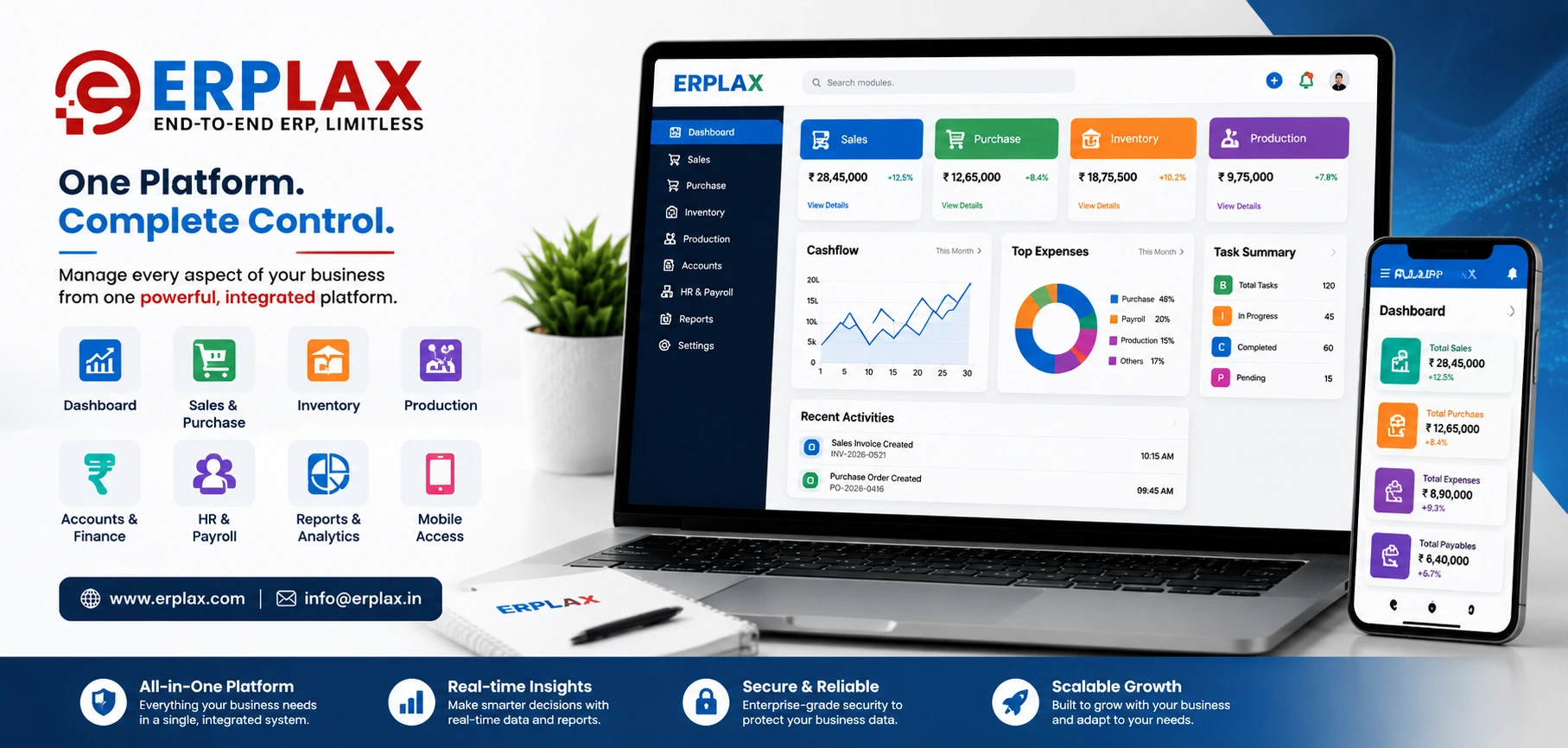
Compare ERP providers on business fit, customization, modules, deployment, integrations and implementation support — not just brand popularity. This guide covers top ERP companies in India businesses commonly evaluate, and how ERPLax fits in as a custom ERP partner.
India has ERP vendors in India serving different business sizes, industries and operational needs. There is no single ERP company in India that automatically suits every organization.
The companies below represent different ERP approaches commonly considered by businesses in India — custom development, large-enterprise ERP, cloud platforms, accounting-focused software, open-source ERP and industry-specific ERP. This is not a numerical ranking — inclusion doesn't mean one company is universally better than another.
A closer look at each provider — what they're commonly used for, strengths worth evaluating, and what to check before deciding.
ERPLax is a custom ERP software company India businesses turn to when they need software aligned with their actual operating processes, not a fixed package. Modules, fields, forms, approvals, reports and integrations are configured around the organization's real workflow.
Points to evaluate: first-phase modules, user & location count, customization scope, data migration, integrations, deployment model, training and support.
Enterprise resource planning built to connect core business processes, with cloud ERP capabilities spanning finance, manufacturing, procurement and supply chain.
Evaluate: implementation scope & total cost
Oracle Fusion Cloud ERP covers finance, procurement, project management and analytics as a connected cloud environment with embedded automation.
Evaluate: implementation resources & subscription cost
Finance and operations applications that connect ERP functionality with the wider Microsoft ecosystem — Teams, Excel, Power BI and Azure.
Evaluate: chosen partner & licence configuration
An integrated platform connecting financials, supply chain, payroll, billing and commerce, with customization through workflows and low-code extensions.
Evaluate: industry functions & report depth
Widely used for accounting, GST, invoicing, banking and inventory records, especially by businesses already familiar with Tally-style workflows.
Evaluate: whether it covers your full workflow
An open-source ERP covering accounting, procurement, sales, CRM, stock, manufacturing and payroll, with India-specific GST and e-Way Bill support.
Evaluate: hosting & implementation partner
A suite of modular business applications — CRM, ecommerce, accounting, inventory, POS and manufacturing — selected app by app.
Evaluate: edition, hosting & partner
Industry-specific ERP for industrial manufacturing, distribution, food & beverage and automotive, with preconfigured industry processes.
Evaluate: product fit & localization
Cloud ERP covering manufacturing, financial management, supply chain, HCM and enterprise asset management for integrated cloud operations.
Evaluate: local support & user adoption
An ERP company in India develops, supplies, configures or implements enterprise resource planning software — through proprietary software, cloud subscriptions, open-source implementation, custom development or industry-specific solutions. Some build their own platform; others implement products from larger vendors; some combine a standard foundation with custom modules, functioning as an ERP implementation partner in India as much as a software supplier.
ERP, or enterprise resource planning companies India businesses use, connects sales, purchase, inventory, billing, accounts, CRM, manufacturing, HR, payroll and reporting through one centralized system. An approved sales order, for example, can update stock requirements, trigger warehouse processing, support invoicing and appear in management reports automatically.
When businesses search for the best ERP software in India, they're usually comparing a mix of large platforms and ERP solution providers in India that offer custom development. Some searchers want an ERP software company in India that can build around an existing process; others are comparing cloud ERP companies in India for remote, multi-branch access, or manufacturing ERP companies in India that handle BOM, MRP and job work.
Not every provider on this list works the same way. Some are large platforms with local partners acting as ERP implementation companies in India; others, like ERPLax, are an ERP development company in India building the system directly around your workflow. If you're specifically looking for ERP solutions for small businesses or ERP software for manufacturing companies, it's worth understanding how to choose an ERP company in India before comparing quotations.
ERPLax is one of the top ERP providers for small businesses in India and a custom ERP software companies for Indian businesses choice across several sectors — including ERP software companies for manufacturing industry use cases and cloud ERP providers for growing companies that need to scale. As one of the ERP companies offering customization in India, ERPLax can configure ERP software for sales inventory and accounting, making it a practical option among ERP companies for small and medium businesses that want ERP software with CRM and inventory management in one connected platform.
ERP is more than a software purchase — it affects employees, departments, approvals and daily operating processes.
Undocumented needs lead to a system that misses real operational gaps.
A capable product still struggles if the provider doesn't understand the workflow.
Customization without a clear scope often causes rework and delays.
Even the right software fails if teams don't know how to use it.
Spreadsheets and disconnected apps create duplicate entry and stock mismatch.
Untested integrations surface as failures only after go-live.
Without clear ownership, issues stay unresolved for longer.
A provider should act as an implementation partner, not just a vendor.
Business model, users, locations, volumes, approvals and growth plans.
Enquiry-to-order, purchase-to-payment, attendance-to-payroll.
Users, roles, price lists, tax rules, approvals and document formats.
Custom fields, forms, calculations, dashboards and integrations.
Customers, suppliers, opening stock, balances and history.
Workflows, taxes, permissions, reports and migrated data.
Administrators, department users and management teams.
Launch plan, support channels and future customization process.
Don't begin by comparing hundreds of features — start with the problems you need to solve.
Identify the real problems — incorrect inventory, delayed orders, disconnected teams.
A manufacturer and a service company need very different workflows.
Confirm coverage for modules needed now and in the future.
What's configurable, what needs development, and how changes are handled later.
Match deployment to remote-access needs vs internal infrastructure.
Subscription, licences, implementation, customization, migration, training.
The demo should reflect your workflow, not just generic screens.
Who manages configuration, development, testing and training.
Confirm connections to the systems and devices you already use.
Room for more users, warehouses, branches, companies and modules.
Software supports how your teams actually work.
Connected transactions cut duplicate work.
Track inventory across products, batches, branches.
Quotation to invoice moves through one workflow.
Review operational data from centralized records.
Roles and approvals clarify responsibilities.
Faster access to order and payment status.
Add modules, users and locations as you grow.
Business model & challenges
Modules, workflows, reports
Phases & deployment model
Standard & custom modules
Clean customer & stock records
Workflows & migrated data
Admins & department users
Agreed rollout plan
Adoption & new modules
We study sales, purchases, production and reports before configuring anything.
Forms, calculations, workflows and reports built to approved scope.
Start essential, add CRM, HRM, manufacturing or POS later.
Greater control without an unnecessarily complex rollout.
Deployment matched to access and infrastructure needs.
Ecommerce, payments, communication tools and custom APIs.
Access configured by user, department, branch and responsibility.
Helping teams understand and follow the new workflow.
Businesses in India commonly evaluate providers and platforms such as SAP, Oracle, Microsoft Dynamics 365, Zoho ERP, TallyPrime, ERPNext, ERPLax, Infor, Ramco and custom ERP companies such as ERPLax. The right choice depends on business size, industry, budget, modules and customization requirements.
Small businesses should look for a provider offering essential modules, manageable implementation, clear pricing and room to expand later. ERPLax can configure sales, purchase, inventory, billing, CRM and reporting for small-business needs.
Manufacturing businesses should evaluate ERP software with bill of materials, production planning, MRP, work orders, inventory, quality control, job work and production costing.
A custom ERP software company develops or configures ERP modules around the specific workflows, forms, approvals, calculations, integrations and reports required by a business.
Compare industry experience, module coverage, customization, deployment, implementation methodology, data migration, integrations, training, support, scalability and total cost.
Neither option is automatically better. Cloud ERP suits remote access and multi-location operations. Cloud ERP may suit organizations with local infrastructure or specific deployment policies. The right choice depends on your requirements.
ERP implementation cost varies by users, modules, customization, branches, data migration, integrations, hosting and training. A requirement study is needed for an accurate quotation.
Timelines depend on module count, workflow complexity, data readiness, integrations, testing and user availability. A smaller first-phase rollout is usually easier to control than implementing everything at once.
Yes, but customization capability differs between platforms and providers. Confirm which forms, fields, reports, workflows and integrations can be modified before selecting an ERP company.
A modular ERP lets businesses start with essential functions and add manufacturing, CRM, HRM, ecommerce, POS, automation or advanced reporting later.
Many ERP providers offer data migration, but scope varies. Confirm which records will be migrated, who cleans the data, and how migrated information is tested.
ERPLax provides customizable ERP solutions based on your business workflow, supporting sales, purchase, inventory, billing, CRM, accounts, manufacturing, HRM, POS, ecommerce, reports and automation with Cloud Deployment.
Choosing an ERP provider isn't only about selecting software — it's about finding a team that understands your business, configures the right modules and supports implementation.
Specialized Applications
Purpose-built & ready to deploy. Hover to explore, click to learn more.
Testimonials
Real stories from businesses running their operations on ERPLax.
ERPLax gave us real-time visibility into stock across three warehouses. Wastage dropped and our fulfillment time improved almost overnight.
GST e-invoicing used to eat up two days every month. With ERPLax's accounting module it's now automatic and our filings are always on time.
Billing at our stores used to take a minute per customer. ERPLax's POS module cut that to under 15 seconds, even during peak festival rush.
Payroll for 200+ employees across two branches used to take our HR team a full week. ERPLax's HRM module now runs it in a single afternoon.
Tracking batch numbers and expiry across our distribution network was a nightmare on spreadsheets. ERPLax's inventory module made it effortless.
Front desk, housekeeping and billing are now all on one screen. ERPLax's hotel management module has made check-in day a breeze for our staff.
Fee collection, attendance and report cards used to live in three different tools. ERPLax brought it all into one dashboard our staff actually enjoys using.
Tracking material costs and site progress across four active sites was chaos before ERPLax. Now our project managers update status from their phones daily.
Our online store orders now sync straight into inventory and accounting — no more manual entry, no more overselling out-of-stock items.
Our sales team can now see every lead's history and follow-ups in one place. Deal closures are faster and nothing falls through the cracks anymore.
ERPLax gave us real-time visibility into stock across three warehouses. Wastage dropped and our fulfillment time improved almost overnight.
GST e-invoicing used to eat up two days every month. With ERPLax's accounting module it's now automatic and our filings are always on time.
Billing at our stores used to take a minute per customer. ERPLax's POS module cut that to under 15 seconds, even during peak festival rush.
Payroll for 200+ employees across two branches used to take our HR team a full week. ERPLax's HRM module now runs it in a single afternoon.
Front desk, housekeeping and billing are now all on one screen. ERPLax's hotel management module has made check-in day a breeze for our staff.
Fee collection, attendance and report cards used to live in three different tools. ERPLax brought it all into one dashboard our staff actually enjoys using.
Tracking material costs and site progress across four active sites was chaos before ERPLax. Now our project managers update status from their phones daily.
Our online store orders now sync straight into inventory and accounting — no more manual entry, no more overselling out-of-stock items.
Our sales team can now see every lead's history and follow-ups in one place. Deal closures are faster and nothing falls through the cracks anymore.