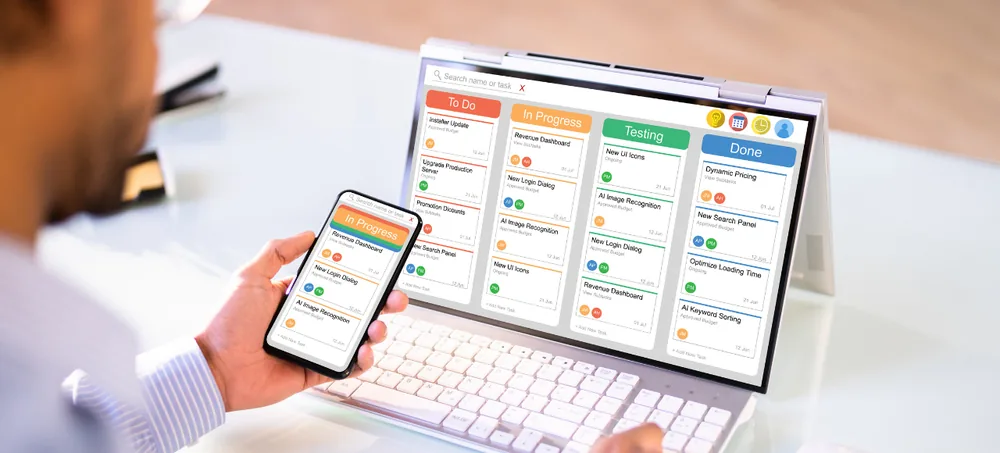
Connect sales, purchase, inventory, manufacturing, billing, CRM, accounts, HRM, approvals and reports through one flexible ERP platform. ERPLax provides custom ERP software in India for small, medium-sized and growing businesses that need better process control, centralized information, automation and management visibility.
Get a tailored ERP walkthrough for your business.
Businesses often use separate software for sales, inventory, purchasing, production and billing — bridged by spreadsheets, email and manual registers. This disconnected setup creates real problems.
The same information is typed multiple times across disconnected applications.
Inventory records drift out of sync with actual warehouse stock.
Orders sit between systems, slowing down dispatch and billing.
Purchases, discounts and expenses wait without a structured approval flow.
Manual pricing and tax entry increase the risk of invoicing mistakes.
Management struggles to see consolidated performance across locations.
ERP is a centralized business platform used to connect departments, workflows and operational information — replacing scattered applications with one shared, current source of truth.
Customer, supplier, product, stock, order and billing data in one system.
Departments, approvals, document formats and calculations built around you.
Management accesses consolidated reports and dashboards instantly.
Instead of maintaining the same information across several applications, authorized employees work with shared, current business data.
A confirmed sales order reserves stock, identifies purchase or production requirements, supports dispatch, generates an invoice and updates customer outstanding information — all inside one connected process that improves coordination, accuracy and management visibility.
The most suitable ERP system is not necessarily the one with the largest number of features — it's the system that fits your processes, team structure, industry and growth plans.
Supports how your organization manages enquiries, quotations, purchasing, manufacturing, billing and reports.
Custom fields, forms, approval workflows, business calculations and document numbering.
Users complete daily work without unnecessary screens, fields or steps.
Includes the modules required now and allows more to be added later.
Supports more users, departments, branches, warehouses, factories and transactions.
Provides meaningful operational and management reports, not just transaction storage.
Connects with relevant websites, devices, payment systems and third-party tools.
Evaluate Cloud Deployment based on access, infrastructure and security.
A suitable provider assists with process study, configuration, migration, testing and training.
The best ERP system in India for one company may not be the best fit for another. The decision should be based on business requirements and implementation quality, not on rankings alone.
Identify the issues the ERP should solve — manual updates, delayed planning, unclear status.
Prioritize the modules needed in the first phase — CRM, sales, purchase, inventory, billing.
Document how transactions currently move from one department to another.
Check approval hierarchy, pricing, product structure and reporting fit.
Manufacturers, distributors, retailers and service organizations need different workflows.
Success depends on process mapping, configuration, testing and user adoption.
Confirm access to sales, stock, production, cost and profitability information.
Confirm whether customer, supplier, product, stock and open transaction data can be migrated.
Identify every external application, device and API that needs to exchange data.
Evaluate whether the ERP can support future branches, factories, users and products.
A full set of configurable modules covering sales, purchase, inventory, manufacturing, billing, accounts, HR and reporting.
Capture leads, assign salespeople and track pipeline through to conversion.
Profiles, credit limits, payment terms, order and invoice history.
Supplier-product mapping, purchase history and performance tracking.
Codes, categories, HSN, tax info, reorder levels, batch tracking.
Enquiries, quotations, sales orders, dispatch planning and invoices.
Requisitions, supplier comparisons, purchase orders and goods receipt.
Stock transfers, reservations, batch and serial tracking, reorder alerts.
Rack and bin management, put-away, picking, packing and cycle counts.
GST invoices, delivery challans, debit/credit notes, e-invoice integration.
Receipts, payments, expenses, outstanding balances and cash-flow reports.
BOM, MRP, production planning, WIP, job work, quality and costing.
Picking lists, delivery challans, transporter details and shipment status.
Sales and purchase returns with approvals and credit-note tracking.
Scanning for receipt, issue, transfer, picking and dispatch verification.
Configurable approvals by transaction type, value, department or user role.
Profiles, attendance, leave, shifts and expense claims.
Sales, purchase, stock, production and profitability at a glance.
Role-based permissions by branch, warehouse, factory or transaction type.
Standard ERP products may cover common business processes but may not fully support every organization's workflow. ERPLax provides custom ERP software in India using standard modules extended with approved custom functions — a practical balance between standardization, flexibility, cost and implementation speed.
Solves a real operational need without unnecessary complexity.
Dashboards built for your management indicators.
Data-migration support and post-implementation care.
Grows without becoming difficult to maintain.
Single/multi-level BOM, alternative materials and version control.
Sales demand, stock, reorder levels and lead times.
Job cards, machine allocation and shift-wise targets.
Incoming, in-process and finished-goods inspections.
Manufacturing businesses need connected control over demand, materials, production, quality, costing and delivery. ERPLax manufacturing ERP connects sales demand with inventory, procurement and production operations across BOM, MRP, routing and job work.
Distribution businesses need control over customers, dealers, pricing, stock, credit and delivery. Trading, retail and ecommerce businesses can connect procurement, product, inventory, billing and order information through the same platform.
Batch tracking across distribution points.
Customer, dealer and distributor-specific pricing.
Store, warehouse and online order data connected.
Salesperson and product-wise margin analysis.
Multiple branches, warehouses and factories in one system.
Custom security controls and approval hierarchies.
Multi-location inventory and inter-branch transactions.
Centralized customer and supplier data across units.
Larger and growing organizations may require ERP software that supports multiple locations, departments and approval levels — scoped according to the organization's operating structure, transaction volume and reporting requirements.
What a well-implemented ERP changes for your operations.
Customer, supplier, product, stock and billing data in one platform.
Review current transactions, stock levels and production status.
Automate repeated entries, calculations and approvals.
Connect enquiries, quotations, stock, dispatch and invoicing.
Monitor available, reserved, incoming and ageing stock.
Monitor outstanding, expenses and expected collections.
Configured prices, discounts, taxes and document formats.
Add users, branches, warehouses and factories as you grow.
Each implementation is adapted to industry terminology, workflows, documents, transactions and reports.
From configured masters to consolidated reporting.
Customers, suppliers, products, taxes, warehouses and document formats.
Record leads, prepare quotations, convert to sales orders.
Check current stock, reservations and purchase or production needs.
Purchase orders, production orders, material issues and job-work.
Receipts, transfers, inspections, WIP and finished goods.
Picking lists, packing documents, delivery challans and invoices.
Customer receipts, supplier payments, expenses and balances.
Monitor sales, stock, production and profitability dashboards.
ERPLax follows a structured process across every stage of your ERP journey in India.
Requirement discussion, process study, configuration, testing, training and deployment.
Customer, supplier, product, stock, balance and BOM data migrated after test runs.
Custom modules, screens, fields, formats, alerts and role-based permissions.
Connect ecommerce, POS, accounting, payment gateways and barcode scanners.
ERPLax can connect ERP with selected platforms, applications, devices and services, subject to API availability and technical feasibility.
Choose a deployment model that fits your infrastructure, security and accessibility needs.
Authorized access across offices, branches, warehouses and factories with centralized maintenance.
Deployed within your own server and network based on internal IT policy and infrastructure.
Combine cloud accessibility with Cloud components for factory-device needs.
ERP software cost depends on the project scope and implementation requirements. ERPLax reviews your business requirements before preparing a custom ERP quotation, so you avoid paying for unnecessary capabilities while ensuring important workflows are included.
19+ years configuring and building business software for growing Indian companies.
Configured and developed around your workflow, documents and reporting needs.
Our team studies how departments operate before configuring the platform.
Sales, purchase, inventory, manufacturing, billing, CRM, accounts, HRM and reports.
BOM, MRP, production, WIP, job work, quality, scrap and costing.
Start with priority modules and add more functions as you grow.
Choose a deployment model according to infrastructure needs.
Access by role, department, branch, warehouse or factory.
Requirement mapping, configuration, migration, testing, training and deployment.
Answers to what businesses researching top ERP software in India typically ask.
ERP software is a centralized platform that connects business functions such as sales, purchase, inventory, manufacturing, billing, CRM, accounts and reporting.
The most suitable ERP depends on your industry, workflow, users, modules, reports, integrations and deployment requirements. ERPLax provides configurable ERP solutions based on these needs.
Small businesses should select ERP software that is easy to use, modular, affordable, customizable and capable of expanding as the business grows.
A suitable ERP should match the business workflow, support essential modules, provide useful reports, allow customization and scale with future growth.
Compare process fit, modules, customization, scalability, implementation support, data migration, integrations, reporting, training and post-launch support.
Yes. ERPLax provides custom ERP software and implementation services for businesses across India.
Yes. ERPLax can configure and develop modules, workflows, documents, calculations, reports, dashboards and integrations according to approved requirements.
Customized ERP software is configured around a company's specific fields, processes, approvals, calculations, document formats and reports.
Yes. Businesses can begin with essential modules and expand the ERP as users, branches, warehouses and transaction volumes increase.
Yes. Enterprise ERP capabilities can support multiple branches, warehouses, factories, departments, users and approval levels.
Yes. Manufacturing modules can include BOM, MRP, production planning, WIP, job work, quality, scrap and production costing.
Yes. The ERP can manage quotations, sales orders, procurement, goods receipt, stock movement, dispatch, billing, returns and payment tracking.
Yes. CRM functions can include lead capture, follow-ups, opportunities, quotations, customer records and sales-pipeline reports.
Yes. Multi-branch transactions, role-based access and consolidated reports can be configured according to requirements.
Yes. The system can track stock across multiple warehouses, racks, bins, branches and factories.
Yes. ERPLax ERP can be deployed in a cloud environment according to project requirements.
Yes. The ERP can also be deployed within the organization's own server and network environment.
Yes. Businesses can begin with priority modules and introduce manufacturing, CRM, HRM or advanced reporting later.
Yes. Implementation can include process study, requirement mapping, configuration, development, testing, training, migration and deployment.
Yes. Customer, supplier, product, stock, balance, BOM and selected transaction data can be migrated depending on the quality of existing data.
Tally and ecommerce integrations can be evaluated when required, subject to technical feasibility and the required data flow.
Yes. Barcode and QR functions can be configured for goods receipt, material issue, transfer, picking, packing and dispatch.
Yes. The ERP can support GST invoice formats, tax calculations, debit notes, credit notes and related reports.
ERP cost depends on users, modules, customization, migration, integrations, deployment, training and support requirements.
Custom ERP can be more suitable when standard software does not support important workflows, calculations, approvals, documents or reports. The right approach depends on business requirements.
Manage sales, purchase, inventory, manufacturing, billing, CRM, accounts, HRM, approvals and reports through one customizable ERP platform. ERPLax provides ERP consulting, development, implementation, migration, customization, integration and support services across India.
Phone: +91 97399 66977 · Email: info@erplax.in · Website: erplax.com
Specialized Applications
Purpose-built & ready to deploy. Hover to explore, click to learn more.
Testimonials
Real stories from businesses running their operations on ERPLax.
ERPLax gave us real-time visibility into stock across three warehouses. Wastage dropped and our fulfillment time improved almost overnight.
GST e-invoicing used to eat up two days every month. With ERPLax's accounting module it's now automatic and our filings are always on time.
Billing at our stores used to take a minute per customer. ERPLax's POS module cut that to under 15 seconds, even during peak festival rush.
Payroll for 200+ employees across two branches used to take our HR team a full week. ERPLax's HRM module now runs it in a single afternoon.
Tracking batch numbers and expiry across our distribution network was a nightmare on spreadsheets. ERPLax's inventory module made it effortless.
Front desk, housekeeping and billing are now all on one screen. ERPLax's hotel management module has made check-in day a breeze for our staff.
Fee collection, attendance and report cards used to live in three different tools. ERPLax brought it all into one dashboard our staff actually enjoys using.
Tracking material costs and site progress across four active sites was chaos before ERPLax. Now our project managers update status from their phones daily.
Our online store orders now sync straight into inventory and accounting — no more manual entry, no more overselling out-of-stock items.
Our sales team can now see every lead's history and follow-ups in one place. Deal closures are faster and nothing falls through the cracks anymore.
ERPLax gave us real-time visibility into stock across three warehouses. Wastage dropped and our fulfillment time improved almost overnight.
GST e-invoicing used to eat up two days every month. With ERPLax's accounting module it's now automatic and our filings are always on time.
Billing at our stores used to take a minute per customer. ERPLax's POS module cut that to under 15 seconds, even during peak festival rush.
Payroll for 200+ employees across two branches used to take our HR team a full week. ERPLax's HRM module now runs it in a single afternoon.
Front desk, housekeeping and billing are now all on one screen. ERPLax's hotel management module has made check-in day a breeze for our staff.
Fee collection, attendance and report cards used to live in three different tools. ERPLax brought it all into one dashboard our staff actually enjoys using.
Tracking material costs and site progress across four active sites was chaos before ERPLax. Now our project managers update status from their phones daily.
Our online store orders now sync straight into inventory and accounting — no more manual entry, no more overselling out-of-stock items.
Our sales team can now see every lead's history and follow-ups in one place. Deal closures are faster and nothing falls through the cracks anymore.