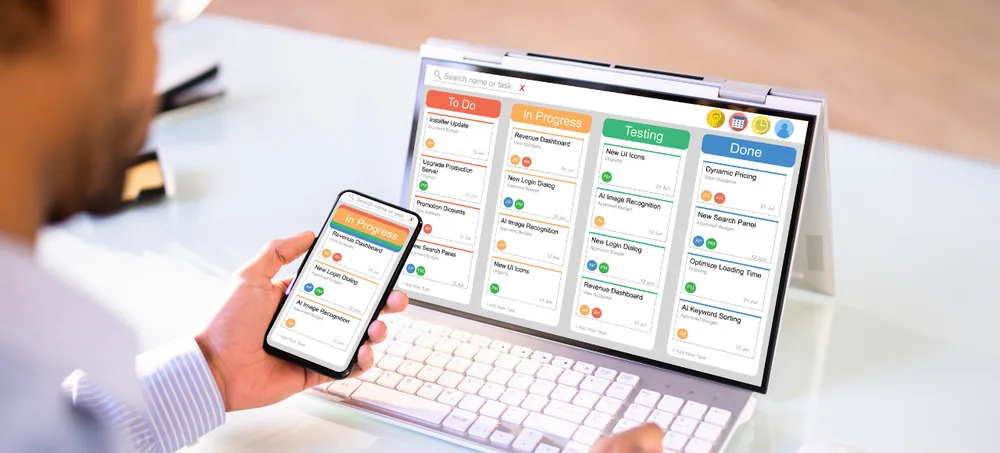
Manage warehouse inventory, receiving, put-away, picking, packing, transport jobs, fleet, freight, 3PL billing, shipment tracking, proof of delivery and accounts through one customizable logistics ERP software platform.
Tell us about your warehouse and fleet - our team responds within 24 hours.
Warehouse and logistics companies manage the movement, storage and delivery of goods across customers, suppliers, warehouses, hubs, vehicles and delivery locations. When these activities run on spreadsheets and disconnected applications, common problems appear:
A warehouse transaction often creates operational and financial consequences. When goods arrive, the warehouse records the customer, item, quantity, batch, condition and location. When goods are dispatched, the system updates inventory, calculates handling charges, assigns transport, generates shipping documents and prepares customer billing.
ERPLax creates a connected workflow: Customer Request → Gate Entry → Goods Inward → Put-Away → Order Allocation → Picking & Packing → Vehicle Planning → Dispatch → Tracking → Delivery → Billing → Profitability Report.
Logistics ERP software is a centralized business system that connects warehouse, transportation, inventory, customer billing, vendor payments, finance and reporting. As broad warehouse ERP software and warehouse management ERP software, it also works as complete ERP software for logistics industry businesses handling receiving, fulfilment, transport and billing in one platform.
Whether you need ERP for logistics companies running a single warehouse or a broader logistics management software platform across multiple branches, ERPLax can be configured as complete warehouse and logistics software - a true logistics company management software and supply chain ERP software connecting operational activities with customer contracts, invoices and business profitability.
Modern logistics ERP systems connect warehouse, transportation, inventory and finance rather than treating each activity as a separate process.
Record every inward, put-away, transfer, reservation, pick, pack, dispatch, return and stock adjustment through controlled transactions.
Maintain warehouse, zone, aisle, rack, shelf and bin locations so employees can identify where each item is stored.
Connect order allocation, picking, packing, shipment planning and dispatch without recreating order information.
Third-party logistics companies can separate stock, orders, rates, documents and billing for every customer.
Maintain carrier rates, vehicle expenses, trip costs, fuel, tolls and other freight charges against logistics jobs.
Review vehicle availability, carrying capacity, current trips, maintenance status and planned assignments.
Generate handling, storage, transport and service charges from completed operational transactions.
Maintain pickup, transit, hub, delivery and proof-of-delivery status against each shipment.
Add more customers, warehouses, vehicles, users, services and integrations as the logistics business grows.
A full module set covering warehouse, transport, 3PL billing and financial processes - configurable around the way your logistics business actually operates.
Maintain customer master data, billing address, pickup and delivery locations, credit limit, contracts and customer profitability.
Create quotations for warehouse and logistics services covering handling, storage, picking, packing and transport charges.
Maintain customer-specific rates by service, warehouse, weight, volume, pallet, route or billing frequency with revision history.
Record goods arriving from factories, suppliers or customers with item, batch, quantity, condition and receipt details.
Record an expected incoming shipment before the vehicle arrives so warehouse teams can plan resources in advance.
Compare expected versus received goods, recording short, excess, damaged or rejected quantities for customer approval.
Move received goods to appropriate warehouse locations using configured rules for category, weight, batch and zone.
Create a digital representation of the warehouse - building, floor, zone, aisle, rack, bay, shelf and bin.
Track inventory at a specific storage location including item, batch, quantity, reserved stock and stock age.
Manage inventory across customer warehouses, distribution centres, fulfilment centres, hubs and cross-docking locations.
Third-party logistics companies can keep each customer's inventory separate within a shared warehouse.
Maintain product traceability from goods receipt through put-away, storage, picking, packing and customer delivery.
Create unique references for pallets, cartons and crates with content, weight, location and movement history.
Generate or scan barcodes and QR codes for receipts, items, batches, pallets, bins, pick lists and shipments.
Evaluate integration with compatible RFID systems for pallet identification, gate movement and high-volume receiving.
Classify stock as available, reserved, under inspection, quarantined, damaged, blocked, expired or ready for dispatch.
Configure stock selection by First In First Out or First Expiry First Out according to product and customer requirements.
Record inventory movement between bins, racks, zones, warehouses, branches, hubs and customer locations.
Plan and record periodic or continuous stock counts with variance reporting and adjustment approval.
Track occupied and available storage capacity across locations to plan incoming shipments and layout changes.
Import or enter customer orders and allocate suitable inventory according to configured rules.
Allocate available, reserved or batch-specific stock to confirmed orders before picking begins.
Configure picking strategies by wave, batch or warehouse zone to improve fulfilment efficiency.
Generate and track pick lists by order, wave, zone or picker with real-time completion status.
Prepare packages or pallets from picked items with package count, weight and dispatch readiness.
Bill for labelling, repacking, kitting and other services performed during warehouse operations.
Move inbound goods directly to outbound shipments with minimal storage time where configured.
Record customer returns, inspection results, restocking and credit or replacement processing.
Record transport requirements linked to customer orders, warehouses and delivery locations.
Select a vehicle or carrier, consolidate loads and create the trip with route and schedule details.
Plan vehicle loading sequence and consolidate multiple orders into efficient trips.
Assign vehicles to trips based on capacity, availability, route and vehicle type.
Maintain a complete vehicle master with capacity, documents, ownership and current status.
Maintain driver records, licences, assigned vehicles, trip history and performance.
Track insurance, permit, fitness and licence expiry dates with configured reminder alerts.
Maintain standard routes, distances and delivery sequences for transport planning.
Update transit milestones manually or through compatible GPS, mobile or carrier integrations.
Record receiver, time, signature, photograph, OTP or uploaded document confirming delivery.
Record delays, failed deliveries, damages or other exceptions with resolution tracking.
Track carrier contracts, routes, rates, shipment assignments, performance and freight invoices.
Maintain freight rates by route, distance, vehicle type, weight, volume and additional services.
Calculate freight automatically using configured rates based on route, distance and shipment details.
Record fuel, tolls, driver allowances and other trip-related expenses against each trip.
Track fuel purchases, consumption and mileage by vehicle for cost control.
Maintain preventive maintenance, breakdown repairs, service dates and odometer readings.
Record vehicle entry, exit, document references, visitor details and arrival time.
Configure returnable and non-returnable gate passes linked to goods movement.
Record inbound and outbound vehicle weight where weighbridge integration is configured.
Manage yard locations, dock scheduling and vehicle staging areas.
Maintain customer-specific service scope, rate cards and billing rules for third-party logistics customers.
Calculate storage billing by pallet, bin, area, volume, weight or fixed monthly rate.
Convert inward handling, outward handling, picking, packing and labelling into customer billing records.
Generate customer transport invoices from completed trips and configured freight rates.
Verify carrier invoices against trips, agreed rates, advances and deductions before payment.
Generate GST-compliant tax invoices, credit notes and debit notes linked to warehouse and transport transactions.
Manage multiple branches, hubs and transit locations through one centralized platform.
Track individual parcels and consignments through warehouse and transport stages.
Store and retrieve shipping documents, contracts, invoices and proof-of-delivery records.
Give customers visibility into inventory, orders, shipment status, proof of delivery and invoices.
Allow carriers to view assigned trips, upload documents and submit freight invoices.
Support receiving, put-away, picking and stock checks using barcode scanners or mobile devices.
Allow drivers to view trips, update status and upload proof of delivery from a mobile device.
Manage receivables, payables, ledgers and accounting entries connected to operations and billing.
Compare customer revenue against warehouse, transport, labour and vendor expenses per job.
Access inventory, warehouse, transport, billing and profitability reports through centralized dashboards.
Control which users can receive, move, allocate, dispatch, approve or bill transactions.
Deploy ERPLax in the Cloud-Based depending on infrastructure, security and accessibility requirements.
ERPLax works as complete warehouse inventory management software, tracking goods from receiving through put-away, storage, picking and dispatch. As multi-warehouse management software, it maintains bin-level visibility across every location, while wave, batch and zone picking strategies support fast, accurate order fulfilment software workflows for high-volume operations.
Tracked by bin, batch and status with real-time warehouse visibility.
Tracked by bin, batch and status with real-time warehouse visibility.
Tracked by bin, batch and status with real-time warehouse visibility.
Tracked by bin, batch and status with real-time warehouse visibility.
Tracked by bin, batch and status with real-time warehouse visibility.
Tracked by bin, batch and status with real-time warehouse visibility.
ERPLax can be configured as complete transport management software and transport ERP software, covering trip planning, load consolidation, vehicle allocation and route management. As dedicated freight management software and fleet management software, it maintains freight rates, vehicle documents, driver records and maintenance schedules in one connected system.
Shipments are followed end-to-end with shipment tracking software and delivery management software capabilities, while dispatch management software workflows coordinate gate exit, shipping documents and proof of delivery. Freight forwarders can configure ERPLax as complete freight forwarding ERP software for managing carrier bookings, consolidations and multi-leg shipments.
Consolidation & route sequencing
Vehicles, drivers & documents
Route, weight & volume based
Transit milestones & POD
Third-party logistics companies manage goods owned by multiple customers while charging for storage, handling, fulfilment and transport. ERPLax works as dedicated 3PL ERP software and 3PL warehouse management software, creating separate controls for each customer's inventory, rates and billing.
As complete third-party logistics software and 3PL inventory management software, ERPLax also functions as customer-wise warehouse inventory software, warehouse rental billing software, warehouse billing software, logistics billing software, logistics contract billing software and 3PL billing software - converting completed transactions into customer billing records automatically. A configurable logistics customer portal software module can also give each customer direct visibility into their own inventory, orders and invoices.
Industry-specific requirements such as temperature control, regulated-product handling or customs documentation are defined separately during implementation:
A confirmed customer request moves through fifteen connected stages, from contract to profitability review.
Record services, warehouses, rates, billing rules, credit terms and reporting requirements.
Enter expected goods, pickup details, packages, quantity, weight and delivery date.
Record the vehicle, driver, customer, document reference and arrival time.
Confirm quantity, batch, serial number, condition and discrepancies.
Assign warehouse, zone, rack and bin locations.
Track stock by customer, item, batch, location, status and age.
Import or enter the customer's order and allocate suitable inventory.
Create pick tasks, confirm quantities and prepare packages or pallets.
Select a vehicle or carrier, consolidate loads and create the trip.
Complete gate exit, shipping documents and inventory movement.
Update transit milestones, delivery exceptions and expected arrival.
Record the receiver, time, signature, photograph, OTP or uploaded document.
Calculate warehouse, handling, value-added service and freight charges.
Verify carrier invoices against trips, agreed rates, advances and deductions.
Compare customer revenue against warehouse, vehicle, labour, carrier and administrative expenses.
ERPLax can integrate with compatible third-party systems and devices according to technical feasibility and approved project scope, using APIs, database connectors or supported file formats.
Access the system from warehouses, branches and vehicles without dedicated server infrastructure - a practical fit for growing companies that want fast rollout of cloud ERP for logistics companies.
Host the system on your own infrastructure for full control over data, security and network access, built as custom ERP for warehouse companies around your specific IT policy.
EchoPx Technologies has delivered 1700+ ERP projects across 19+ years for 1500+ clients - configured, not just installed, around each customer's real workflow.
ERPLax configures modules according to the company's warehouse, transportation, billing and reporting requirements.
The system can reflect how your company handles goods inward, storage, fulfilment, transport, delivery and customer billing.
Connect inventory and fulfilment activities with fleet, freight, billing and accounts.
Configure storage, handling, transport and value-added service charges according to customer contracts.
Start with warehouse, transport or billing modules and add CRM, fleet, portals or integrations later.
Choose the deployment approach that suits infrastructure, accessibility, security and integration requirements.
Connect compatible ecommerce platforms, scanners, GPS systems, weighbridges and accounting tools.
Control which users can receive, move, allocate, dispatch, approve or bill transactions.
Reports built around inventory accuracy, warehouse utilization, delivery performance and profitability.
Automate tasks, approvals, alerts, document creation, billing triggers and status updates.
Implementation guidance and user training for the modules included in the project.
Expand the ERP as customers, warehouses, vehicles, branches and shipment volume increase.
Logistics ERP software is a centralized system for managing warehouse inventory, customer orders, transportation, fleet, freight, billing, accounts and operational reports.
A Warehouse Management System focuses mainly on receiving, storage, picking, packing and warehouse inventory. A Transportation Management System focuses on shipment planning, carriers, routes and delivery. ERP connects these operational functions with CRM, billing, accounts and business reporting.
Yes. ERPLax can be configured for goods receiving, put-away, bin inventory, customer-wise stock, picking, packing, dispatch, warehouse billing and reporting.
Yes. Inventory can be tracked across warehouses, branches, hubs, yards, fulfilment centres and transit locations.
Yes. Goods can be tracked by warehouse, zone, aisle, rack, shelf and bin according to the configured warehouse structure.
Yes. Customer-owned inventory, rate cards, warehouse transactions, reports and billing can be maintained separately for each customer.
Yes. Storage billing can be configured by pallet, bin, area, volume, weight, unit, average stock, peak utilization or fixed monthly rate.
Yes. Inward handling, outward handling, picking, packing, labelling, repacking, kitting and other services can be converted into customer billing records.
Yes. Barcodes or QR codes can be used for items, batches, serial numbers, pallets, bins, pick lists, packages and shipments.
Yes. The system can track batches, lots, serial numbers, manufacturing dates and expiry dates through receiving, storage, picking and dispatch.
Yes. Stock-allocation rules can be configured for First In First Out or First Expiry First Out.
Yes. Transport bookings, vehicle allocation, drivers, routes, trips, expenses, freight and delivery status can be managed.
Yes. Carrier contracts, routes, rates, shipment assignments, performance, freight invoices and payments can be tracked.
Yes. Shipment milestones can be updated manually or through compatible GPS, mobile, carrier or third-party integrations.
A configured mobile workflow can allow drivers to upload signatures, photographs, OTP confirmation, delivery remarks and location information.
Freight can be calculated using configured rates based on route, distance, vehicle type, weight, volume, minimum charge and additional services.
Yes. Preventive maintenance, breakdown repairs, service dates, odometer readings, expenses and document expiry alerts can be maintained.
Integration can be evaluated when the weighbridge provides a compatible communication method, database or API.
Yes. Vehicle entry, vehicle exit, document references, visitor details, returnable passes and non-returnable passes can be configured.
Depending on implementation scope, ERPLax can support tax invoices, GST reports, debit notes, credit notes, e-invoice integration and e-way bill integration.
A customer portal can be configured for inventory, receipts, orders, shipment status, proof of delivery, invoices and reports.
Yes. Integration can be evaluated for products, inventory, customer orders, fulfilment status and shipment updates.
Yes. ERPLax can be deployed in the Cloud-Based according to infrastructure, security, accessibility and integration requirements.
Yes. ERPLax is modular. A company can begin with warehouse and inventory modules and later add transport, fleet, billing, portals, accounts or integrations.
Connect warehouse inventory, order fulfilment, transport, fleet, freight, 3PL billing, delivery tracking and accounts through one flexible ERP system.
Specialized Applications
Purpose-built & ready to deploy. Hover to explore, click to learn more.
Testimonials
Real stories from businesses running their operations on ERPLax.
ERPLax gave us real-time visibility into stock across three warehouses. Wastage dropped and our fulfillment time improved almost overnight.
GST e-invoicing used to eat up two days every month. With ERPLax's accounting module it's now automatic and our filings are always on time.
Billing at our stores used to take a minute per customer. ERPLax's POS module cut that to under 15 seconds, even during peak festival rush.
Payroll for 200+ employees across two branches used to take our HR team a full week. ERPLax's HRM module now runs it in a single afternoon.
Tracking batch numbers and expiry across our distribution network was a nightmare on spreadsheets. ERPLax's inventory module made it effortless.
Front desk, housekeeping and billing are now all on one screen. ERPLax's hotel management module has made check-in day a breeze for our staff.
Fee collection, attendance and report cards used to live in three different tools. ERPLax brought it all into one dashboard our staff actually enjoys using.
Tracking material costs and site progress across four active sites was chaos before ERPLax. Now our project managers update status from their phones daily.
Our online store orders now sync straight into inventory and accounting — no more manual entry, no more overselling out-of-stock items.
Our sales team can now see every lead's history and follow-ups in one place. Deal closures are faster and nothing falls through the cracks anymore.
ERPLax gave us real-time visibility into stock across three warehouses. Wastage dropped and our fulfillment time improved almost overnight.
GST e-invoicing used to eat up two days every month. With ERPLax's accounting module it's now automatic and our filings are always on time.
Billing at our stores used to take a minute per customer. ERPLax's POS module cut that to under 15 seconds, even during peak festival rush.
Payroll for 200+ employees across two branches used to take our HR team a full week. ERPLax's HRM module now runs it in a single afternoon.
Front desk, housekeeping and billing are now all on one screen. ERPLax's hotel management module has made check-in day a breeze for our staff.
Fee collection, attendance and report cards used to live in three different tools. ERPLax brought it all into one dashboard our staff actually enjoys using.
Tracking material costs and site progress across four active sites was chaos before ERPLax. Now our project managers update status from their phones daily.
Our online store orders now sync straight into inventory and accounting — no more manual entry, no more overselling out-of-stock items.
Our sales team can now see every lead's history and follow-ups in one place. Deal closures are faster and nothing falls through the cracks anymore.