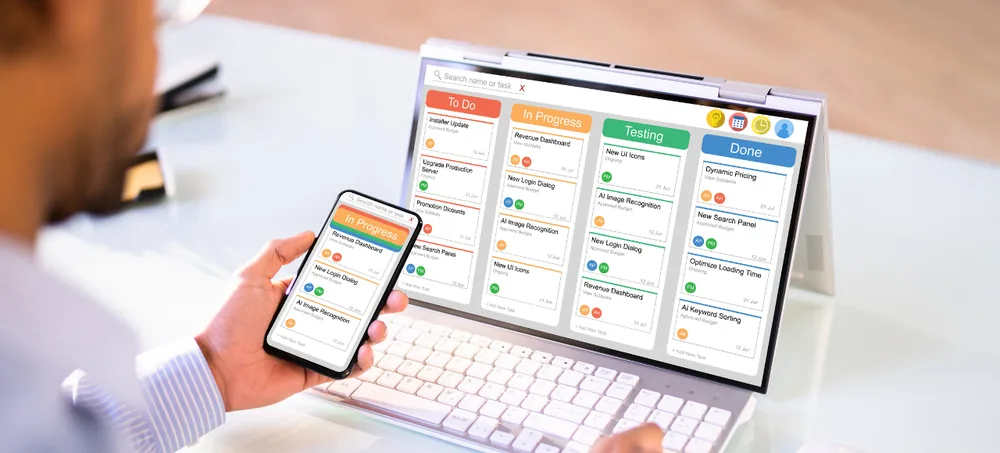
Connect production, BOM, material planning, purchase, inventory, quality, sales, billing and reporting through one customizable manufacturing ERP system. The best ERP for manufacturing should do more than provide standard software modules — it should fit the way your factory actually plans materials, creates production orders, issues stock, tracks work in progress, checks quality, calculates costs and dispatches finished products.
Get a requirement-based walkthrough for your manufacturing operations
Manufacturing involves much more than buying raw material and producing finished goods. Every customer order can affect material requirements, supplier purchases, production schedules, machine or workforce allocation, work-in-progress inventory, quality inspections, costing, finished stock and delivery commitments. When these processes are managed through separate spreadsheets, accounting tools and manual registers, manufacturers may face the following challenges.
ERPLax brings these operations into a connected ERP system for manufacturers, helping teams work with centralized information and configurable workflows. Instead of forcing every factory into a fixed process, ERPLax can be configured around your actual manufacturing operations.
Manufacturing ERP software is a business management system designed to connect production-related activities with other important business functions such as sales, purchasing, inventory, warehouses, suppliers, customers, billing, accounts support and reporting. A manufacturing ERP can connect the complete operational cycle: Customer Enquiry → Quotation → Sales Order → Material Planning → Purchase → Production → Quality Check → Finished Goods → Dispatch → Invoice → Reports.
Unlike standalone production software, an ERP provides visibility beyond the factory floor. Management can view how sales demand affects production, how production affects material requirements, how purchasing changes inventory, and how manufacturing and dispatch affect business performance. ERPLax can customize these workflows according to your manufacturing model, products, departments and reporting requirements.
Centralize operational data and automate repetitive processes.
Plan manufacturing based on orders, BOM requirements and material availability.
Track raw materials, WIP and finished products with warehouse-level visibility.
Material requirements from production demand help purchase teams plan procurement.
Connect material consumption and production activity to understand costs.
Sales, production, warehouse and dispatch teams work with connected order information.
View production, inventory, purchases and orders through configurable dashboards.
Start with essential modules and add CRM, HRM, automation and reporting as you grow.
There is no single ERP platform that is automatically the best choice for every manufacturer. A small engineering company, food processor, electronics assembler and multi-location manufacturer can have very different production workflows. The best manufacturing ERP software for your business should therefore be evaluated on practical business fit.
The ERP should understand processes such as BOM, material planning, production orders, material issues, WIP, finished goods and quality.
Forms, approval processes, production stages, documents, reports and calculations should be configurable to your workflow.
Production and inventory should work together so consumption and receipts update relevant stock records.
The ERP should support additional users, products, warehouses, branches and modules as the business expands.
Management should access meaningful operational reports without collecting information from different departments.
The ERP should exchange data with relevant accounting, ecommerce, payment, communication and logistics applications.
Requirement analysis, process mapping, data migration, training and post-implementation support matter as much as the software itself.
Connected modules covering product masters through role-based security.
Centralized structure for raw materials, components, consumables and finished products with tax, reorder and batch/serial configuration.
Single & multi-level BOM, assemblies, alternate materials, revisions and approval workflows.
Production plans, orders, work orders, job cards, priorities and status tracking.
Compare BOM requirements with available inventory to identify shortages.
Receipt, issue, return, transfer, adjustment and reorder alerts.
Production stage, quantity completed/pending, material consumed, rework and rejection.
Finished quantity, production reference, batch/serial, warehouse and dispatch status.
Factory stores, raw material and finished goods warehouses, transfers and bin locations.
Manufacturing dates, expiry, supplier and production batch references, dispatch traceability.
Enquiry, quotation, purchase order, receipt, invoice, return and approval workflows.
Material sent, job-work order, expected return, process charges and job-work reports.
Product, quantity, BOM reference, process, team, dates and supervisor approval.
Incoming, in-process and finished goods inspection with acceptance, rejection and rework.
Materials, consumables, job work, labour, machine, overheads and wastage.
Lead → Quotation → Sales Order → Production → Finished Goods → Dispatch → Invoice.
Leads, enquiries, follow-ups, quotations, pipeline and customer-specific pricing.
Sales/purchase invoices, GST billing data, credit/debit notes and outstanding reports.
Material inward, stock identification, picking, packing and dispatch.
Production plan vs actual, WIP, purchase requirement, costing and supplier performance.
Purchase, production order, material issue, stock adjustment and quality approvals.
Permissions by module, department, user, branch, warehouse and approval level.
Bring sales, purchase, stock, production and dispatch information together.
Plan production using available order, material and operational information.
Track raw materials, WIP and finished goods through connected inventory processes.
Automated data flow between departments reduces repetitive data entry.
Connecting sales orders, production and dispatch reduces information handoffs.
Understand material consumption and production-related costs using reports.
Sales teams access order and production information more easily.
Configure processes according to how your factory actually operates.
Add modules, users, warehouses, branches and integrations as you grow.
ERPLax can be customized for different manufacturing environments.
The exact modules and processes are configured according to each company's production model and requirements.
Products, raw materials, BOM, suppliers, customers, warehouses & approval rules.
Create an enquiry, quotation or sales order.
Use product BOM to determine material needs & check stock.
Create purchase requirements and purchase orders.
Generate order with product, quantity, BOM & stages.
Issue raw materials from warehouse against the order.
Track quantities, consumption, WIP, rejections & completion.
Record applicable inspections and approval status.
Move approved goods into the relevant warehouse.
Pick, pack, dispatch and create the applicable invoice.
Monitor production, stock, purchasing, sales and costing.
ERPLax can integrate with relevant business applications and hardware depending on project requirements.
Integration scope depends on the systems, APIs and workflow involved.
ERPLax is delivered as a cloud-based manufacturing ERP, giving authorized teams browser-based access without maintaining separate installations for every location.
Access production, inventory and business information across factories, warehouses and offices.
Keep sales, purchase, production and reporting data in one connected cloud platform.
Give management and distributed teams easier access to operational information.
MRP, or Material Requirements Planning, primarily focuses on materials required for production. ERP, or Enterprise Resource Planning, has a wider scope. A manufacturing ERP can connect MRP, production, inventory, purchase, suppliers, sales, customers, billing, CRM, HRM, reports, approvals and integrations.
| MRP | Manufacturing ERP |
|---|---|
| Material requirements planning | Complete business planning |
| Production-focused | Production + sales, purchase & finance |
| Limited customer management | CRM & customer integration |
| Limited reporting scope | Business-wide reporting |
| Standalone material tool | Connected ERP platform |
For businesses that want to manage both factory operations and wider business processes, an integrated ERP provides broader functionality than standalone material planning software.
Before selecting software, document the processes your team performs every day.
Document the complete journey from sales order to dispatch.
Inventory mismatch, delayed purchase, poor visibility, duplicate entry.
Separate must-have requirements from features for later.
Confirm BOM, material flow, production, job work & costing support.
Ask the provider to demonstrate your actual workflow.
Identify accounting software, machines, scanners & APIs.
Prepare samples of reports used by each department.
Identify existing product, customer, BOM and stock data.
Include department users in testing and training.
Choose a platform that accommodates modules, users and locations.
ERPLax develops and configures ERP around your actual manufacturing and business requirements.
Production stages, BOM structures, job cards, approvals and reports configured to your operation.
Start with essential functionality and add modules phase by phase.
Connect production with sales, purchase, inventory, warehouse, billing, CRM, HRM and reports.
Access your ERP through a centralized cloud platform without maintaining separate installations.
Connect ERP with third-party software, ecommerce and communication platforms.
Configure permissions according to departments, responsibilities and approval hierarchy.
Reports built around the KPIs and operating information your management team needs.
ERPLax supports ERP planning, implementation, training and ongoing system requirements.
Begin with core operational modules and expand as processes become more complex.
Manufacturers researching ERP Software for Manufacturing often want something purpose-built rather than a generic accounting package, and ERPLax functions equally well as focused ERP Software for Manufacturing Industry or as complete ERP Software for Small Manufacturing Companies for teams comparing providers. The same platform extends naturally into Manufacturing Management Software work, doubling as dependable Production Planning ERP for scheduling-focused teams.
Whether your search is for thorough Manufacturing Inventory Management Software or a broader Manufacturing Business Software foundation, ERPLax remains available as genuine ERP for Small Manufacturing Business connecting every department. The platform also serves as complete Custom Manufacturing ERP Software built around your exact production workflow rather than a fixed generic process.
The best ERP for manufacturing is not necessarily the system with the longest feature list. It is the ERP that fits your production process, gives employees the information they need and can adapt as your manufacturing business grows. Whether you are replacing spreadsheets, moving away from disconnected software or planning a more integrated manufacturing system, we can map your workflow and build the right ERP configuration for your operation.
Specialized Applications
Purpose-built & ready to deploy. Hover to explore, click to learn more.
Testimonials
Real stories from businesses running their operations on ERPLax.
ERPLax gave us real-time visibility into stock across three warehouses. Wastage dropped and our fulfillment time improved almost overnight.
GST e-invoicing used to eat up two days every month. With ERPLax's accounting module it's now automatic and our filings are always on time.
Billing at our stores used to take a minute per customer. ERPLax's POS module cut that to under 15 seconds, even during peak festival rush.
Payroll for 200+ employees across two branches used to take our HR team a full week. ERPLax's HRM module now runs it in a single afternoon.
Tracking batch numbers and expiry across our distribution network was a nightmare on spreadsheets. ERPLax's inventory module made it effortless.
Front desk, housekeeping and billing are now all on one screen. ERPLax's hotel management module has made check-in day a breeze for our staff.
Fee collection, attendance and report cards used to live in three different tools. ERPLax brought it all into one dashboard our staff actually enjoys using.
Tracking material costs and site progress across four active sites was chaos before ERPLax. Now our project managers update status from their phones daily.
Our online store orders now sync straight into inventory and accounting — no more manual entry, no more overselling out-of-stock items.
Our sales team can now see every lead's history and follow-ups in one place. Deal closures are faster and nothing falls through the cracks anymore.
ERPLax gave us real-time visibility into stock across three warehouses. Wastage dropped and our fulfillment time improved almost overnight.
GST e-invoicing used to eat up two days every month. With ERPLax's accounting module it's now automatic and our filings are always on time.
Billing at our stores used to take a minute per customer. ERPLax's POS module cut that to under 15 seconds, even during peak festival rush.
Payroll for 200+ employees across two branches used to take our HR team a full week. ERPLax's HRM module now runs it in a single afternoon.
Front desk, housekeeping and billing are now all on one screen. ERPLax's hotel management module has made check-in day a breeze for our staff.
Fee collection, attendance and report cards used to live in three different tools. ERPLax brought it all into one dashboard our staff actually enjoys using.
Tracking material costs and site progress across four active sites was chaos before ERPLax. Now our project managers update status from their phones daily.
Our online store orders now sync straight into inventory and accounting — no more manual entry, no more overselling out-of-stock items.
Our sales team can now see every lead's history and follow-ups in one place. Deal closures are faster and nothing falls through the cracks anymore.