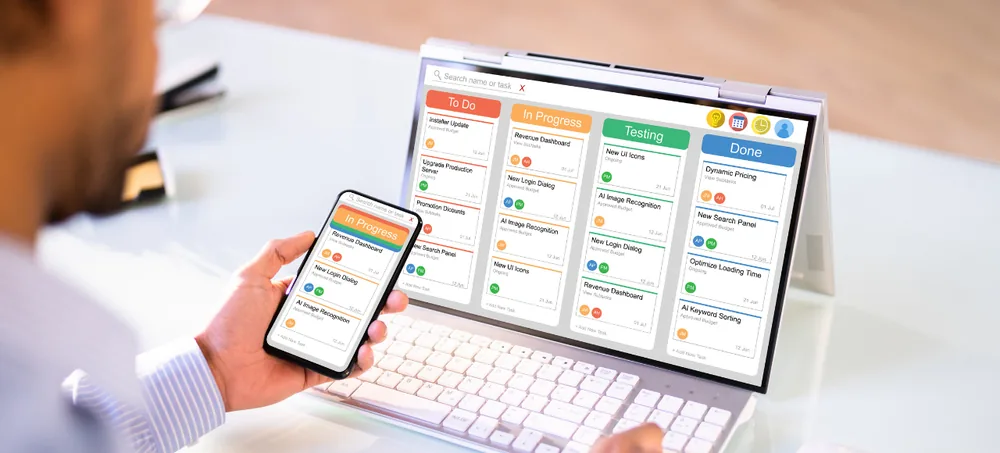
Manage textile production, fabric inventory, purchases, job work, quality, billing, sales and reports through one customizable ERP platform. ERPLax provides Textile Manufacturing ERP Software in Bangalore designed around the actual workflow of textile manufacturers, garment units, fabric processors, apparel businesses and growing production companies.
Get a requirement-based walkthrough for your textile manufacturing unit
Textile manufacturing involves much more than maintaining purchase and sales records. A manufacturer may need to manage yarn, fabric, dyes, chemicals, accessories, multiple production stages, subcontractors, warehouses, customer specifications, wastage and finished goods at the same time. When every department works independently, management may struggle to answer basic questions.
ERPLax Textile Manufacturing ERP Software helps create a connected flow of information from enquiry and sales order through purchase, manufacturing, quality inspection, inventory, dispatch and billing.
Textile Manufacturing ERP Software is an integrated business management system developed to manage the operational and administrative processes of textile and apparel manufacturing companies. Instead of using separate applications for inventory, production, purchase, billing and reporting, textile ERP connects these activities through one centralized system.
For example, when a customer order is entered, the ERP can help your team review the required products, materials, available stock, BOM, production requirements, purchase needs, manufacturing stages and delivery status. The software can be configured according to the size and complexity of your textile operation.
ERPLax helps connect departments through common masters and workflows, reducing repeated data entry across applications.
BOM, inventory and production information can be connected to help purchasing and production teams plan material requirements.
Maintain organized records for yarn, fabric, accessories, dyes, chemicals, packing materials, WIP and finished goods.
Track production orders and process status instead of relying entirely on manual follow-ups between departments.
Track material sent outside the factory for dyeing, printing, embroidery, stitching or other subcontracted processes.
Sales, purchase, production, inventory and billing departments work with connected records, reducing inconsistencies.
Management can access operational reports without manually combining spreadsheets from multiple departments.
Start with essential ERP modules and add manufacturing, CRM, warehouse, HRM or additional reporting as operations expand.
Connected modules covering product master through user roles and reports.
Configure workflows according to your actual manufacturing process — ERPLax can support fabric-first or garment-first production stages.
Garment workflow: Fabric → Cutting → Stitching → Finishing → Inspection → Packing → Dispatch. Your process does not have to follow these examples — ERPLax can be configured around your actual workflow.
Keep production, inventory, orders and purchase information available within one connected system.
Move information between sales, production, inventory, dispatch and billing without unnecessary duplicate entry.
Track materials and finished goods more systematically across warehouses and manufacturing stages.
Automated calculations, connected masters and controlled workflows help reduce mistakes from repetitive manual entry.
Connect sales demand, BOM, inventory and purchase information to improve planning.
Know which materials have been issued to outside processors and what remains pending.
Bring material, production, wastage and job work information together for better costing analysis.
Access order and dispatch information faster when customers request updates.
Configure modules, approvals, fields, reports and processes according to your business.
Start with the modules currently required and add additional functionality phase by phase.
ERPLax ERP Software for Textile Industry can be customized for different textile and apparel businesses, including:
The modules and workflow can be selected according to the scale and process of each business.
Business process study: workflow, departments & material flow
ERP configuration: masters, BOMs, user roles & warehouses
Sales or production requirement created
Material planning against inventory & BOM
Purchase & material receipt into inventory
Production: issue materials & record processing activities
Job work: track material sent to & received from workers
Quality inspection at incoming, in-process or finished stages
Finished goods moved to required warehouse
Dispatch documentation & customer invoice generation
Reports & analysis across production, sales & costing
ERPLax can be integrated with third-party platforms and devices depending on project requirements.
Different manufacturing businesses have different IT policies and accessibility requirements. ERPLax can recommend the appropriate approach after understanding your workflow, users, infrastructure and integration requirements.
Suitable when teams require remote access, multi-location access, centralized business information and flexible user access from different branches or factories.
Can be considered where the organization requires ERP infrastructure within its own environment.
ERPLax develops ERP solutions based on the actual business process rather than forcing every textile business into the same fixed workflow.
Configure product variants, raw materials, production stages, BOM, job work, quality, warehouses and reports according to your operation.
Begin with purchase, inventory, production and billing and add CRM, HRM, ecommerce, POS or automation later.
Connect BOM, material planning, production orders, inventory, quality, job work and finished goods management.
Choose deployment according to your business and IT requirements.
Connect ERP with third-party applications, websites, communication services and business systems where required.
Provide employees access according to their department, responsibility and authorization level.
Develop reports around the information your management team actually uses.
ERPLax supports implementation, user training and ongoing usage requirements.
ERPLax is suitable for small, medium and growing textile businesses that want to implement ERP progressively rather than deploying every module at once. Your textile manufacturing process may include unique materials, production stages, job workers, quality parameters, costing methods and customer requirements — your ERP should reflect those processes.
Businesses evaluating Textile ERP Software Bangalore alongside broader Manufacturing ERP Software Bangalore options often need something built specifically as Textile Manufacturing Software rather than a generic package. ERPLax functions as complete Textile Production Management Software and genuine Textile Production ERP, extending naturally into Custom ERP Software for Textile Industry work and dedicated Textile Business Management Software for owners tracking the whole operation.
For garment-focused operations, the same platform serves as Garment Manufacturing ERP Software Bangalore, Garment ERP Software and Apparel ERP Software, covering the full scope of ERP for Garment Manufacturing Industry needs including Garment Production Management Software for cutting and stitching floors. Stores teams get dedicated Fabric Inventory Management Software and Textile Inventory Management Software, while process-heavy manufacturers can rely on it as Fabric Manufacturing ERP Software for weaving, dyeing and finishing stages.
Your textile manufacturing process may include unique materials, production stages, job workers, quality parameters, costing methods and customer requirements. ERPLax provides custom Textile Manufacturing ERP Software in Bangalore to connect production, fabric inventory, purchasing, sales, job work, quality, billing, CRM, warehouse operations and management reports through one scalable system.
Specialized Applications
Purpose-built & ready to deploy. Hover to explore, click to learn more.
Testimonials
Real stories from businesses running their operations on ERPLax.
ERPLax gave us real-time visibility into stock across three warehouses. Wastage dropped and our fulfillment time improved almost overnight.
GST e-invoicing used to eat up two days every month. With ERPLax's accounting module it's now automatic and our filings are always on time.
Billing at our stores used to take a minute per customer. ERPLax's POS module cut that to under 15 seconds, even during peak festival rush.
Payroll for 200+ employees across two branches used to take our HR team a full week. ERPLax's HRM module now runs it in a single afternoon.
Tracking batch numbers and expiry across our distribution network was a nightmare on spreadsheets. ERPLax's inventory module made it effortless.
Front desk, housekeeping and billing are now all on one screen. ERPLax's hotel management module has made check-in day a breeze for our staff.
Fee collection, attendance and report cards used to live in three different tools. ERPLax brought it all into one dashboard our staff actually enjoys using.
Tracking material costs and site progress across four active sites was chaos before ERPLax. Now our project managers update status from their phones daily.
Our online store orders now sync straight into inventory and accounting — no more manual entry, no more overselling out-of-stock items.
Our sales team can now see every lead's history and follow-ups in one place. Deal closures are faster and nothing falls through the cracks anymore.
ERPLax gave us real-time visibility into stock across three warehouses. Wastage dropped and our fulfillment time improved almost overnight.
GST e-invoicing used to eat up two days every month. With ERPLax's accounting module it's now automatic and our filings are always on time.
Billing at our stores used to take a minute per customer. ERPLax's POS module cut that to under 15 seconds, even during peak festival rush.
Payroll for 200+ employees across two branches used to take our HR team a full week. ERPLax's HRM module now runs it in a single afternoon.
Front desk, housekeeping and billing are now all on one screen. ERPLax's hotel management module has made check-in day a breeze for our staff.
Fee collection, attendance and report cards used to live in three different tools. ERPLax brought it all into one dashboard our staff actually enjoys using.
Tracking material costs and site progress across four active sites was chaos before ERPLax. Now our project managers update status from their phones daily.
Our online store orders now sync straight into inventory and accounting — no more manual entry, no more overselling out-of-stock items.
Our sales team can now see every lead's history and follow-ups in one place. Deal closures are faster and nothing falls through the cracks anymore.